

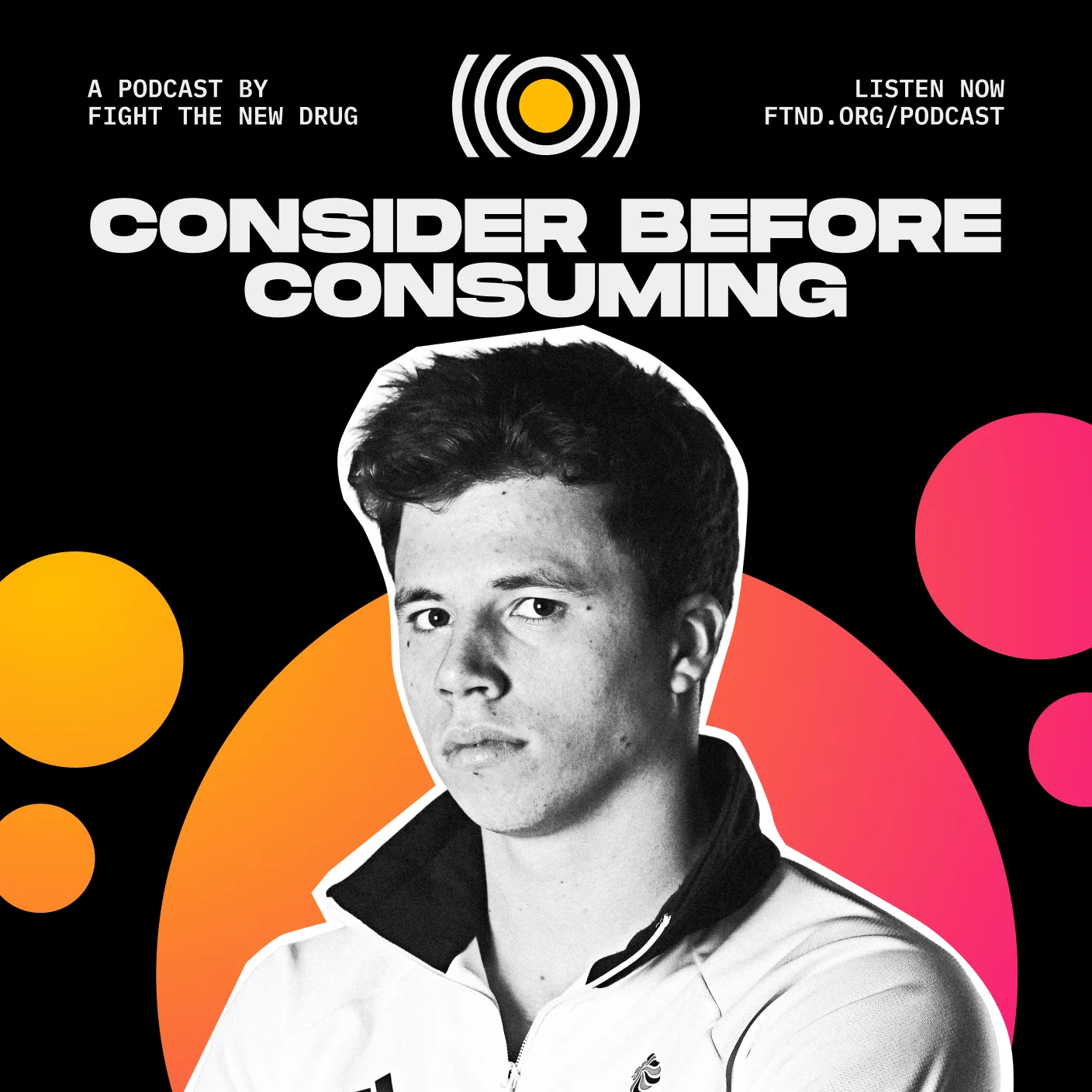
Episode 174
Why Quitting Porn Took More Than Olympic-Level Discipline
Available wherever you get your podcasts
Freddie Woodward is an Olympian and former Team Great Britain diver who began viewing pornography as a young teenager. Despite the extraordinary discipline it took to reach the 2016 Olympic Games, Freddie found himself unable to simply use that same discipline to quit porn.
Can you be addicted to porn and not realize it? Why is it so hard to quit porn? How does porn affect motivation, relationships, and mental health? What actually helps someone stop watching porn for good?
In this episode, Freddie shares how his porn use became a daily habit, how it escalated into other online sexual behaviors, and what happened when intimate content of him was leaked online in 2017. He also reflects on using porn to cope with difficult emotions, life after the Olympics, years of unsuccessful attempts to quit, and the tools that ultimately helped him change. Today, Freddie says he’s more proud of quitting porn than becoming an Olympian.
This episode is sponsored by Relay, a secure peer-support app that connects you with a small group of people who understand what you’re going through and help you stay accountable on your journey to quit porn. CBC listeners can try Relay free for 7 days by signing up at http://ftnd.org/joinrelay.
FROM THIS EPISODE
- Freddie’s Instagram: Freddie Woodward | Men’s Identity Coach
- Article: Benefits of Quitting Porn According to 90 Real People
EPISODE TRANSCRIPT
Fight the New Drug (00:00)
Okay, well, Freddie, it’s so great to be able to chat with you today. We’ve loved seeing the content you have online and kind of following your journey. And I’m really excited for our listeners to get to hear from you today. So thank you for your time and for joining me for this conversation.
Freddie (00:16)
Yeah, of course. Well, thank you for having me on. I really appreciate it.
Fight the New Drug (00:19)
Of course. just to kind of dive in at the beginning, can you tell us what were you like growing up and how did you first get into diving?
Freddie (00:28)
Yes, so was really lucky. I always say kind of in jest, but that diving found me because I was talent spotted when I was seven years old. So they have an amazing swimming and diving facility in my hometown of Sheffield in the UK. And UK Sport invested a lot of money in grassroots sports back in the sort of early 2000s.
So yeah, in 2003, they came around to my school as well as lots of other schools around the city because, well, we have this good diving facility, so we’re going to try and get young divers in Sheffield. And I was useless at football. I couldn’t kick a football to save my life, or soccer. So I was like, OK, this sounds good. And I was always interested in gymnastics, actually. I wanted to start that. I’d done a little bit of trampolining and played around with other sports, but thought, maybe gymnastics is the one. And then diving came to test me. And I was like, yes, I want to be in the chosen squad.
And so it was just, and then yeah, right from the offset, was never recreational. It was always, okay, you are here because we’re trying to get people on the Olympic pathway to the Olympic games. And so, you know, immediately it was four, five, six days a week. And it just, became my life, my identity.
Fight the New Drug (01:44)
Yeah. So right out of the gate, it was so much more than a hobby. It sounds like there was never really a phase of it being a hobby. It just always was this is the the path.
Freddie (01:55)
Yeah, literally never, never. It was immediately very intense. I mean, I think that was, you know, I think it was a good thing because I’d say the other sports that I’d done, I was just sort of dabbling with, know, it like once a week or something and, you know, not really like paying that much attention to it. Like I was playing cricket. And for people who don’t know cricket, you’re fielding, so like you’re not batting, you’re not swinging, most of the time you just stood there and I was just like not paying attention.
So I think it was really good that I actually got involved in this where it was almost chosen for me. Okay, all right. And I just, without philosophically analyzing it, I just bought into it immediately.
Fight the New Drug (02:38)
That’s amazing. What did your life look like as a teenager training at that level, at such an intense level, so young?
Freddie (02:46)
Yeah, mean, obviously it was pretty different to most people’s. I know, even just like, most of the people around where I lived, like the school, where I lived was pretty close to my high school, my secondary school. So most people would, you know, walk to school, walk home from school. And that like kind of casual, silly walk home from school, I just never did because I got on a bus with my two diving bags, you know, my, well, sorry, no, my school bag and then my diving bag. I was like, two backpack Fred, just getting on the bus into town, train from four till seven and then come home, pretend to do some homework, and then do it all again.
Fight the New Drug (03:25)
Yeah, wow. What did it ultimately take to go from, you know, being the kid who loved diving and competing at the, you know, to diving and competing at the Olympic Games?
Freddie (03:39)
Yeah, I mean, it was an unbelievable thing. There’s a big part of me that’s still like, it’s like, I can’t believe that that actually happened. Because it was the dream, like I said in the beginning, it was always like, you are here because we’re trying to get people to the Olympic Games. So it was my dream, and it was also a dream that I, let’s say, bought into. But I was never the extra special one.
There was always like, was a few guys who were exceptional. And I was never the one who really stood out. And so I never really fully believed it was possible. And for some reason, and I still struggle with this, I had quite low self-esteem in some regards. And when it came to diving, they’re like, I never felt like I was good enough. There was the term imposter syndrome. I really felt that towards myself as a diver and that people would, see that I’m not very good, that I’m weak.
So I put a lot of pressure on myself to try and be better, to try and prove myself. And I think that is what, in some sense, got me to the Olympic Games because that was a lot of drive there. So when it did actually happen, and then even in 2016, like I started the Rio Olympics 2016 that I competed in. And even at the start of that year, I don’t think any people in British Diving would have said like, yeah, Freddie is going to be on the team because there’s so many hoops to go through, other people who you probably say were ahead of me. And so when it did all come together, I like, I couldn’t really believe it. But also looking back, I think I should have believed it more, trusted in myself more. But nevertheless, it was a life-changing experience.
Fight the New Drug (05:22)
Yeah, well it’s, I mean, it’s truly incredible to have made it, you know, to the Olympics and through diving in the journey that you’ve had. And as you mentioned, it it diving was really all-consuming for so much of your life growing up as a young person. And it’s interesting because we’re here today to talk a little bit about your experience with pornography. And so wanna talk about the role that it played in your life, but can we just start with when did pornography first enter your life and what do you remember about that first exposure?
Freddie (05:55)
Yeah, so I don’t remember specifically what age I was when I first saw, like, hardcore video content online. But I remember the kind of stuff that it was. And even before that, was very interested in, I don’t know, like women, the female body, let’s say, from a young age. Like I had a Guinness Book of World Records book, and in there were two, there were like two pages and they were like full-page pictures. And one was the world’s most expensive lingerie set. And the other was the world’s most expensive bikini. And obviously they’re being donned by, you know, a beautiful woman. And I remember being really interested in those pages. I just, I’d be reading the Guinness Book of Records and getting inspired by it, but really I’m just like looking at those specific two pages.
And I was young then. I mean, I’m probably like six, seven, eight years old. And then also in the UK, we have this newspaper called The Sun, and they’ve changed things now, but at that time on page three, so you basically turn over the inside cover, and then like right there you have almost completely naked woman, like breasts out. And so, like, again, as young boys, you know that you go into like a corner shop or, like, a newspaper store and, like, if you just open The Sun, you’ll be able to see like that. And so I was pretty interested in that. And I think I even had a stash of just page threes that I’d taken out and stored somewhere in my room. So yeah, definitely something that I was interested in.
But then, yeah, obviously with the internet and with even being around older men through diving in particular, because in school you don’t really integrate around your years; as an 11-year-old, you’re not hanging out with, like, the 18-year-old. But in diving, it was a bit different, which is an amazing thing. Like this is not a criticism of diving or like the club that I was in. It was great, but obviously you’ve got these influences from older guys, and you eavesdrop on conversations and even, know, videos are shared, and you see what they are.
And so, you know, I started to explore that myself, and yeah, I would guess like, I guess somewhere from 11 to 13, probably like when I started watching that stuff. And again, I remember, in the beginning it was like, it was sort of striptease-type things. So it was just like a woman, you know, slowly kind of like taking off her clothes and, you know, and then kind of going a bit further. But that was the stuff that like, I think I first started watching. And then obviously, you know, things kind of went from there. Yeah, yeah, to
Fight the New Drug (08:47)
Escalated. Sure.
Freddie (08:49)
a degree.
Fight the New Drug (08:49)
And how did your relationship with pornography change as you moved through your teenage years?
Freddie (08:56)
Yeah, so I don’t really… it’s kind of…don’t really know when it became a daily thing, but I think it was pretty quick. Because my memory is all through sort of my mid-teenage years, you know, like 14, 15, and then onwards, it is pretty much a daily thing. And then, you know, maybe on Sundays, maybe more like that’s my day off training, the day that I’m supposed to be like, at home working.
I think I was also even a little bit more isolated from friends in school because I had loads of friends. That wasn’t an issue, but I like wasn’t in the outside of school social groups, if that makes sense. It was just like, you know, cause all Fred’s diving, like Fred’s diving. You know, so then on a Sunday it was, it was, I remember a lot of the time, like not necessarily like having loads to do and I’m, or I’m supposed to be getting on with, say, homework and catching up with school. Cause otherwise I’m so busy.
So Sundays could be more problematic. But yeah, in general, it’s just like, well, I I had access to a computer and It was a yeah, it became like just pretty much a sort of daily daily kind of ritual But I really think anything about it. I thought, well, this is Incredible that I have access to this- how lucky am I? And why wouldn’t I watch this? I’d be crazy not to, so yeah, let’s go. That was kind of my attitude to it.
Fight the New Drug (10:23)
Right. When did you first start noticing that your pornography use might be becoming a problem for you?
Freddie (10:30)
Most of the time it was like, this is, yeah, this is fine. But there’s a small niggle in the back of my mind, right? And I first started noticing that around exam times.
So in the UK you have important exams like 15, 16, and then you also have like, 18. And so, you know, both of those sets of exams, I’m trying to do a maths, like past paper to try and, know, to try and study, let’s say, and you get stuck on a question, and so all I want to do is watch porn. And it’s just like the air in my mind, like, you know, and then the classic excuse is like, well, yeah, just take this small break and then you’ll be able to focus afterwards and all these kinds of things. So I didn’t like that. I didn’t like that I couldn’t just get on with doing my homework or my revision, but I didn’t really analyze that too deeply.
And then obviously that carried on, and I still thought I was completely justified in watching. I didn’t really see then at all how it might affect my behavior with women. Like didn’t see a problem there. I thought like I had female friends, I had some girlfriends. There was nothing obvious that I was doing that was like, know, clearly misogynistic or something.
And so I didn’t think there was a problem there. It was mostly around, like, productivity. And so, you know, as that continued and as I left school, I decided not to go to university, just to train full time because like my goal was the Olympic Games. And in the UK, we’re not very good, well, we’re not good at all at combining, like, study and sport like the US. And so, but I wanted to be in the UK because I wanted to be with my coach. You know, I wanted to be like relevant to the GB team, not like bits of out of sight, out of mind in, you know, Texas A and M, right?
So, yeah, so but then leaving school, I’m like, not studying anymore. So I’ve got no reason really to be behind a piece of technology other than just, say, socially or for fun.
And so that was sort of okay because I was diving, like that was the thing that I was doing, but I also still didn’t like this idea. You know, if I ever tried to, I don’t know, learn a course or like edit a video or something like that, porn was just really in the way. So that frustration was building a little bit, but it was still like back of mind. Yeah, I mean, I suppose that was when it’s like, that was the first signs of it.
And then obviously as things, you know, as things progressed and, like, you know, basically content of me got leaked online, which I’m sure we’ll talk about a little bit more. That was when I was really faced with like, no man, think you’ve actually got a problem, and like what you’re doing is, yeah, it’s not, it’s clearly behavior that isn’t well thought out and in line with who you really want to be, and yet you’re doing this anyway. So that was like the big kind of shock moment for me.
Fight the New Drug (13:42)
Right. But just going back for just a moment, the way that you’ve spoken about this, it really sounds like you had no knowledge of porn possibly having negative effects, right? It was so normalized, it was available. Had anyone had conversations with you about about porn at all, or was it just kind of something that was like, yeah, this is just normal, this is expected of, you know, guys and this is what what we do?
Freddie (14:12)
Pretty much, pretty much.
Fight the New Drug (14:13)
Yeah.
Freddie (14:14)
I mean, no one, you know, I remember one time I got challenged by my dad because he’d, in my school planner, so I’m probably 14, maybe 15, and in my school, like, kind of planner journal thing, someone had written loads of different URLs for, like, these kind of niche porn sites. But it was a joke and I, you know, they weren’t like the classic ones anyway, so I had no use for them. So when he saw that, I was just like, well, no, this is just guys messing around, which is all true. So he called me out on that.
Fight the New Drug (14:43)
Right.
Freddie (14:45)
But, beyond that, like, no, nothing. And one of the things that I’ve reflected on again recently is I even, again, at some point in the back of my mind, I was like, is this an addiction? Like, is this normal? You know, and so I Googled that, and this is before everything got released online, I would guess 18, 19. And I googled like, you know, what is porn addiction? How do you know if you’re addicted to porn? Like probably a lot of guys have googled. And I can’t remember exactly what the source was, but I found this article, and it might have even been the BBC. That’s my memory, but I don’t know for sure. So I can’t really say, but it was like, well, but I distinctly remember it saying that porn addiction is probably if you’re watching for 10 hours a week or more, then you might have an addiction.
But less than that, you’re okay. This is what I read into it. And I’m watching 20 to 30 minutes a day, probably on average.
Fight the New Drug (15:44)
Sure.
Freddie (15:45)
Basically, I go to bed, I open my laptop, whatever, act out, and that’s at least 20 minutes later, roughly. So I’m miles off. Like, you know.
Fight the New Drug (15:55)
No problem. Yeah.
Freddie (15:59)
Put that to bed. And then I, yeah, but that did actually buy me years more, kind of use of just not really questioning it or just kind of squashing all of my doubts. That said, I was fine.
Fight the New Drug (16:13)
Right. ‘Cause if you’re
always just adding up to that ten hours every week, well I’m not even close to the ten hours, so yeah.
Freddie (16:20)
I’m not even close. Yeah. Yeah. I can get four times worse before I’m an addict, know, like, well,
Fight the New Drug (16:25)
Right.
Freddie (16:27)
So yeah, I think, and I do think that that’s one of that’s like such a big, such a big problem. And even, know, like, I mean, yeah, doctors’ advice and, you know, I think this is one of the good things with social media now that I mean, there are problems with it, but, you know, content like mine or other people’s will, you know, is kind of finding people. And so you’re not, you’re not…because again, know, I wouldn’t really even, again, now things might be different, but I wouldn’t really even trust necessarily like your regular doctor to even give you the right advice on this necessarily. I don’t want to like name,
Fight the New Drug (17:02)
Sure. Sure.
Freddie (17:04)
you know, single people out, but sort of generally speaking. And yes, certainly back then, I just think the kind of, you know, global opinion on it was just that, you know, it’s okay. It’s okay, well it’s educational even.
Fight the New Drug (17:21)
Sure. Which is, you know, what a lot of people say about it, especially when they aren’t having conversations with trusted adults, or they don’t have somewhere else to go to answer questions that are natural and normal about sex, they turn to pornography. And so it’s something that we’re working really hard to help people understand that what you see in pornography isn’t necessarily an accurate representation of, you know, healthy intimacy or healthy relationships.
So I’m curious to know, were you aware of, like, what was going on emotionally when you were most likely to turn to pornography through all of those years? Was that something that was like, Okay, you know, I’m dealing with this high demand, you know, diving schedule, I’m dealing with school, I’m you have so much structure and rigidity in your life generally. Is that something that played a role in seeking out pornography, do you think?
Freddie (18:16)
Well, it certainly played a role. Looking back, I can see clearly some of these emotional signals that I was unaware of. I think really I was not really aware of that and in tune with that at all at the time. I think if you’d have asked me, why did you watch? Well, because I was bored. I’m sure I could have given you an answer like that, which…which is obviously true and it’s revealing, but I wasn’t like going any layers deeper.
And I certainly wasn’t seeing it as this crutch that helped me say, deal with some of the shame and low self-worth that I was battling with every day with diving, for example. Which I’m, again, looking back on now, I really see. So yeah, I think…think it’s very clear to me now, and this is something I talk about a lot, it’s used as, and I used it as this way to try and regulate my emotions or to try and escape what I was feeling or to kind of just manage what was going on. But I certainly did not understand that at all as a teenager, a young man. I was so, so far away from that.
Fight the New Drug (19:37)
Right. I wanna bring this back to the Olympics for just a moment. Can you remind me how old you were when you went to the Olympics?
Freddie (19:44)
I just turned twenty-one. Yeah.
Fight the New Drug (19:47)
Just turned twenty-one, okay. What was that like? I mean, we touched on this briefly earlier, but what was it like to reach the Olympics after spending so much of your life working toward that goal?
Freddie (19:57)
Yeah, it’s so funny because I think sport is one of those things that is like the ultimate long-term commitment, or one of them, right?
Fight the New Drug (20:05)
Right.
Freddie (20:06)
Like, I knew, as a seven-year-old, well, I don’t know if I really knew, but I bought into it nonetheless. Like I am on this long, long, long journey and yeah, know, okay, Freddie, like 14 years later, you’re gonna go to the Olympic Games, like 14 years, like whoa. And you’re gonna be training like basically every day and putting in all of that time and effort. So it’s an incredibly long term commitment.
Then something like, you know, porn is the complete opposite. It’s just immediate gratification, immediate. It’s the most short-term thinking that you can do. And so it’s so, you know, counter opposite to, to porn. But yeah, obviously like, I, yeah, it was just, I mean, the Olympics itself was this life-changing experience. And I mean, there’s always this thing for athletes in some degree where afterwards you’re like, that was it?
Fight the New Drug (20:57)
Right.
Freddie (21:00)
And it’s like the better you do, the more you feel that, you know, I mean, so I finished 19th, which I was super proud with.
Fight the New Drug (21:07)
Yeah, incredible.
Freddie (21:08)
And, I would have liked to have done slightly better, but I was still, it was a really solid performance. But like a friend of mine, he won a gold medal, and he had depression afterwards, actual depression. And that kind of blew my mind, but it still sort of happens to everyone, was like, of this thing I’ve been working for all this time, it wasn’t actually the point. Like the point was doing the thing, and then you’ve done the thing, and you’re like, and now that doesn’t, it’s not there anymore or you have to re-decide to recommit to it. So yeah, I mean, but, at the same time, like I was just overwhelmed with emotions.
You know, I remember just like driving in my car like two or three weeks afterwards and just, I just burst into tears out of nowhere. Like something just triggered this, this, this memory or whatever. And I was like, I’m an Olympian. No one can take that away from me. It’s kind of these, both of these things, but yeah, mean, so, so, so proud. And as I said, I never really believed that I, it was my goal, but I never really believed that I was gonna do it. And so, yeah, it was amazing, but just so, the goal setting involved in sport is just so like counter opposite to what the behavior that you do when you say using things like pornography.
Fight the New Drug (22:26)
Right. And that’s what I wanted to ask you a little bit about. I mean, it’s incredible that you made it to the Olympics, finished nineteenth, truly incredible. But then what was that transition really like after you don’t have that goal in front of you anymore? And what role, if any, did pornography play in kind of coping through that transition?
Freddie (22:47)
Yeah, I mean, I think it played a big role because I never really had to deal with that because as soon as I stopped, because, you know, I had this after Rio, I actually thought about quitting anyway. And my coach was like, just four more years, you know, like we’ve been now; we can take it off that pedestal; we can, you know, let’s see where we can go. So the goal then was like, all right, top eight, top six.
And I was bought into that. I knew the kind of things that I needed to do to, like hit those higher echelons. Okay, cool. But then I had, I basically overtrained and got loads of injuries, and my knees were kind of smashed. I, rather than, like, make progress, I sort of, I went backwards slash just kind of held, and other people really accelerated. And I was still in the same city, and I was like, I’m just not, I don’t think I’m really bought into this anymore. And it felt like what I would have to give to potentially get, say, an Olympic medal or an Olympic final.
The balance was just off at that point. And so I stopped. I did my last competition in the summer of 2018. And then in October 2018, I flew to Miami, and I did a contract with Royal Caribbean as a diver, as a performer. And I started high diving, and I started doing more dancing and being a showman rather than just an athlete. And I was like, this is great.
And like my efforts were collaborative. It wasn’t like just me versus, you know, the world. So it felt, in a sense, like having done all the sport, it felt more positive. You know, I do a few dives, and it’s a bit more chill, and it doesn’t really matter if it goes wrong. And at the end of it, it’s like, you get a round of applause from everyone.
Fight the New Drug (24:34)
Right.
Freddie (24:35)
Like, God, I’m never going back to competitions.
Fight the New Drug (24:37)
Right.
Freddie (24:41)
So, but the problem with that was I didn’t deal with the whole, like, identity loss thing because I was still Freddie the diver. Okay, yeah, it was like, you know, I was Freddie the high diver. I was Freddie the performer, but it was kind of the same general sort of box. So again, through that whole time in the back of my mind though, it’s like, yeah, but like, who are you? And what are your skills? What can you actually do? Yeah, you can dive. Cool. Excellent. You know, but what are you really doing with that? Like, what value are you really bringing to the world?
And I really, I really hated that idea. I remember watching with a friend, I was watching this program called Terrace House, which is a Japanese reality TV show. And this was before I had a Japanese partner. And the Japanese are just like super sweet. And it’s like, they’re all like living, it’s like load of young people living in a house together. You know, a bit like the reality TV shows you’d see in the UK or America, except they’re all just there trying to progress their careers. So there’s not that much drama, and it’s like, it kind of gets into more detail about what they do. And there was this one, there was this one woman on it who was an illustrator. And I was like, what, I was like sat with my friend. We were trying to watch some just like fun, you know, lighthearted TV. And I was like, sat there almost having a panic attack. Like, what are my skills? Like, what can I actually do? And I was really freaking, freaking myself out. But I sort of just still just like push that to one side.
And I think porn was the thing that was there to help me deal with that, to not face me properly, not face, ignore the responsibility of developing myself and going out of my comfort zone again. Because yeah, I did something really uncomfortable with diving. But 20 years later, it’s not that uncomfortable.
And I also wasn’t, I think because of porn as well, what I wasn’t when I was an athlete was particularly proactive at doing things for like my future. I was always very good at, I was pretty good at hobbies alongside diving. So, you know, I always like, dabbled in things and I tried things. I liked being creative and like, you know, doing random stuff, but I never like took that responsibility of like, yeah, but what work are you going to do? You know, are you like, I wanted to do public speaking, but I didn’t reach out to anyone.
You know, I just waited for things to come to me and these sorts of things. And so then, yeah, I was left in this position where there wasn’t a clear fallback. But I think for my entire history, porn was a thing that was like, you don’t want to reach out to someone, or you should probably maybe, if you want to do public speaking, you should reach out to people. No, it’s OK. It’ll come to me. Everything will work out. You know.
Fight the New Drug (27:30)
Right. Right.
And as that…I mean, that makes so much sense. You know, you had no time to pursue other things when you’re pursuing an, you know, Olympic path. And I think that journey makes a lot of sense. And, you know, from what we hear from other individuals who have experienced or struggle with pornography who aren’t, you know, pursuing the Olympics, it’s a similar thing in a in a lot of instances of porn becomes the coping mechanism at such a young age, and it’s the thing that is always there for someone in, you know, difficult times.
And so it’s as unique as your story is, because not everyone on earth is an Olympian, it’s so common as well for individuals to experience something in this way.
I wanna ask you a little bit about as you were in that, you know, kind of transitional time, did you notice your pornography consumption escalating, and did the things you were consuming online begin influencing the choices that you were making elsewhere in your life?
Freddie (28:33)
Hmm. I mean, my use certainly escalated in a sense, like what I watched. I think I began to be way more picky about what I would watch and could watch. For example, like for me, in porn specifically, I mean, this doesn’t really, this didn’t apply to real life, but like breast size was something that was important to me, you know, but not fake. It was like large, like real-seeming breasts, you know, and, if, but if it wasn’t that, like I wouldn’t, I wouldn’t watch, and then you’d spend a long time trying to find the right thing. And, and yeah, and other, you know, other, I don’t know, other, other kinds of storylines that felt right. And with, again, without that, you know, so where I was beginning, like just being able to be like incredibly aroused with just a, like a woman simply like taking her clothes off.
I was like, there’s no way I would have watched that. I was so far away from watching that as a clip. So, spending longer trying to find things and things just becoming less and less satisfying. Which I think is where my taste for sending and receiving pictures and videos came from. It was like the step above. It was like a bit sort of riskier. So was like more of rush.
And yeah, so I think that’s kind of where it escalated to. And yeah, I mean, certainly in low times as well, that’s when I could really, that’s when I could binge if, you know, a bad competition or like, I don’t know, an argument with a partner or like something like that, or like even sometimes like traveling and feeling uncomfortable, you know, not feeling like settled in a place or like in a new place or like…having to do something new and going out and meeting people. It was often in those situations where I could end up binging a lot more. And then that in itself would just drive this shame spiral of like, what are you doing? This is gross, and this isn’t the real you. Why are you here? That post-nut clarity that people talk about.
Fight the New Drug (30:55)
Right.
Freddie (30:57)
Yeah, that really started to weigh on me.
Fight the New Drug (31:01)
Yeah. You mentioned this a little bit earlier and just a moment ago, but in 2017, there was some intimate content of you leaked online. Can you tell us a little bit about what happened and what that experience was like for you?
Freddie (31:14)
Yeah, so I mean, was like, that was one of, if not like the worst day of my life, really. It was so crushing. But I’d been dancing around that for a long time. You know, I knew it was a possibility. I knew it. And I was doing that. And I was doing it anyway. And I think that, I think, and also, you know, some of my peers had had similar things happen. You know, they might have had bigger profiles than me, but so I knew it was a thing. So I think that’s what made it hurt so much as well, was just, the mirror of like, this is what you’ve been doing. You knew this might happen, and here it is. And I was in a long-distance relationship at the time. And it actually, it first came to me by someone messaging my girlfriend at the time and sharing those images and saying that I’d sent them to him.
So it was a man talking to her, saying that I’d sent them to him. Now, maybe I had, but he’d been pretending to be a woman. So, you know, so I don’t know like what was going on there, but and even before that, I knew that probably these people that I was talking to, mean, some of them, like some were people over the years, like I’ve shared pictures with people I know, right? Or had met. But obviously some like weren’t, it just like people who just, you know, appear on Instagram and, you know, it’s like, they’re good enough of a cover-up that you can sort of like lie to yourself and say like, yeah, it’s probably legit, and nothing’s happened now, and it’s exactly the kind of thing I’m looking for. So you just sort of go along with it. But yeah, but still knowing in the back of my mind that this is just not…they’re probably not who they say they are.
And so yeah, when that all broke, obviously, then I, you know, we ended up breaking up, obviously, because, you know, it was so much for her to handle, you know, and I’d been, you know, unfaithful, because it had been, you know, obviously during our relationship, I’d been sharing stuff. And so that was terrible. And I didn’t want people to find out, obviously.
I had this thought of, well, can I get jobs? Would I be booked for, let’s say, if I did become a public speaker like I was talking about before, would I be booked for that if they found this out? What kind of implications? My family, all these things. So it was just the worst.
And I’m also in the process of trying to get stuff removed. I’m discovering and uncovering all, just scratching the surface of the kind of online forums that exist, and seeing the way people are talking about me in these forums and people making money off my pictures and videos, and I’m the mug, you know, with getting nothing. So the whole thing was awful.
And I wasn’t mature enough at the time to be able to just like…hold my hands up and be like, well, yeah, like this is what happened and I should not have done that. But this is me. I just wanted, I was trying to like play like whack-a-mole, you know?
And yeah. And so that from there also, the other sad thing about like my story in that sense is that because I didn’t want people to know about that and this idea of like, what if people find out, I won’t be able to get jobs. I just tried to contain the whole thing and like therefore disappear.
So, it’s not like I was trying to be a massive influencer at the time, but any thoughts of using social media kind of evaporated, and I just kind of pulled away from it. And that should have been the very thing that I should have been doing to advance my career as an athlete or about-to-retire athlete or as a performer. Because I think that’s something that most athletes should be doing or should be considering, at least in this day and age. And if I’d have been doing it then, right now it would be a very different story. Instead, I just lost the confidence to even try it, and I felt like I had to just disappear.
Fight the New Drug (35:30)
Right. Did that experience change your relationship with pornography or some of your other online behaviors, like sending images, or those, you know, communications that you mentioned with strangers, relatively strangers on online?
Freddie (35:43)
Yeah, yeah, yeah.
Fight the New Drug (35:43)
Did did that behavior change with this?
Freddie (35:47)
Yeah, so that stopped. I think I stopped doing those things. I was like way more on top of that. At least with, like strangers, I think.
Fight the New Drug (35:59)
Right.
Freddie (36:00)
But then pornography, no. And that was the time when I was like, okay, I’ve got to actually stop this. And before then I’d had this feeling of like, I didn’t watch porn yesterday, nice. You know, so this like positive thought of like, I didn’t watch it. So that was also like a bit of a clue, but at that point I was saying, okay, no, I have to stop this. And I just couldn’t.
I would go a week or two, kind of at best, without it. And it’s like that, it’s like, that’s what really triggered that to happen. And so, and then that’s actually when I started feeling worse about myself, really. And I’m working as a performer, and like, I love that; it’s a really good lifestyle, but I’m also, like not really seeing…I’m not seeing the future so much there either.
Like what, where can I go from here? I know, okay, yes, this is a cool job and I’m still cool, you know, but where do I go from here? So again, like, my world and my confidence was also, was like shrinking really. And I was like, and I don’t, I don’t want this to be offensive to anyone, but like, in me as this, seeing myself as this kind of high-performing individual or wanting to be high-performing, I just felt like I was just kind of, I had to therefore just ride out mediocrity. And that just made me feel terrible, actually. So that, yeah, that’s where I kind of went to. And then the whole time I’m still using porn regardless. And I’m like having these thoughts of, well, so is this just me forever? You know.
Like I never imagined myself being 60 years old and watching porn. Like that seems unbelievable. Like having a family and watching porn. But nothing about where I’m at right now suggests that that wouldn’t be the case. And
Fight the New Drug (37:44)
Right. I think what you said makes a lot of sense. You know, you became an Olympian. That takes so much discipline, right? And you are a high-performing individual. And I’m curious to know what struggling with pornography taught you about the idea that someone should just be able to stop when they want to, right? Because that would imply if you have enough discipline, you could just stop pornography at any time. How did your experience with discipline really shape that idea?
Freddie (38:13)
Yeah, so, and I think, again, built into my whole athlete identity was just like, you’re not quite good enough, so you just have to work harder and try harder and do more and be more. And obviously, discipline is a great tool, absolutely. And you need it for life. You do need it, in some sense. But when it comes, I just think porn does not respond. Quitting porn doesn’t respond to…
to that at all. And I think that’s where so many men, including me, get really lost. But you have to see it from a different place. I think you have to become actually a different person, really, or a different version of you.
And it’s amazing because I think eventually you can get to a stage where, like where I’m at now, I don’t have to fight to not watch porn, because it’s just not an option. It’s not, I won’t do it. And yeah, do I think about it? Yeah, of course. I mean, I like, because of this, I’m talking about porn quite a lot. So, like, yeah, the idea comes into my mind. Like, of course it does. But that’s not a problem, you know?
And I just think, I think being able to, me being able to stop pornography for good was like a journey that I had to go on like with myself to get to a place of better self-awareness, better emotional intelligence, more emotional maturity in particular. And like, just seeing myself in a completely different way. And it’s like when those sorts of things fall into place, it’s like then it all changes and you don’t need it anymore. Before, I was just kind of this like, the self-awareness was so low.
So it’s like, yeah, that’s what, know, discipline is not, it’s not intelligent, let’s say. It’s not, it’s not working on any form of higher level. It’s just a kind of tool that you’ve got. And then you’re just kind of beating yourself over the head with it. I think that’s sort of why it doesn’t work. But I think a lot of, a lot of guys and particularly high performers are just kind of stuck in this place of like, well, that’s the tool I’ve got. So what do you mean? I can’t use it. Yeah. But I’ve also become way happier.
Freddie (40:36)
I think it’s like doing what I needed to do to be able to quit porn. I haven’t just quit porn, I’ve also just like stepped into a happier, more peaceful version of me. That still has loads of problems, but I’ve enabled this progression, and I’m less afraid of negative emotions and boredom and…
I’m still a bit ADHD, but I’m like, sort of, kind of know that, and I’m okay with it, and I have other things that I can do instead.
Fight the New Drug (41:12)
Right. I love the way that you’ve described this journey because it really it really isolates how pornography is really a symptom of a deeper problem. Like like so for so many people it’s like, okay, well if I can just quit the porn, that’s the thing. And it’s like, well, why are you consuming pornography? Why are you in this place? And the way you describe this, tapping into that, you know, processing emotions and emotional intelligence and and developing skills to cope with emotions as they come up rather than just trying to to quit pornography. Like, that’s the true way to find kind of that lasting change, you know, rather than just white-knuckling your way through with enough discipline to try to quit. It’s really being able to go to that deeper level. And I love that you said you’re so much happier now because you’ve given yourself that space to process all of those things at that deeper level. And I and like we see that time and time again when people are able to really get to that place once they get past this idea that it’s just, you know, the quitting, just the cutting it out of your life.
Freddie (42:16)
Yeah, yeah, yeah.
Fight the New Drug (42:19)
So I love hearing that. For you personally, what really helped you make that lasting change? Was there something specific, or a day you remember, or a specific tool that helped you personally?
Freddie (42:35)
Yeah, so I mean, there’s a few things. I think the first thing I would say is, and this might be difficult to hear for a lot of men, but I needed to hear this. For a long time, I say I was trying to quit porn, but deep down I just wanted to control it. I wanted to feel like I was in control, but maybe still on special occasions, you know, I could use it, you know, a couple of times a year, once every three months, I don’t know, something like that.
If I ask myself honestly, that’s where I want it to be. In this place where, yeah, no, don’t need this, but like, in the right moment, I’ll have this like amazing porn session. And that’s a very problematic way to think about it because first of all, I’m making porn this reward for myself. When in reality, it’s not. It’s only taking away from my life. But it’s this like illusion of thinking that it was giving me something. So I think you have to kind of face yourself.
And I’m not saying you just have to immediately go cold turkey. You have to do work around this, but I think you also have to accept, I believe, that you’re heading towards a life without it, completely without it. So facing that and facing what your real sort of intentions are around it, there’s a lot of debate about, well, is it an addiction? Well, no, because it’s behavioral, well, yes, because, I mean,
In some sense, I’m not really interested in that because it’s kind of a semantics problem. To me, it behaves like an addiction. Now, if you don’t want to label yourself an addict because that makes you feel more shame, like I totally get that. But for me, seeing it as an addiction makes the dealing with it easier. Because it’s something, well, if it’s an addiction, then it’s like, know, well, can an alcoholic have one drink? Well, no, they can’t.
And then I think that’s the same with me in a sense. like, yeah, maybe after this I could have, I could watch some porn and like everything would be okay, but I’ve just, I’ve opened that door a little bit. And then maybe even with where I am now, like with no issues around it, maybe in two weeks you’d be like, well, you watched it that once and that was fine. So maybe you could do it again. And then before I know it, I’m watching it every day again. And so it behaves like that to me. Yeah, I would say that. I would say the first.
Then a few things. So I read The Easy Peasy Way to quit porn, or the Easy Peasy Method. And that did help me, actually, because it changed the way I saw pornography and my relationship to me, to it. Now, it didn’t just like fix me, like reading this book once and then like, okay, I’m done. And I think it sounds like some people have like a lot of success with it.
But a lot of people don’t. And so I want to say to the people who don’t or who haven’t tried it, I think it’s a useful tool to reframe the way you see porn, and it might give you some space from it to sort of see light at the end of the tunnel, which is what happened to me a little bit. Reading that, had maybe, I don’t know, three months away from it, which is like way longer than I’d ever done. And I felt different. So I was like, okay, this is interesting. But from there, there was a lot more work to do. I felt like that’s kind of like surface level, but I hadn’t really changed me as a person. I hadn’t got a deeper understanding of why I didn’t, you know…
So these sorts of things, I think, like, I think meditation is, and mindful meditation is one of the most powerful habits you can have. Not just to help you quit porn, but to just improve the quality of your life in general, because it’s all about awareness and being present in the moment and noticing what’s coming up and not being fused to your thoughts. You know, when an urge comes, if you’re able to just see it as a bit of an object of consciousness, rather than who you are, like completely consumed by it in that moment, you’ve got a bit of separation, then it’s easier to just let it come and go rather than just have to act on it. And so I think meditation helps break this automaticity. It also helps you slow down, understand yourself, not be having to do something all the time.
You know, obviously we’re in this, you know, the 21st century is amazing, but I mean, gosh, the challenges from a dopaminergic point of view are just unbelievable. Like everything is trying to addict you, everything. And porn, think, is one of the most difficult and problematic ones because it lives in the dark. It taps into something that we’re naturally wired to want anyway, and then supercharges that.
Like, yeah, of course, of course I want to watch naked women. Like, why wouldn’t I? You know, like we were talking about in the beginning. So, you know, I think from that point of view, it’s also really confusing. So, you know, understanding that and trying to do really anything you can to get away from this like immediate, like short-term gratification stuff, action. So, you know, long-term thinking.
I think making sure that you have a long-term vision or goal in place, you know, so I I wanted to go to the Olympics and then after that, what was my…I didn’t really have a goal for the future. I was just trying to like make things work and have fun and like, okay, cool. But there wasn’t this great a vision for the future. So I think you need something like that.
And then I guess kind of, this should also be maybe the first thing I say, but I think it’s recognizing that everything, everything can change. Everything is temporary. Like your identity, the way you see yourself. It’s not this fixed thing. A lot of people would call this a growth mindset, but I think that’s something that you have to adopt. Like, I can change. I can be a different person. And you absolutely can because you’re different, you know, all the time, you’re constantly evolving and adapting, and it depends where you are, who you’re with. Even your thoughts themselves, they’re not even really yours anyway. They just, you know, they just sort of show up. So, I think embracing this idea of change and that you can is essential because if you think you can’t change, well, you won’t, you know. If you think you’re sort of doomed to be, you know, addicted to porn forever, then it’s going to be more difficult to come away from it. But if you accept the fact that there’s been times in your life where you didn’t watch porn, when there was an age where you didn’t need it, when you imagined your future self, you never imagined them using it. So you can change. You don’t need it. And yes, of course, seeing all of this does take time and learning some of the emotional maturity and emotional regulation things like, it’s it’s real work, but it’s so worth it.
Fight the New Drug (49:50)
That’s so beautifully said. There are so many more things I would love to talk with you about. I love hearing your perspective on all of these. We’re about at time, so I just want to ask you about one final thing. You’ve said you’re more proud of quitting porn than making it to the Olympics. Can you tell us why that accomplishment means more to you?
Freddie (50:16)
And this connects really well with what we were just talking about, but it was me facing me, and I was in complete control of all of that. Whereas the Olympics, yes, I could work really hard, but it’s an external goal, and Olympic selection isn’t my choice. I’m not in control of the other athletes. Yeah, I obviously, I’m immensely proud of the Olympics, immensely proud. And it’s something that I wasn’t totally in control of.
Whereas this was a battle, maybe that’s wrong word, but this journey that I had to face with myself, and I had to, and I am having to face myself, but seeing how much my life has changed for good and how much more happy and content I am, and like just seeing, you know, seeing the joy in little things even more and how my relationship has flourished. And, you know, now like I’m engaged and she’s 18 weeks pregnant and
Fight the New Drug (51:24)
Congratulations.
Freddie (51:26)
Thank you so much. So, you know, I just, these amazing things and like the head space that I’m in to be able to really appreciate them more is just the best feeling.
And it’s like, you know, that when everything got released online, let’s say, that was one of the worst days of my life for sure. But now it’s like, that’s also allowed me to come on this journey, and maybe it was the trigger for me to actually get away from porn earlier than I might’ve done. And that’s just changed my life completely. And now I’m able to talk about it and talk about something real.
When I was an athlete, I…because I wasn’t like right at the top. I wasn’t Tom Daley, if you’ve heard of him. You know, some big profiles in diving, and like, they deserve all the credit they get. And I was like sitting just below that. So I never really got the spotlight. But I always felt like I wanted to share some of my opinions and some of my like thoughts and stuff. But I just never really had that opportunity, and I didn’t make it happen for myself.
Now, like I’ve been on, you know, one of the biggest morning TV shows in the UK, like talking about this, which is scary, but it’s also, it’s like, it’s something real. You know, I’m not just talking about some like BS and like pretending that it’s important. And yeah, not everyone’s going to get this, of course, and that’s okay, but like it’s real, you it’s important. And yeah, so I just, you know, I just see there’s these few things that just have made it, yeah, something that, you know, I am very proud of, and the direction of my life I just feel much happier about.
Fight the New Drug (53:16)
Well, Freddie, thank you so much for sharing all of your experiences with us in in this forum and in this spotlight. And we’re certainly grateful that you have gone on the journey you’ve gone on to be here. I know there are so many of of our followers and supporters, and those listening to this episode, who will benefit immensely from being able to hear your vulnerability and transparency throughout this conversation and to continue to follow your journey if that’s something that can be helpful for them.
Do you want to share where listeners can learn more about you or continue to follow you?
Freddie (53:53)
Yeah, sure. So I think probably the best place is Instagram. So I think my handle is freddiewoodward.menscoach. I have a couple of accounts, but that’s my one that’s like purely dedicated to this. So I would say go there. I think I’m on YouTube as well, but mostly mostly on Instagram.
Fight the New Drug (54:11)
And we’ll be sure to link that as well for our listeners to be able to find you and follow you. So thank you again. It’s such an honor to get to meet you and to speak with you today. And I’m looking forward to continuing to follow your content and your journey as we all kind of bring our voices together in this movement to help people see how much happier and healthier life can be without pornography. So thank you.
Freddie (54:37)
Well, and thank you, and for you, for providing this space and this platform and for sharing, you know, spreading this message because it’s difficult. And so we need the work that you’re doing as well. So thank you.
Fight the New Drug (54:50)
Thank you.
Fight the New Drug collaborates with a variety of qualified organizations and individuals with varying personal beliefs, affiliations, and political persuasions. As FTND is a non-religious and non-legislative organization, the personal beliefs, affiliations, and persuasions of any of our team members or of those we collaborate with do not reflect or impact the mission of Fight the New Drug.
MORE RESOURCES FROM FTND





A database of the ever-growing body of research on the harmful effects of porn.