

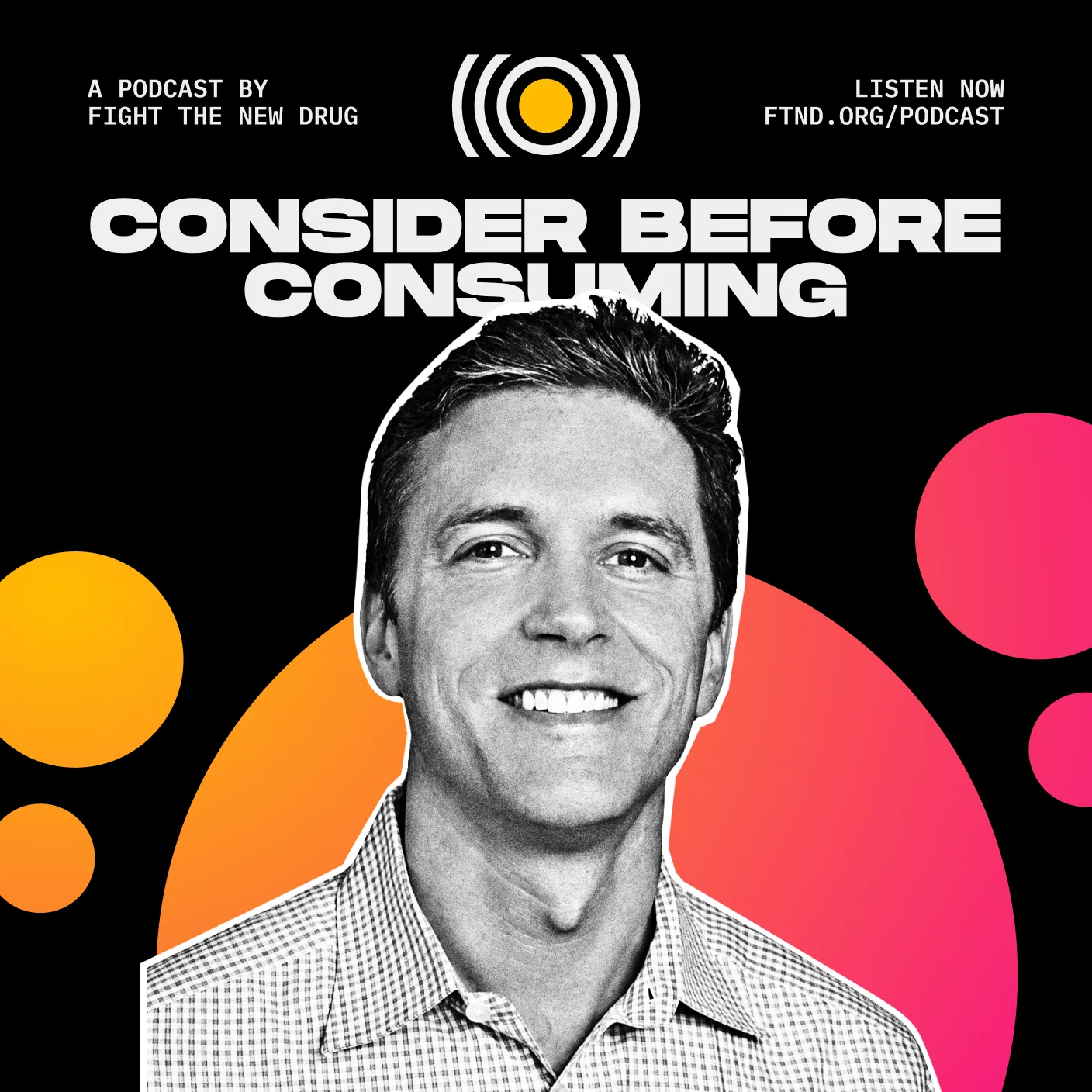
Episode 172
Porn Used to Be Something You Found. Now It Finds You.
Available wherever you get your podcasts
Dr. Michael Robb is a developmental psychologist and Head of Research at Common Sense Media. In this episode, he joins us to unpack findings from two major Common Sense Media studies: Teens and Pornography, which explores how teens are exposed to and engage with online pornography, and Teens in the AI Era: Pornography and Sexual Content, which examines how AI-generated explicit content is creating new challenges for young people.
Common Sense Media’s research found that the average reported age of first exposure to pornography was 12, while 30% of teens reported seeing pornography during the school day. And as AI-generated sexual content becomes increasingly common, 44% of teens say they’ve encountered it, with about 1 in 4 of those teens seeing AI sexual content depicting themselves or someone they personally know.
Why do teens watch porn? What are teens learning from pornography about sex? And how is AI-generated porn changing what young people encounter online? Dr. Robb discusses differences in how boys and girls engage with pornography, why so much exposure happens accidentally, what teens themselves say they’re learning from porn, and what parents and trusted adults should know about explicit deepfakes and AI-generated sexual content.
FROM THIS EPISODE
- Article: Nearly Half of Teens Exposed to AI-Generated Sexual Content
- Article: How Many Students Watch Porn at School?
- Common Sense Study 2023: Teens and Pornography
- Common Sense Study 2026: Teens in the AI Era
- Conversation Guide: Let’s Talk About Porn
EPISODE TRANSCRIPT
Fight the New Drug (00:00)
Doctor Michael Robb, I’m so grateful to have you here joining us today on the Consider Before Consuming podcast. To start, can you introduce yourself and tell us a little bit about the work that you do?
Michael Robb (00:09)
Sure, my name is Michael Robb. I am the head of research at Common Sense Media. I am a developmental psychologist by training. And for the last decade or more, my job has essentially been to ask kids and families what their lives actually look like, especially as it relates to media. So, you know, what are they watching, what are they playing, what are they using? For parents, it’s often about what’s concerning them or what are they excited about, and then turn that into something that parents or educators or policymakers can act on.
I think a lot of the conversation around kids and technology runs on either anecdotes or it runs on fear. And so my job is to try to put real numbers underneath it. So we’re arguing about something that’s at least that we’re trying to measure.
Fight the New Drug (00:57)
That’s very well said, and we love the work Common Sense Media does. We reference it often. We’re always excited when new research is coming out, and I’m excited to get to discuss that with you today.
What role does research play in Common Sense Media’s broader work with kids, families, media, and technology?
Michael Robb (01:14)
Sure. It is the foundation, honestly, because I think everything else that we do with Common Sense works better when we try to start from an evidence base. And on a on a practical level, research does three things for us. Number one, it helps parents to understand kind of what’s what’s normal, you know, what’s out what else is happening out there.
I think a lot of parental anxiety comes from not knowing whether their kid is the only one dealing with something. I think it we also, you know, the research helps to give educators a picture of what’s actually walking into their classrooms. And lastly, it helps to give policymakers something concrete. You know, just saying I’m worried about this does not move legislation, but a, you know, a nationally representative number could.
So the only other thing I’d say there is that the research helps to keep us honest. So sometimes we go into a study expecting one thing, and maybe the data says something different, and then we have to change what we’re telling families, and that’s just the nature of the job.
Fight the New Drug (02:19)
Yeah. And I think that’s so important to mention, as you spoke about how sometimes when we want to address these issues, it’s driven by fear. And sometimes we’re afraid that the impact or the outcome of something might be one thing, but data shows us it’s actually something completely different. And that’s really important for us to make sure we’re addressing the correct pieces of any of these issues. So it’s so, so important to have that foundation.
Michael Robb (02:43)
Yeah, I I think more often than not, it’s not it’s not just giving me the numbers. Like I feel like my job is often being like Captain Killjoy in terms of trying to give people a more complete and nuanced picture of what’s going on.
So often when we talk about the things that are happening in kids’ lives, we wanna boil it down to like just one thing. And it’s very rarely just one thing. You know, there are very few silver bullet solutions to really, really big problems in in kids’ lives or in society more broadly.
Fight the New Drug (03:12)
Well said. And you know, you’ve spent years studying young people’s experiences with media and technology. And when you look at kids growing up today, what has changed most significantly about the environment that they’re growing up in now?
Michael Robb (03:26)
I mean, there are several shifts, so I’m gonna cheat by saying a couple of them.
I think one of the big shifts is that content that kids encounter is not something that kids go to find anymore. It comes to them. So, you know, when I was a kid, if you wanted to see something, you had to go looking. And there was some friction at every step. You needed a place. If you were trying to see something that you weren’t supposed to see, maybe you needed some privacy, you needed a bit of luck. And now the delivery mechanism is a recommendation algorithm, and it doesn’t care how old you are; it doesn’t often care whether you ask for something.
Kids, you know, when you talk to them, they say they’re kind of getting hit with things when they’re just scrolling or even like in the middle of a mobile game or in an ad. So that’s a big shift.
I think a second one is that there’s no longer a clean line between being an audience and being a subject. I mean, cause you know, kids used to consume media that was about other people. And now media gets made or can get made about them, or it’s made by them or by their peers, and sometimes it’s made without them knowing. I think that is a new psychological situation to grow up in. I don’t think we we fully reckon with it reckoned with it. And I think the third thing is the speed, right?
The gap between a technology arriving and adults figuring out how to handle it. You know, sometimes that that used to be in, you know, historical times, maybe that was years and now it’s months. And the institutions that are supposed to protect kids, you know, your schools, laws, policies that individual technology platforms have, they’re just structurally very slow. So, you know, we’re we’re still getting a handle on social media and now we’re also dealing with AI, so it just it goes very fast.
Fight the New Drug (05:09)
Right. The safeguards can’t necessarily keep up with the speed at which technology is advancing and and the impact that that’s having on young people.
Michael Robb (05:17)
That’s right.
Fight the New Drug (05:19)
In twenty twenty three, Common Sense Media released a report, which we reference all of the time called Teens and Pornography. And it’s a nationally representative survey looking at teens exposure to and use of online pornography. And what prompted you to conduct that research and what were you hoping to better understand?
Michael Robb (05:38)
Yeah. Great question. What prompted it was there was a a gap there, right? There was a lot of strong opinion about teens and pornography, and very little, you know, recent nationally representative US data. So most of what existed was either older data, some of it was coming from other countries, or those small samples you couldn’t really generalize from it. So, you know, we have, we’re having debates or just kind of running on assumptions. And we just kept hearing from parents and educators who wanted to know some very basic things.
You know, how common is this? How young is it affecting kids, or are they being exposed? Is this happening like on purpose or is it happening to them? And and what do kids think they’re getting out of it? That’s a question; that last question I think is one that we should also think more about because I think this is there’s a tendency to treat issues around online pornography and kids as just kind of a purely moral issue, you know, should they or shouldn’t they? And skip past some of the developmental questions that I’m interested in too, which is, you know, if a twelve year old is watching this, what is he or she learning? Learning something. so we want to ask kids directly instead of guessing on their behalf.
Fight the New Drug (06:44)
Yes, which is so important, especially when we’re making decisions about safeguards to protect children, we need to know what their actual experiences are with regard to things like this
Michael Robb (06:52)
Absolutely.
Fight the New Drug (06:53)
So the survey found that 73% of teens had seen online pornography, with the average reported age of first exposure being twelve years old. What stood out to you about how early and how common young people were encountering this content?
Michael Robb (07:08)
So I think two things stand out. The first is that twelve is an average, which means a lot of kids are actually below that. And in that original 2023 study that we did, 15% of kids told us that they first saw pornography when they were 10 or younger. So that’s like, you know, around fourth, fifth grade, somewhere around there. And in this new research that we just released a few months ago, 12% said age 10 or under, and more than half had seen it by 12. So it’s fairly stable in our measurements, and it’s pretty early, I think. The second thing, and this is the one that I think parents are interested in, most of this isn’t necessarily a choice.
So, in the data that we have, 61% of teens say that they’ve encountered pornography accidentally, and only 43% say that they’ve ever sought it out. So, and there’s overlap between those two groups. You can seek it out intentionally, or you could encounter it accidentally. But you know, the headline is that the single most common way an American teenager first sees pornography is not necessarily by looking for it directly. And I think that helps to reframe some of the conversation. Because if you’re thinking of this as a as a discipline discipline problem, you will respond one way. And if you’re thinking of this as an exposure problem, that it’s arriving like uninvited into kids’ feeds, maybe years before a kid has kind of any framework for understanding it, you may respond differently. So it helps to stop being about catching your kid and more about preparing them.
Fight the New Drug (08:40)
That’s really well said, you know, we often say it’s not if it’s when young people will be exposed to pornography because so often it’s it’s not that they’re seeking it out, or it’s that you know, if parents have all of the quote unquote right or correct safeguards in place, they have filters, all of these things, kids can still be exposed because there are so many different ways that that young people are stumbling across this content or being shown it by someone else. And so it’s really important to be able to understand that early exposure.
Michael Robb (09:10)
Yeah, and actually in our earlier study, we asked about parent controls. And in our that 2023 study, only about a third of kids, sorry, about a third of of teens said that there were either content filters or controls active at all. And that would and that dropped more like the older they got. So, you know, the older they got, the less likely there were to be any kind of controls. And even where they exist, you know, sometimes those controls are aimed at the wrong target. Because, like, a filter is built to block a category or a website. It’s not necessarily built for a video that can surface in a social feed or an ad, Inside of a like a mobile game that they’ve downloaded, or even just something that like a friend would drop into a group chat where a lot of this might happen.
So yeah, the parental controls I think is it’s a part of the solution, but it’s doesn’t replace a conversation for sure.
Fight the New Drug (09:56)
Right, it’s another example of technology advancing so rapidly, you know, the ways that these ads can be implemented into games or other things so much more quickly than filtration software can keep up with, oftentimes. So it’s certainly a tool that can be used, but as you mentioned, it doesn’t replace a conversation. And and I want to talk more about that in just a moment.
Speaking about, you know, kind of intentionally seeking out pornography, what did research tell you about why boys in particular were intentionally seeking out pornography?
Michael Robb (10:27)
So, I think, you know, that gap between intentionality and accidental, like that’s a real gap. In our in our new data, 53% of boys say they’ve sought out pornography intentionally compared with 32% of girls. Overall exposure is high for both groups. So 79% of boys and 68% of girls say they’ve seen it. But that intentional seeking is kind of where they diverge. And as for why you see that gap, I mean I’d point point to a few things that some of the broader research on this topic supports and that some of the interviews we’ve done one-on-one with kids about other subjects have echoed.
Some of it is that boys report more solitary use that’s tied to things like, you know, masturbation, and pornography is mapping onto that desire directly. Some of it is social. You know, for boys, this, like pornography can circulate as a group activity, something that you might send to a friend or joke about. That might lower the barrier. And some of it might be that girls face a higher social cost for admitting to it. So there’s probably some underreporting in that gap.
So, but yeah, I just the question about gaps is interesting, especially when I think about boys and girls. Because when I think sometimes it gets framed as a boy problem. And when that happens, then girls stop getting asked about it. And girls are seeing this content, so and they need the conversation just as much, but they might be less likely to get it.
Fight the New Drug (11:47)
That’s really well said. I think culturally there’s certainly an acceptance and normalization more so of boys consuming pornography than of girls. But it’s certainly something that we’re seeing. I, you know, Fight the New Drug, our nonprofit, was founded 17 years ago at this point. And I would say what we were seeing with the normalization kind of split by gender around that time versus now is certainly we’re seeing many more women and girls being exposed to pornography.
As well as being targeted by pornography in ways that maybe it was previously targeting men and boys primarily. And so it’s really important to have this conversation and be aware that this is something that even if culturally it’s normalized for more for boys, it’s certainly something boys and girls are both seeing.
Michael Robb (12:34)
Absolutely.
Fight the New Drug (12:36)
I think people would be surprised by where teens are encountering pornography. So, can you share a bit about where that’s happening now?
Michael Robb (12:44)
Yeah, and I think that is interesting because it maybe it changes people’s mental picture of how you encounter pornography. I think the assumption is that it’s happening on pornography websites, and that is true; it is. Those matter, but that is definitely not the whole story. Teens tell us that they are seeing it regularly on social media and on mainstream video platforms, places that nobody necessarily thinks of as adult sites that are on kids’ phones, that a lot of parents have approved.
And sometimes the places where kids see it are really surprising. So in our last study, 30% of teens said that they’d seen pornography during the school day. So like not at home, not at midnight in the room, but at school. And of those teens, 44% said it happened on a school-issued device.
So, you know, I think the the model that a lot of parents have that it’s this is like a in a bedroom at night thing or this is like just a personal phone thing, that’s incomplete because it’s happening in lots of spaces, it’s happening in feeds, it’s happening in ads, in games, and group chats, potentially on the laptop that the school district handed out. Which is why things like filtering software alone were never gonna be the answer, because y you can’t filter your way out of a delivery system that’s that broad.
Fight the New Drug (13:58)
Right, exactly. And you know, even if you you have all of the right things in place, you won’t always be with your child, and they will be around other children with other devices, with other safeguards in place or not in place. And so it’s just it’s really important to have conversations as you mentioned, which we’ll continue to talk about.
One of the findings that really stands out is that forty-five percent of teens say pornography provided them with helpful information about sex. So this goes back to what you pointed out earlier about what are they learning from this.
And when teens describe pornography as quote unquote helpful for learning about sex, what do we know about what they believe they’re learning from it?
Michael Robb (14:36)
Yeah, that helpful framing is interesting. So yes, forty-five percent said pornography gave them helpful information about sex. And then we asked, like, what specifically. And then about four or five said that it was helpful for them just about learning how to have sex. About three-quarters said it was helpful because they learned what behaviors might feel pleasurable for them. A similar amount said that they were learning about what kinds of partners might be attractive to them. And so it’s important I think to try to understand what’s happening here rather than just being alarmed by it because I think again that helpful framing is important.
Like the kids are not they’re not being perverse. They have real questions about, you know, like, what is what’s happening here? You know, what might be expected of me? Certainly questions about, like, is my body normal, or what does somebody want me to look like? And pornography is a source that might answer those questions. Now does it answer it correctly? Maybe not.
It is something that is available immediately, privately, at any hour, with no adult present, no judgment present. You compare that to, like, a sex ed class that may or may not exist, or a parent conversation that feels excruciating to them. This may feel to some teens like a better choice. Again, it might not actually be, but it might feel to a teen like it is. Obviously the problem here, like if that’s the way they’re feeling, like this is essentially a curriculum that nobody has designed.
It’s this is a pornography curriculum that is optimized for arousal and engagement and not accuracy. So you’re missing all the lessons on things like communication or consent. Very few kids say they’ve ever seen pornography that, you know, where somebody’s asking for consent. And more than half said they had seen depictions of the opposite of where, you know, more violent pornography that involved things like either simulated rape, choking, someone who seemed to be in pain. So they’re they’re getting some kind of an education. It’s oftentimes a a bad one. But it might be the one that’s available. And I think that maybe that’s an indictment of the alternatives more than of of the kids themselves.
Fight the New Drug (16:42)
Right. And how well are teens able to distinguish between pornography as performance and what sex and relationships actually look like in real life?
Michael Robb (16:53)
I mean the honest answer is probably better than adults give them credit for and probably less well than they give themselves credit for. Both are probably true.
I think only a quarter of teens say that pornography accurately shows the way that most people have sex. So, you know, that means about roughly three-quarters of them know that it’s performance or not really accurate. And when you talk to them, like they’ll tell you it’s fake and that it’s staged. Or like the bodies aren’t realistic. That’s not how anybody behaves. So
they’re not necessarily naive, but I think that knowing something is fake and then being unaffected by it are different things.
So, you know, that’s probably a good place to push back on an argument that, well, kids are savvy, they’ll be fine, argument. You can know perfectly well that, you know, a magazine cover’s airbrushed and you can still feel plenty bad about your body, ’cause knowledge is not something that just automatically neutralizes the influence that something might have. Especially when that exposure starts really young. Right? When it’s starting at eleven or twelve, before there’s any real-world experience to compare it against. So, you know, that’s a developmental issue.
If if your first several hundred impressions of sex arrive before you held anybody’s hand, like that material is not competing with reality. It’s just establishing like a a baseline. And that baseline is gonna leave them feeling wanting eventually.
Fight the New Drug (18:15)
Right. That’s very well said. And I think going back to the point we keep bringing up about this idea that you know, safeguards don’t replace a conversation, but I think it actually is even broader of we’re looking to replace just one single conversation with an ongoing discussion between trusted
Michael Robb (18:30)
Totally.
Fight the New Drug (18:30)
adults and young people, right? Because young people have questions about sex. That’s natural and normal. Their bodies are changing, they have hormones, they’re trying to learn what’s going on. And if they don’t have a trusted adult, they can go to with these these questions in an ongoing way as things come up, then they will search it online and they will seek out answers from something that even if they can determine, okay, this is a little far-fetched, it still can have that impact, as you mentioned, which can affect, I mean, sexual templates, affect relationships for years to come, without being able to have that kind of real-world tangible conversation with the trusted to help guide them through these things as well.
Michael Robb (19:09)
Yes, agreed. And it’s all the more reason why you start those conversations early rather than later. I think there’s a temptation like, my kid’s not ready yet, but it’s actually easier in a lot of ways to talk to young kids. It’s a little less embarrassing than talking to a teen. They’re more likely to just kind of… I mean they might not have a ton of questions for you, but they they are genuinely interested and I think more willing to hear you out and hear like your point of view as a parent or a trusted adult or whoever you are to that child, about like what is realistic and what’s not realistic and kind of what your values are. ’cause that conversation, I don’t know, it can feel cringy when you’re a teen.
Fight the New Drug (19:49)
Yeah.
And we often hear that adults are less comfortable with the conversation than teens, actually, because teens do want answers to questions they have. And so it’s something that it it takes a lot of work on all parts, and we have some wonderful discussion guides on how to have healthy conversations about pornography. There are lots of other resources out there as well. But that is something to remember that the earlier those age-appropriate conversations can start, kind of the better when it comes to these issues.
Now, since your earlier research on teens and pornography, generative AI has made it possible for young people not only to consume explicit content, but to create it, which is something you kind of mentioned earlier. How significant is that shift?
Michael Robb (20:30)
It’s it’s a pretty significant shift. I mean it’s a it’s a different thing, right? So you now you have a person in image who never agreed, never participated, may have no idea it exists if it’s a real person, a representation of a real person. Their contribution might have been just the posting of a photo of their face in some other context. And the barrier to doing or creating this content is gone, right? It does not require skill or equipment. I mean all you need is like a few minutes on a phone here to do this.
And we had a boy in one of our studies, you know, we were talking to them, and he basically just said, you know, with no hurdles or anything that you have to jump over, you can just do it right there. He just acknowledges how easy it was. So you have a different risk profile. Every teenager who has ever posted a picture of their face is now potentially the subject of pornography.
And on the other side, a fourteen-year-old can commit a very serious legal offense. Right? Generating a sexual image of a minor, you know, like of a classmate or something, like that’s child sexual abuse material. It’s a felony. So, and you can do that in about the time it takes to send a text, you know, when you’re thinking that you’re doing like a funny prank. So it’s it’s a shift, right? It’s it’s like a different category almost, and it’s a new way that kids can can hurt each other, they may not even know what they’re doing.
Fight the New Drug (21:49)
Right. And in your latest research, what did it reveal about how teens are encountering and engaging with AI-generated pornography and sexual content?
Michael Robb (21:59)
So, this was a nationally representative survey. It’s over 1,300 kids between the ages of 13 to 17. Of those more than 1,000 kids, 44% of teens said that they had seen sexual content they would believe was AI-generated. And I say sexual content because there’s a lot of material out there that’s not necessarily does not involve either sexual like explicit nudity, but it might just be sexual in nature. Right? And it could involve like, you know, putting somebody in very skimpy clothing or in compromising situations like that.
So 44% say they’ve seen that kind of sexual content. For most of them, they didn’t seek it out, similar to our last survey. So 79% of those who had seen that AI-generated content said it came across to them mostly accidentally, mostly in their social media feeds. And then among teens who said they’ve seen this content, about a quarter said that they had at some point either seen it depicting themselves or someone they know personally. And again, among those who had seen it, more than one in ten had seen it of themselves.
So this wasn’t just like deepfakes of celebrities, like it was, you, or the other people in your school. I think the other thing here is like this is not just a receiving thing, it’s also a creation thing.
So eight percent of the teens in our survey said that they personally created AI-generated sexual content, and 13% of teens said that they know somebody who had. So you can call it, you know, one in five who were inside that circle one way or another, and of those, about two-thirds say the content depicted someone they knew or depicted themselves. So, you know, the a lot of people are creating this as well. So yeah, it’s it’s a lot.
Fight the New Drug (23:37)
And yeah, and boys were more likely than girls to report creating AI-generated pornography. What do we know about what’s driving that difference?
Michael Robb (23:50)
I mean, we should probably separate out what we can measure from what we can reasonably infer.
What we measured is that boys are more likely to be seeking sexual content generally. So they’re already closer to the tools and the spaces where this circulates. I think what we’d infer from interviews that we’ve done and from other research is that, you know, a lot of this doesn’t necessarily feel like harm to the kid doing it. Like it kinda gets framed as like messing around, it’s like a joke. Maybe it’s a thing you do to get a reaction in a group chat. And then there’s this, for some kids, there’s like the “it’s not real” logic gives you a bit of like a moral escape hatch.
Fight the New Drug (24:26)
Right.
Michael Robb (24:26)
Because a quarter of kids who’ve seen this content told us they think it’s less harmful than real pornography because, quote, nobody gets hurt.
And there’s a gender dimension here as well. Like girls are noticeably more worried about getting targeted by AI-generated pornography, and they are more likely to say strongly that creating this without permission should be illegal. So there’s a bit of a gender gap here as well.
Fight the New Drug (24:50)
Right. And we do know the idea that nobody gets hurt is just that. It’s an idea because there are certainly real-world impacts to those who are victims of of this type of content, and when something is perceived as real by so many, and the impacts that that can have. We’ve spoken with many survivors of issues like that as well. So it’s certainly complex and and worth continuing to take a look at how we can mitigate this; it’s exploitative in nature, and how we can mitigate that, and help better educate young people so they really understand what those impacts are.
According to research, teens seem fairly aware that AI sexual content can influence how their peers think about bodies, sex, consent, and relationships. Were you surprised by that level of awareness? And does recognizing the influence seem to change how teens engage with the content?
Michael Robb (25:42)
Sure, I wasn’t surprised that they see it, but I’m struck by how consistent it all is. So we have about two-thirds of the teens, all teens, say that this content shapes how kids their age think about what bodies should look like and about what sex and consent are, about what to expect from a romantic partner and whether you can trust a video. Can you trust a video or a video at all? But I mean if you try to notice the wording of what kids are agreeing to, they’re they’re telling us that it affects teens their age, right? So not necessarily themselves. And psychologists call that a third-person effect. People readily see media influence on everybody else, not as much on themselves.
So, I mean, I read this as like this is awareness, it’s real, it’s partial. I think they have accurate insight into the phenomenon, maybe some blind spots about their own exposure, how it affects them. But like for the question of like how does awareness change behavior? Probably not much.
I think I think that’s an important finding. Because among teens who’ve encountered this content, you know, the most common response is well, you know, I just try to forget about it and move on. And only thirty percent of people are actually reporting this content to the platform, and when we asked about this in focus groups, you know, we had kids who would say like, well, it’s just like a time consuming, the account’s just gonna come back anyway. So, you know, maybe it’s just easier to just not think too much about it.
Fight the New Drug (27:04)
Right, almost accepting it as an inevitability of living in this time rather than as something that can be changed.
Michael Robb (27:13)
That’s right. Yes. I think the odds are kinda stacked against you.
Fight the New Drug (27:17)
Yeah.
Among teens who had seen AI-generated sexual content, sixty percent said it makes it harder to know what real bodies look like. And we’ve talked for years about unrealistic bodies in traditional pornography, but what changes when those bodies, you know, don’t have to exist at all because it’s AI-generated?
Michael Robb (27:38)
Yeah, so with conventional pornography, that was kind of always a distorted sample in the sense that, like, it’s selected people with real lighting, real editing, but there’s a real human
Fight the New Drug (27:50)
Right.
Michael Robb (27:50)
body underneath it, and human bodies have limits. So whatever a kid was comparing themselves to, it existed somewhere. But AI does not have that constraint, right? Because the image does not have to be achievable by anybody, because there’s no body. It’s just an aggregate of what a model has learned about people and what they find appealing. So there’s not really even like a biological ceiling to to this.
So we had a girl in one of our studies who, when we were talking to her about this, she said it sets a standard that isn’t realistic. When I see an AI-generated photo of a perfect body, well, pfft, there is no perfect body.
What’s also interesting is that we tend to assume that this is a girls’ issue that maybe they are more affected by, like, the unrealistic bodies, but I think boys also feel it. 65% of teens said that this content affects how much they trust photos and videos in general. So it’s not only just what bodies should look like, it’s also just an erosion of what an image is telling you about anything true at all. And that’s kind of a big thing to lose when you’re still a teenager.
Fight the New Drug (28:56)
Absolutely.
You know, we’re entering a world where someone can generate sexual content tailored to virtually any person, scenario, or preference. What concerns or questions does that raise for you?
Michael Robb (29:10)
A few. The first is consent, right? That’s probably the most concrete. When content can be made of any specific person, a photo of your face is just raw material. And two-thirds of the kids in the survey said that they were worried about de be being depicted without their consent. And that’s affecting the real-world behavior. So they’re trying to adjust their lives around it.
So because so many kids feel like they might be depicted without their consent, about two in five of them say they are more careful about what they post. About a third have made their accounts private. Many are posting fewer pictures of themselves or just deleting their accounts entirely. And that’s, you know, that’s kids maybe withdrawing from online life as a defensive measure, maybe involuntarily, not that they were like it’s something they were happy to do. And you you could argue about like maybe that’s actually better in the long run. But har hard to say because some some kids, you know, they need that social outlet in specific ways.
And I think the other thing is, you know, conventional pornography, like on traditional pornography, it was a it was a mass product. Like you got what was made, it wasn’t about you. But all this infinitely customizable content is different, and it’s shaped around one specific person’s preferences. There’s no friction, there’s no negotiation, nobody else needs to be in the frame. And that is the opposite of the skill set that actual intimacy with other people requires. And I don’t have data necessarily on where that leads, but I and I would be suspicious of anybody who said that they do, but I suspect that that’s not, that’s not a good thing.
Fight the New Drug (30:46)
Yeah. And you know, looking across everything you’ve learned about young people through your research, what do you think parents and other trusted adults most need to understand about what teens are navigating right now?
Michael Robb (31:00)
Number one, your kid has almost certainly encountered this, and it probably wasn’t their fault. You know, l like I said, most kids have already seen pornography in this age group, and a good chunk of them have seen AI-generated sexual content. Most of that exposure was accidental. So if you’re going into that conversation looking just for a a culprit or somebody to blame, you may have already kind of, you lost the room with the kids.
The second thing is it’s okay to be in that conversation, and many kids want you in that conversation, but don’t know how to start it. So only 20% of kids said that they had ever talked to a trusted adult about AI sexual content. A third more said that they’d like to, but they don’t know how to. So that’s there. There’s a third of American teenagers who are like waiting for that conversation. But they and they told us what would make it easier.
So things like knowing an adult would understand and they they wouldn’t be blamed. Right? So going into this with an open mind and not looking to, like, blame or embarrass kids, like that’s gonna be really important. And so those are both things that you can say out loud in advance before you have that conversation.
And I think the third thing is that this isn’t only about protecting your kid from harm. It’s about making sure your kid doesn’t cause it. So, you know, a kid who generates a nude image of a classmate has not only potentially really hurt somebody deeply personally, but in the eyes of the law produced child sexual abuse material. And that’s a real legal issue. A lot of kids don’t know that. Telling them is a short conversation and definitely not one to skip. As you mentioned earlier, it’s not one conversation. Like this can be a series of one-minute conversations. It doesn’t have to be a sit-down for 20 minutes and of short, awkward, low-stakes ones over years. That’s fine.
Fight the New Drug (32:49)
And we hear that all of the time: how much more effective that is and how much more comfortable that is for everyone. And it really just opens that door to let young people know they can come to you when something comes up, and you will be approachable. And I think that is key. Especially with how rapidly technology is advancing. You know, you could have all the conversations you want right now, but next year, what are all of the new things that are going to become relevant that need to be addressed? And if that door is just open once and then closed, it doesn’t really allow for that safe space other than for a young person to go search on the internet, which we know is not a safe space more often than not with regard to these topics.
Michael Robb (33:27)
Right. Right.
Fight the New Drug (33:30)
Is there anything you’ve learned from teens themselves that gives you hope as you continue to do this work?
Michael Robb (33:37)
I mean, I think their moral instincts are are pretty good. I mean, by far, the the majority of teens, 82% of teens who’ve seen this kind of AI content, say creating it without somebody’s permission should be illegal. Granted, there’s a percentage of teens who don’t say that, and that does concern me. But by far the majority do. And also lots of kids say that most teens don’t really understand the implications of what they’re doing, so there’s runway here to make improvements.
And I think they’re also thoughtful in a way that probably surprises people. When we were doing focus groups, and we brought, you know, we actually take took the data after we’d run it and brought it back to them to ask them about like what they made of this data. And they were really sharp about the the mechanics of all this. More than a lot of adults, I think maybe.
You know, we had a seventeen-year-old who was explaining the kind of dopamine loop that keeps kids engaged, and maybe also like, you know, the friction that’s involved in about why they don’t report content. You know, kids who are telling us like it’s just really naive to assume that anybody hasn’t been exposed since it’s so easy and so accessible and it also feels pushed. And that that was a phrase they actually used. It says it feels pushed. And that’s a really good description of I think, the modern internet and kind of the pornographic landscape, than lots of like other analysis that I’ve read.
So I think that they’re not missing judgment or intelligence. They’re missing information. They’re missing maybe some backup, like some people backup, adult backup, trusted adult backup.
So, you know, I I think the hopeful version of this is like kids are ready for this conversation. They’re just waiting for somebody to start it.
And beyond the things I’ve already shared, like like the honesty, the things that that do stick out to me is like just kind of like how astute they are when they talk about it. Like this is something that they are enmeshed in already. Like they have plenty of background knowledge.
So like, when you are starting this conversation, you’re not starting this conversation as from a place of like where kids have have nothing to bring to the table. Like they will already have questions, opinions, and thoughts about this topic.
Fight the New Drug (35:41)
Which, if I may interrupt, is so important to note because we hear from so many parents who say, Well, I’m worried that by having this conversation, I will make them curious about it and I will make them learn about something they didn’t know about, and what you’re saying is the exact opposite. They already know about this. They already have information. So you’re not likely going to be the one to introduce them to this topic.
Michael Robb (36:03)
That’s true. I just had a conversation with a parent who was telling me that they had not yet had just kind of a a general sex conversation with a, it was an upper elementary school kid, which, you know, everyone parents should respect their values, do it at your own pace, but there is a danger that like if you don’t say something, somebody else will.
Fight the New Drug (36:20)
Right.
Michael Robb (36:20)
So who do you want to be the first person to bring up that conversation? You know, that is something that I think parents do need to think about.
Fight the New Drug (36:26)
Well, that’s so well said.
It’s been…I could talk to you about this research for hours because it’s truly something that, you know, we’re so, so grateful for the work of Common Sense Media. And, as a nonprofit that primarily focuses on reaching teens because they’re the ones experiencing this issue in new ways that no other generation has before, and then their support systems, parents, educators, you know, it’s really, really important that we we are hearing from teens themselves and that they have a voice in in helping us understand what’s going on.
So I I know we’re just about at time, but is there anything else that feels really important to share on this topic or from your research that you want to be sure to mention today?
Michael Robb (37:07)
I mean, I mean, I think we’re we’re I’ve said it a few times, but like, I think parents are afraid that their kids are gonna just shut down. So, expect that and don’t read it as failure. You know, teens often told us straight out they do not want to drag adults into their problems necessarily. So deflection might be a default setting for some kids. I think, you know, based on other research and conversations with other groups that do do this work, it can help maybe to do this as a side-by-side conversation rather than a face-to-face conversation.
You know, people say, like, do do it in the car, on a walk, while doing dishes, somewhere without eye contact, and go in with a low bar. That is totally fine. Like your goal for a conversation with your kids should be it’s to just be on record of somebody who can hear what they have to say without judgment and without losing it. Right? That’s that’s a win, even if your child is just kind of grunting at you.
Fight the New Drug (37:59)
Right. And I think that’s such a key part of what you’ve mentioned throughout this conversation is just trying to go in without losing it, trying to go in without looking for someone to blame, trying to go in as a resource to help your child rather than to punish them for a behavior that was maybe something that they encountered by accident. Or if they have questions about you, want that door to stay open. So really making sure to try to find a way to navigate these conversations in that healthy space.
Michael Robb (38:31)
Yeah, and let me add one more thing because, you know, there’s a temptation to treat all this as one conversation, like one kind of conversation, but there’s obviously, there’s an age gradient here.
So the conversation you have with an eight-year-old is not gonna be the one that you have for the fifteen-year-old. Because the the version that you have for an eight-year-old might not even necessarily be about pornography. It might be about, hey, sometimes things pop up on your screen that are weird or gross but then involve like naked people. That is not your fault. Come tell me, you’re not gonna be trouble. Like you don’t have to over explain everything, you’re just kind of installing a reflex.
Fight the New Drug (39:02)
Right. Right.
Michael Robb (39:04)
And then you can get more specific as they get older. You know, like you can name pornography or pornography related issues by middle school, early middle school. And by high school, you’re probably talking about more about AI and consent and what the law says.
Fight the New Drug (39:18)
Yeah, very well said. And and appropriate even to to start small and and in age-appropriate ways and then slowly build. And all children are different; you know your child best. And so just being able to be the safe adult to have those conversations is so, so important.
Dr. Michael Robb, thank you again so much for joining us on Consider Before Consuming. We will certainly link to Common Sense Media’s research in the show notes of this episode. It’s something, again, we reference often, and we look forward to the future of the work that you’re doing and to continuing to see the way that young people are experiencing these issues today.
Michael Robb (39:55)
My pleasure. Thank you for having me on.
Fight the New Drug collaborates with a variety of qualified organizations and individuals with varying personal beliefs, affiliations, and political persuasions. As FTND is a non-religious and non-legislative organization, the personal beliefs, affiliations, and persuasions of any of our team members or of those we collaborate with do not reflect or impact the mission of Fight the New Drug.
MORE RESOURCES FROM FTND





A database of the ever-growing body of research on the harmful effects of porn.