

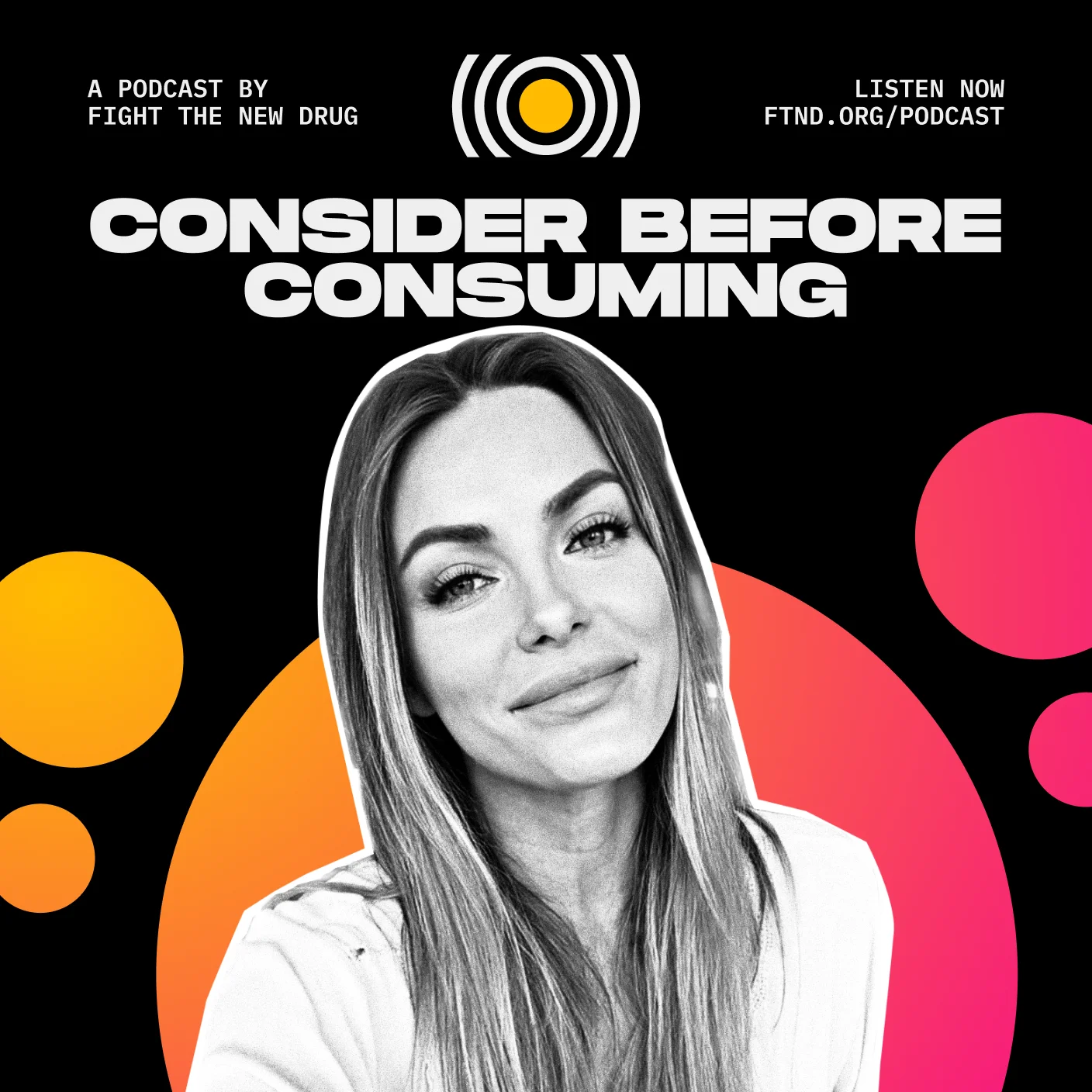
Episode 175
Crystal Harris on What Really Happened Inside the Playboy Mansion
Available wherever you get your podcasts
This episode contains discussions of sexual abuse, coercion, exploitation, child sexualization, and other potentially distressing experiences. Listener discretion is advised.
Crystal Harris, author, advocate, and widow of Playboy founder Hugh Hefner, spent nearly a decade inside the Playboy Mansion.
What was life inside the Playboy Mansion actually like? How did an environment marketed as glamorous and empowering affect the women living within it? And what happens to intimate images when the people depicted no longer have control over where—or how—they’re used?
In this episode of Consider Before Consuming, Crystal joins us to discuss entering the Playboy world at 21, the control and abuse she says she experienced inside the Mansion, the sexualization of young women and girls, similarities she sees between Playboy and platforms like OnlyFans, and her ongoing fight to protect private images in Hugh Hefner’s archives from being digitized. She also shares how her understanding of consent has evolved, her concerns about AI and image ownership, and what healing has looked like as she’s worked to reclaim her identity and voice.
FROM THIS EPISODE
Crystal’s Instagram: crystalmharris
EPISODE TRANSCRIPT
Fight the New Drug (00:00)
Well, Crystal, thank you so much for joining me today. I’m really grateful for your time and really looking forward to this conversation with you. To get started, can you tell us a little bit about what life looks like for you today?
Crystal Harris (00:13)
Today, wow, my life today is a lot different than it was. today I am spending most of my time in Hawaii. I am working on my master’s degree in psychology and trying to understand the things that happened in my previous life. And I’m grateful that I’m in a good place and happy and healthy and married to somebody that I really care about that’s nice and normal and kind.
That’s that’s life. No, that’s my my highlight reel.
Fight the New Drug (00:47)
Amazing. And for anyone who maybe only knows of your name from Playboy, which we’ll talk a bit about today, what would you want them to know about your story before we dive into that?
Crystal Harris (00:58)
Yeah, I think I was somebody who was a bit lost in life when I was younger. You know, I didn’t really have any self-confidence. My upbringing was a little rough. And so I ended up at the Playboy mansion and I didn’t really know who I was. I didn’t really have the self-respect I needed. So because I didn’t know who I was, it was dictated to me by somebody else. That person was Hugh Hefner, and when someone gives you your identity, they could also take it away. And so it was a very, it was a very tough existence, just trying to be what somebody else wanted me to be. And so it was hard and exhausting. And yeah, I just I just want young girls to really find themselves and know who they are and really have a solid center so they don’t get you know pulled pulled in the wrong direction.
Fight the New Drug (01:53)
Yeah. And going back to your childhood, what was your childhood like? And were there particular experiences that you feel shaped you?
Crystal Harris (02:02)
Yeah, so my mom and dad moved from England when I was about eight. We moved to Southern California. And my dad was a singer, but he got sick shortly after we moved and passed away when I was twelve. So it was just my mom and I, and she she struggled. You know, she wasn’t a citizen, so everything was under the table. And so I I I struggled a lot.
We didn’t have any money, and I always thought like people with money are you know were better than me and so I always just made myself small to be accepted, like, my whole childhood and I think that was part of how I ended up where I ended up.
Fight the New Drug (02:46)
Yeah. And before you ever visited the Playboy mansion, what did Playboy represent to you?
Crystal Harris (02:53)
Wow, that is a a good question. My first experience with Playboy was seeing my stepdad’s Playboy magazines. My mom, she married this man so she could get her green card. And he, you know, he lived in a condo, which I thought was just like, wow, good. We lived in the tiny little apartments and like, he lives in a condo in La Jolla in San Diego. And he was a business person and he had all these Playboy magazines. So I I associate it with power. I associate it with sophistication.
I saw these women in the pages and I thought, wow, they must have the whole world at their feet. Like they’re they’re beautiful, they seem powerful. And that was kind of my initial introduction to Playboy. And I know there was a a Girls Next Door show that I was that I ended up being a part of for one season, but at that time, I I didn’t really watch watch the show, but I just, I knew Playboy was a powerful company.
Fight the New Drug (03:57)
And did you ever imagine yourself becoming part of that world?
Crystal Harris (04:03)
No, no, I never I was shy, I was insecure, I I never I never imagined that in a million years that that would happen to me.
Fight the New Drug (04:15)
Yeah. What was happening in your life when you first met Hugh Hefner and what initially drew you into this lifestyle?
Crystal Harris (04:22)
That’s a great question. So I would when I was in college, I would start doing little modeling things here and there, like giving out keychains, bars, and you know, I got paid, I don’t know, some twenty five or thirty-five dollars an hour. I’m like, wow, like that’s pretty good for a college kid.
And I had seen like a lot of different celebrities. I had seen like Jenny McCarthy, Pam Anderson, Carmen Electra, like they all were beautiful and famous and you know, just powerful. And I I just felt like if I wanted to be anything in this life, like I need to look like those people. And so I started molding myself to look like that. You know, I got breast implants, I bleached my hair.
I just started molding myself into these into these people, which was interesting because that’s that’s kind of how I felt, you know, I I could be a better sure. And I was I was in college and I was studying psychology and I thought like you know, I was having lots of anxiety and my mom was also struggling with a lot of different substances and things and I just thought, like, is this all there is? Like, is this all there is to life? Like, I don’t I don’t really want to be a psychologist because I have so many of my own problems. And then, in the midst of all of that, I got invited to go to a party at the Playboy mansion. Or I got invited to submit a photo through a girl I modeled with. she she said that they were having a party and you could submit your photo. I thought okay, I’ll submit a photo, but they’ll never pick me, and they did.
Fight the New Drug (06:13)
Yeah. And can you paint a picture of what life was like in the Playboy mansion? What it was actually like maybe compared to what you thought it was going to be like?
Crystal Harris (06:23)
Yeah, yeah. So I ended up going up to that party and met Hef and shortly moved in. When I first went up there, I thought it was so beautiful and glamorous and there’s all these celebrities and like this is what it’s like, you know, on the or how the other half live, my mom would say. So once I moved in—I was pretty eager to move in. And once I moved in, you know, things quickly shifted.
You know, I started getting a little bit more controlled, bossed around, told kind of what to do, what to wear, and everything was controlled, like when I woke up, when I went to bed, what I ate, what I wore. but I just wanted to be the best at it that I could be, which is so strange looking back.
Fight the New Drug (07:16)
Yeah. And I mean, even things down to like you had a curfew and you know, there was so much rigidity in not just your life at the mansion, but what you were able to do in terms of whether or not you could leave and when you could leave and how you could leave as well, is that right?
Crystal Harris (07:31)
Yeah, absolutely. I had a curfew. Most days it was 6 p.m. He had movie nights then. And so it was kind of disguised as the schedule. But looking back, I realize just the control of being back right at six. You know, most of the time I’m home before dark. And when I finally left, like I couldn’t I couldn’t figure out how to turn the lights on in my own car. So the control happened gradually, but yeah, yeah, it became pretty overwhelming.
Fight the New Drug (08:04)
Yeah. And when you’re in this environment, you know, with all of these other girls living at the mansion as well, how did that environment shape the way that you saw yourself and your self-worth?
Crystal Harris (08:16)
At first I thought I was going to make friends with people. I didn’t have that many friends going into it, so I thought we were all gonna be friends. But then the conversations turn into, you know, what what you can do differently, like, your hair is too short or your your hair’s not light enough, or you have like a cellulite pocket here, you know, you should go to my doctor. He’s good at, you know, doing the lipo. And so you just you just start things, you didn’t you didn’t even realize about yourself, you start to hate. You know, you’re like, I hate everything about myself. So it erodes your confidence and self-esteem.
And I remember having quite a few surgeries when when I was there. And so that’s what the women are talking about. And I learned that some of the most beautiful, you know, a lot of like the most beautiful women in the world came through there. And those were also some of the most insecure women I have ever met.
Fight the New Drug (09:12)
And I mean you were so young at the time, right? When you first went to the mansion. Remind me how old you were.
Crystal Harris (09:18)
Yeah, so when I had come to Playboy parties, I was twenty-one, but then when I had moved in, I was twenty-two.
Fight the New Drug (09:25)
Yeah. So so young to be, you know, in an environment with so much kind of scrutiny over the way that you look and the way that you are perceived and exist generally, at a at a rather impressionable time in life, I have to imagine, being so young.
Crystal Harris (09:44)
Yeah, it was it was when I was in it at twenty-two; I felt like a grown-up. You know, I felt like I had it all figured out. But looking back, I found some videos the other day, like, my gosh, poor the poor thing. I looked like a baby.
Fight the New Drug (09:59)
Yeah. And you went from, you know, moving in and then eventually became Hugh’s wife. Can you talk us through what that experience was like a little bit?
Crystal Harris (10:09)
Becoming his wife was very interesting. He was older at that point, and I, you know, there there must have been it’s almost like a Stockholm syndrome, and he started having a harder time getting around, and we’d already been married by that point, but I I just felt I can’t leave him, like he needs me. And when the wedding happened, I thought, okay, he wants this, you know, ending to his story, like this PR ending where he got married and lived happily ever after. And yeah, I filled that role for him, I guess.
Fight the New Drug (10:45)
Yeah. And kind of on the journey to becoming his wife and being in that environment, looking back, you’ve described him maybe as predatory at that time. Do you still feel that way about this situation?
Crystal Harris (11:01)
Absolutely. Absolutely. He would always talk about how he had such a high IQ. I’m not sure if that’s proven or just him talking about it. But you know, I think back and and it’s like if you had an IQ that high, you would want to be with somebody that’s, like, intellectually stimulating, or you can have all these conversations. But he wanted all of us to be, as…I don’… to put it bluntly, like as dumb as possible. You know, he wanted us to be this, like, damsel in distress that was completely helpless. And even looking at my old videos, I I found so many old videos recently. My voice and the way I acted, it was, you know, I’m embarrassed, and I I feel sorry for her. But it is this dumb kind of kind of act that he he really liked. And it’s it’s very odd to me.
And as I deep dive further into so many things, like, even while I was there, I didn’t think of it. well, I thought it was weird then, but now it’s it’s to me. I’m like, how did how dare he? But he was also dating twins at the same time as me, and it was sisters. And and like the incest was okay for him, but you know, that’s so damaging to someone’s soul for the rest of their lives. And I can tell those women are still struggling. So he had no regard for other people’s emotional well being, I guess, will be.
Fight the New Drug (12:29)
Yeah. And you know, something that I’ll ask in this way because I’ve seen you speak about this online, but do you regret marrying Hugh Hefner?
Crystal Harris (12:39)
Yes, absolutely. I wish I wish I had never I’d never been there. I wish I would have never had, you know, the that almost decade of my life sucked away into that bubble of a Playboy mansion. And people people say today, like, you wouldn’t- no one would know who you are if it wasn’t for him. And I’m like, I’m totally fine with that. Like if I could press delete undo, I would absolutely have those lives the years those years of my life.
Fight the New Drug (13:09)
Yeah. And another criticism that’s come up is that, or followed you, you know, through the years, is this assumption that your relationship with Hugh Hefner was motivated by money. And I know that you’ve addressed this publicly, but would you be open to talking a little bit about how those assumptions affected you and also kind of what the reality of of your time in the mansion was really like?
Crystal Harris (13:33)
Yeah, absolutely. I always just wanted to be, I don’t know if I was brainwashed, probably, probably beyond that, trauma-bonded, but you know, we filmed a season of Girls Next Door. I remember Hef was making $400,000 per episode of that. We made nothing. He was making about, I think, $800,000 for this special, this wedding special we were gonna do on Lifetime, and I didn’t make anything from there. I had a cover issue, cover issue of Playboy, and I think they paid me around 25,000. He made four million off of that issue.
So the the thing is, saying that people are there for money is very interesting because he was making so many, so much money off of exploiting women. And he disguised it as, you know, female empowerment. But how is it female empowerment when you know everybody has less resources than you do? Like, I don’t think he ever wanted to see a woman doing better than him. But I never asked him for anything.
I I’ve I found a video recently where I asked to go see my family. I asked to go see my aunts and uncles. I hadn’t seen them in, I said, seven years on the video. And he said, you know, aunts and uncles, like, that’s not your family. And and I was trying to get him to explain further because that’s family. And he said, Well, whatever it takes for you not to go. And basically he was going to give me whatever I wanted, like financially, to not go see my aunts and uncles. I didn’t end up going, and I also didn’t get any, you know, I he didn’t give me any money. I didn’t ask for it. So things like that.
And one day he bought me like this diamond bracelet. And he said, You never asked for anything, so so like I wanted to buy you this. And it wasn’t it wasn’t like that. I tried to like build my own nest egg.
Sure, like, I had some brand deals on social media. I think, like Skinny Bunny Tea and some other, like, things I would never promote now paid me, you know, it was like 7500 a week or something like that for a while. And I’m like, if people want to work with me because I live here, sure, like all the sacrifices I made. So there was that. But but yeah, I the money motivated thing. I wasn’t sure what I honestly what I was looking for. But I I definitely did not find it there.
Fight the New Drug (15:59)
Yeah. And know, Hugh Hefner passed away in twenty seventeen, and was there a point after he passed when your perspective on that world really began to change? You know, we’ve we’ve spoken about a couple of things that are a perspective you have now with some hindsight, but do you remember kind of a shift after he passed away in your processing of your experience there?
Crystal Harris (16:25)
Yeah, absolutely. I think after he passed away, I was still on the board of his foundation. And it took me like five or seven years, I don’t remember exactly, but to write a book finally about how he could be controlling and all the all the things there, the good and the bad. but since then, now I have this whole this whole other discovery I’ve made.
While I was on the foundation, the head of the foundation there, like I never really had a say. It was almost like it went to this other man. He’s he’s unrelated to Hef, but he has kind of the same values, equally as misogynistic. And he started wanting to digitize all of Hef’s scrapbooks. And I did more of a deep dive through the books, and I found images of, you know, thousands of women that are are nude intimate photos and I thought, you know, you can’t digitize this. You cannot put this out, especially with AI and everything that’s going on now. And do you have consent from all these women? And then I also started finding photos of people that were not adults. And I raised the alarms even more. And you know, I I I started finding gr grooming letters where little girls would send in photos of letters saying, what does it take to get into the mansion? I have a Playboy bedspread and I I just want to be there. What do I do? And and he’s writing back. Like he’s he’s kind of grooming them. And so I thought, like this stuff needs to be destroyed. It needs to never see the light of day. And so that ended my relationship with the foundation. I hired Gloria Alred and we are fighting them to liberate all the women and children out of these books because it’s twenty twenty-six and people need to be respected and be able to give their consent.
Fight the New Drug (18:23)
Yeah, which is I mean, that work is so important, and I’m so grateful that that was your response to kind of finding all of this information. You’ve posted some things about what’s in these books, and I wanna I wanna talk about a couple of different things. First, I wanna talk about with Playboy broadly, the sexualization of young girls.
As you mentioned, there’s some grooming of these young girls with these letters. But you’ve also, I mean, there are comics that very much normalize sexual assault and and child sexual abuse. There are images of young girls that that are included in Playboy, whether it’s in centerfolds and then showing childhood photos alongside these adults or others who have been photographed by Playboy as children. Can you talk a little bit about that?
Crystal Harris (19:14)
Yeah, absolutely. As I continue looking into all of this and as I was removed from the board of the foundation, I you know, I thought of, okay, what do we have access to? And it is all the issues of Playboy magazine because, you know, Playboy, the company wants to make money so you can pay for their subscription of literally every issue. So I went through, and what I saw was horrific. And it’s all public, like if somebody wants to go look through.
And one of the worst things that I realized is the cartoons are sent to Hef, sent into him, and he creates the captions. So not only is he seeing this child molestation depiction in a cartoon, he is encouraging it by writing a caption for it and then putting it in the magazine. And there are so many in there. And then another light bulb went off in my head because I’m looking through these centerfolds of these women, and almost every single centerfold has this what they call the playmate data sheet that talks about the the playmate and where they’re from and you know, measurements and all the all the things. But then at the bottom they have photos of the playmates from when they were children. And why do you need photos of them as a child in a pornography magazine? I I am not sure. And it was very scary. And I found a woman who was a playmate and her she has a photo of her as a naked baby about eight weeks old. Why would that need to be in Playboy magazine?
Fight the New Drug (20:56)
Yeah. It’s really alarming, and that was something I was unaware of. I think so many people have this perception of Playboy being, you know, as you’ve mentioned, this this idea pitched as women’s empowerment and women who are consenting to this. And it’s it’s certainly not that. There’s a lot of objectification, obviously, of women, and is it really empowering, as you’ve mentioned, if a company is profiting off of you know, women who are being objectified in many ways and those women themselves are not sustaining resources in the same way as this profitable company. But I just had no idea really how much just sexual abuse generally, child sexual abuse, and images of children, including naked images of children, were included in in these issues. It’s really alarming, and I think it’s something we’re not talking about enough.
Crystal Harris (22:01)
Yeah, absolutely. And the more I’ve been talking about it, the more I hear from women. And I heard from another woman. She was a child model in the magazine. And I’m like, what does that mean? And so I looked through some of the issues, and she’s in like the the Playboy logo t-shirts and stuff. And she’s a she’s a child modeling Playboy things you could buy. I’m like, that this is so strange, and why didn’t people see this before? Why didn’t I see this before?
Fight the New Drug (22:31)
Yeah. And and then you go to the images of women that are made to look really young, right? Like sexualizing women that are dressed as children, holding teddy bears, made to look very, very young, in a way that is certainly concerning.
Crystal Harris (22:49)
Absolutely. There is so much of that. And the captions that go along with it, like come here, daddy, and things where you know they have pigtails and the high socks, and they’re in the bed, and you have some Disney sheets. Like it’s it’s disgusting. Like I’m trying to think, is that something that Hugh Hefner was interested in himself, or was it something that he thought the readers would be interested in? So it’s it’s really, really strange. I I yeah, I c I cannot wrap my head around some of that.
Fight the New Drug (23:27)
Yeah. And just the degree to which, the degree to which it’s normalized, right? I mean, how many people did each of these issues have to go through before they are put out and and for so many people to normalize this and for no one to really kind of say, that’s concerning along the way? It’s really just as you’re looking back now saying, Whoa, this this red flags, you know, all over. It really is interesting, and I think it’s important that we’re having this kind of shift culturally now where we can look at this and say, Hey, this is not okay. But for how many decades has this been normalized and and perpetuated by Playboy and and others?
Crystal Harris (24:06)
Yeah. Absolutely.
And I do think people that worked at Playboy were intimidated by Hef. Like I think they were very intimidated by Hugh Hefner. And also the media put Hugh Hafner and Playboy on such a pedestal. Like, that still blows my mind. I found a letter in the scrapbook that said it was from a man to Hef saying, Thanks for teaching me how to treat women. And it’s just absolutely horrifying. You know, maybe that, like, paved the way for the manosphere that’s happening today. I’m not entirely sure, but yeah, it’s Playboy was powerful, and the the man at the helm, if he’s saying we’re gonna push this through to publication, like I don’t think there’s anybody questioning him because they all wanna keep their job, which is which is gross. I mean you can’t find any of them now. I’m like trying to find him to chat to some of them, and it’s like all crickets.
Fight the New Drug (24:59)
Right. I wanna ask you a little bit about the empowerment piece of the way that Playboy has been pitched. Not just Playboy itself, but I think also Hugh Hefner has been promoted at as this champion of women in in some ways. And I wanna know your perspective of that, but also looking back at this experience of an industry that presents itself as something so glamorous and so empowering, how do you really see that industry now?
Crystal Harris (25:28)
My gosh. Yeah, going back to how Hef wanted it to come across as empowering, I think that’s really sad. You know, Gloria Steinem recently passed, and I was looking into her work, and she went to the Playboy Club disguised as a bunny to see what it was like, and you know she had a miserable time. And I watched an interview where she said she doesn’t hate all men, just Hugh Hefner, and they asked why, and she’s like he’s a joke. You know, like he’s this guy that wanted to be handsome. He wanted to be good with women; he wanted to be all these things, but he wasn’t. And he just kind of created this thing that was a big joke. And the weird thing is he got so many people brainwashed, myself included, because I can watch I can watch so many different things now on TV and be like, how did you not notice? My gosh, but I was one of those people.
And so it you really can get sucked into something.
And I remember him showing me old interviews where he’s arguing with feminists, and he said, they they told him, like, you treat women as animals, as though they’re animals with the bunny tail and all of that, and and Hef said, women are animals. What’s left? A mineral or a vegetable? And then here I am, like, yeah, yeah, you tell them. But really, he’s just jumping off the backs of women to elevate himself, like nobody ever would want to see this man nude in a magazine. Ever. So of course he has to have people that someone would actually want to look at. And the exploitation started all the way back to Marilyn Monroe. And like, I feel to this day so sorry for her because now she’s next to Hefner for all eternity, and she doesn’t deserve that.
Fight the New Drug (27:23)
Right. He was buried next to her, for anyone who doesn’t know. Yeah.
Crystal Harris (27:26)
And that’s all he wanted. Yeah, he was he was buried next to her. And when he was getting older, I remember his estate attorney saying, I don’t know Hef’s wishes, like about his funeral or after he passes. Because I think his ego was so big he didn’t think about his own mortality. He thought he was going to be around forever. And so finally I asked him and I said, you know, if something were to happen to you, like I think I know, have a good idea of who your friends are. Like what would you want for your memorial or anything like that? And he said, I don’t care about any of that. I won’t be here. I just want to be, you know, next to Marilyn Monroe, I bought the plot. That’s all that’s all he wanted. That’s all he cared about. And and I I think it’s so he can get the you know, secondhand attention from her.
Fight the New Drug (28:09)
And I I think you mentioned in your post he never actually even met her. Is that right?
Crystal Harris (28:14)
Correct. He never met Marilyn Monroe, and she never had any interest in meeting him.
Fight the New Drug (28:20)
Yeah, which really, I think, just speaks further to a level of entitlement to women that he had that, you know, she didn’t have any interest in meeting him, and yet he he chose to be buried right next to her.
Crystal Harris (28:36)
Yeah, the the interest goes to disgusting levels. You know, I I recently was just realizing so many other things. Like he loved to date playmates and then the playmate’s daughter, like later on. So there’s been a lot of, like, playmates and the playmates’ daughters. Yeah, and then a most most recently I spoke with somebody who used to date his son, and after she dated his son, like, Hef was trying to encourage her to be his girlfriend as well. And just it’s really disturbing the how many lives this man just impacted in such a negative way. And he didn’t I don’t know if he lacked emotional intelligence. Like, I’m not sure how he could, or maybe he was just so selfish he didn’t realize like that he was hurting so many people.
Fight the New Drug (29:30)
Yeah. And it sounds like from the way that you’ve described mansion and his staff and people who worked for him, you know, no one was ever telling him no to anything. It was like he really built the world the way that he wanted to see it. And that world included a lot of objectification of women and commodification of women, and no one was ever saying, Hey, red flag here.
Crystal Harris (29:55)
Yeah, they were all afraid of him. The staff was all afraid of him. You know, I’ve been talking to a lot of them recently and one one of them’s like this sweetheart, she’s like, yeah, he called down and like cussed me out. And and I said, I’m so sorry, I didn’t know that happened. She’s like, it’s okay. Like, how often can you say you got cussed out by Hugh Hefner? But I’m like, That is that is terrible and you know, everyone would freak out if they put the napkin on the wrong side of the tray or you know, like everybody lived in fear, myself included, you know.
I remember just racing back, like hitting all the potholes in the LA streets, like just trying to make it back for movie night because it you know, I don’t even know what would have happened if I were late because I never was late. So just the the fear. But now that my eyes are open and my soul and heart are open to, like, the truth; he was just a sad little man, you know, this the Wizard of Oz, you know, we’ve pulled the curtain, and it’s just this l little man.
Fight the New Drug (31:01)
Yeah. I wanna ask you a little bit about you’ve spoken about being sexualized from a young age, and do you see similarities between the messages young women received in Playboy or in the Playboy era and the messages that young women are receiving now on social media or subscription platforms or things that are similar?
Crystal Harris (31:21)
Yeah, I think it’s very sad. And I think it’s still happening. I thought it would get better. Like I really, I really thought it would get better, because I feel around the time when I was part of that world there was a specific look, you know, this kind of Playboy look. And really that was Hef’s personal type of look. So everyone tried to mold into this, you know, image. And and now I feel like with the internet it’s it’s kind of scary, and it it’s still happening. I don’t know what we can do.
You know, I see, yeah, I see so many women that have gotten completely ill from having breast implants. And people know now like what the dangers can be, but they’re they’re still getting them. You know, I’m seeing people getting facelifts, you know, younger than 40, and it’s really sad that that appearances become become that way. Like it’s it’s really it’s really, really sad. And I I don’t know what to do and I don’t I don’t know how we fix it.
Fight the New Drug (32:30)
With platforms like OnlyFans being a platform that is, you know, kind of fueling and perpetuating some of these very same things, a lot of people think that a platform like OnlyFans is so much different from Playboy because content creators, as they’re called, have so much more control. From your perspective, what has changed and what hasn’t from the era of Playboy to the era of OnlyFans?
Crystal Harris (32:55)
Wow, so I think that don’t think too much has changed because with Playboy and with all these naked images that we had, Playboy would sell them to, like, third-party porn sites. So basically you do the shoot, make minimal money, and then it goes on the Playboy site, and then it gets blasted out to like every single third party.
I’ve spent, you know, tens of thousands of dollars, probably over maybe over a hundred by now, to try and remove images from the internet. And I feel that with OnlyFans, it is this supposed to be this exclusive space, but those photos are going out, and those photos are leaking. And and people that are nude on OnlyFans, so you can see those people on the internet. And then, you know, eventually, like when some of those people have kids of their own, they ha they have regrets, and it’s tough.
And with the like the the way pornography was before, sometimes it would be having to interact with people. And OnlyFans is like, okay, well, I don’t have to have, like, sex with anybody, but, you know, I do this. But the women I spoke to that are on OnlyFans, it’s so draining for them because these people really are sucking all of their energy and their soul. And I think a lot of people have a hard time with it, and I don’t talk to many people who find light on platforms like that.
Fight the New Drug (34:23)
And we’ve had that same experience in the former OnlyFans performers that we’ve spoken with as well.
You’ve recently spoken quite a bit about how Playboy continues licensing and profiting from images long after they’re created. So, you know, as you mentioned, the amount of work that goes into trying to get those taken down if that is something you’re pursuing. But for anyone who’s you know, maybe doesn’t have resources or isn’t in that that place or doesn’t have the option because Playboy is still licensed and profiting from those images. Can you explain a little bit about what that looks like and why, you know, why you started talking about that now?
Crystal Harris (35:00)
Yeah, absolutely. I mean, even currently, Playboy has a version of OnlyFans that they have creators, creators on. And those women are messaging me as well because they’re saying Playboy is taking their content that they’re creating and selling it to third-party sites without their permission. And it’s so sickening to see this, like, keep being perpetuated.
And it’s it’s tough. I I like I want to help, but I I I’m trying to figure out how, but but these these women feel exploited and taken advantage of in so many different ways. And yeah, I d I just I just think it’s it’s bad all around.
Fight the New Drug (35:45)
Yeah. You know, you’ve become such a an important advocate for women who are in these positions. As you spoke a little bit about earlier, you are fighting the Playboy Foundation on digitizing all of these images of of women. Well, first of all, what concerns you most about what could happen if those materials become public? And where are you at in that fight? Do you know, do all of the other women who are in these images know that they’re they’re in these images? What is that looking like at this time?
Crystal Harris (36:21)
I think a lot of women don’t even know they’re in these scrapbooks. I think there are so many beautiful women from the 50s, the 60s that have since passed away that are in there. I worry about their their families, their children. I worry about artificial intelligence. Like you could take these images of these beautiful women from the 50s, 60s, 70s, I mean, all of them, but you a lot of the ones that can’t even speak for themselves because they’re not even here, and turn that into a whole character, a whole like pornography, film. Like you could you could do so much with these, this w these women’s IP that you know, they they they’ll have no control over, and they need to be protected. And I think that’s part of why I feel this is so important because for a woman to a woman to have no say or control over their own body is is so disturbing and especially the the children that are in there as well.
Fight the New Drug (37:31)
And I I think that’s such an important thing you mentioned because, you know, even if at the time in the fifties or the sixties a woman did, you know, fully, enthusiastically, knowingly consent to these images being taken, or even, you know, a decade ago, there was no anticipation of the world that we live in right now, of, you know, the internet, of AI being able to turn into these things. So it’s certainly reasonable to say that someone wasn’t consenting to those images being turned into anything under the sun that they possibly could be now with with AI. And I think that’s such an important point that you made.
Broadly outside of these scrapbooks, you know, with AI making it easier than ever to manipulate and redistribute images, what concerns you most about the future of rights and privacy with regard to this industry that you’ve had an inside look at?
Crystal Harris (38:31)
I’m scared. You know, I’m scared. I’m scared about the future. I’m scared about the way things the things are going. I’m scared about AI. I’m scared about all these, you know, romantic bots you can create, and you know, I saw all of that, and it’s it’s making people lose real connection. it’s scary, you know, it’s it’s really scary.
And, you know, even just trying to get my own images, all the money I’ve spent, it’s like they’re still popping up everywhere. And it those haven’t even been translated to like the the AI space yet. But it just it honestly feels like soul-destroying. And then it it also feels like just the sand’s just going through your fingers, and you can’t you can’t have control of it. And it’s it’s sad because it’s your own self. Like everyone should be able to control their own image and likeness and I don’t know like there I I’ve seen all of these whistleblowers talking about the future and how scary it’s gonna be and and I don’t know how we can stop it.
Fight the New Drug (39:39)
Yeah. As you’ve navigated, you know, your own personal experiences and these experiences doing this work now, advocating for other individuals who are being exploited without their their knowledge, how has your understanding of consent changed over the years?
Crystal Harris (39:59)
I am so careful about what I get involved with, or the the or the advice that I give. You know, I’m older now, but I have a lot of younger friends that I’m I’m worried about. And, you know, even with some some of my friends, like one of my friends, I met her because she was trafficked through the Playboy Mansion. And I only heard of her story recently, and she talks about, you know, posting your children online and how a lot of a lot of content that’s meant for moms is being pushed to men. Like, it’s because there’s a the child is in the image, and it’s just really scary. And I feel like if I ever have a child, nobody will know. Like that’s that’s my goal. Like if I have a child, nobody will know I have a child. Like they will not be getting posted anywhere. Yeah, or these the YouTube moms that put their kids on when they’re just, they can’t really consent. Like the consent is consent consent is such a big deal and it r can ruin people’s lives for the rest of their lives. And I I I just think we need to put more emphasis on on that.
Fight the New Drug (41:15)
I wanna ask you a bit about your healing journey. But before I do, I I wanna go back a little bit to why you needed a healing journey in the first place, which was a lot of the abuse that you experienced in the Playboy Mansion. And I’ve seen you’ve been so open about your experiences online, which I think is so important because so many people truly don’t understand, you know, what women like you have experienced there.
You just mentioned you met someone who was trafficked through the Playboy Mansion. I think certainly people don’t believe that that’s something that happened. So I I’m curious to know if you are comfortable sharing any more about the abuse that you experienced in the Playboy Mansion, some of the control to the point where you know being threatened if you tried to leave, things like that that I’ve heard you speak about in other avenues. Can you really paint that picture for someone who maybe, from the outside looking in, just has no concept of the harm that actually happened?
Crystal Harris (42:23)
Yeah, absolutely. Yeah, every type of abuse was experienced there, emotional, physical, sexual, you name it. It was hard, you know, a lot of people think that the girlfriends there were for show and Hef didn’t really have sex with them. And and he did, you know, he had sex with all of us, and it was pretty frequent.
And, you know, we would be down in movie night and he’d he’d start undo- opening a piece of tissue and it has the blue pill in there, and take a Viagra and then we’d all just like, like we’re gonna have to do this. And so we’d go up there and, you know, he would he would force me to like perform with other women. And some of my earliest sexual experiences were negative with women, which is very like, I had friends that kind of did things to me when I was young and they were women.
And so, you know, I I think Hef like expects everyone to be like, like the women are also into women, but that’s not always the case. You know, I were I was forced to be with women that I didn’t want to be with. You know, everyone’s kind of making fun of each other, like, when you’re in there in in this room with him.
He makes everyone kind of smoke marijuana beforehand, and you know, I was never really one that got got into that, and so that was tough.
So, and just not being attracted to somebody that’s in their eighties and people go people always say, Why did you leave? Why did you why didn’t you leave? Why didn’t you leave? But I felt at that time like broken, like I don’t know, damaged goods. Like, I guess this is my life, this is what I chose.
Yeah, he would he would like force us to use like dirty sex toys that he would put inside of us and just all kinds of things where nothing was clean, nothing was sanitary, there was no type of protection, and pornography was blaring on two different big screens. And it was really traumatizing. Like some of the stuff that would would play would be abusive to women.
And so you’re in this environment and it’s overly sexualized and it’s miserable. Yeah, other than that, like getting yelled at or the financial abuse, we would have to go and like ask him for, you know, eventually I started making money where I had enough. I still didn’t leave for some reason. But you know, having to beg him for money.
You know, it’s Friday, like, can I have my allowance? And, you know, you’d have to like be there while he counts, like 100, 200, and yeah, it was it was pretty it was pretty bad. I know I like laugh about it, but I think it’s to hide hide the pain and you become just this robot.
And then there are all these other celebrity men that come up there, and so you’re like, Okay, this is kind of what everyone’s doing, but you don’t realize that the good ones aren’t coming up there. And so my my sample of what Hollywood in LA was was like was very small, but yeah, that’s that’s like part of it, yeah.
Fight the New Drug (45:58)
Yeah, thank you for sharing that. And I just want to go back to something you mentioned was this idea that you felt like you were damaged goods, or you thought, well, I guess I chose this. And I think kind of similarly to what we’ve been talking about with consent is, you know, you agreed to live in the mansion based on kind of the version of it that was sold to you, which was bright and shiny and wonderful on the outside, but then when you were living this experience, it was different than what was initially sold to you. And I think that’s a gap that a lot of people don’t understand because they also think it’s the bright, shiny thing that’s sold on the outside. And so just you know because initially you walked through the door certainly doesn’t mean that it was your fault that you know things ended up being different than you expected or that you were kind of stuck in this abusive scenario, that you know, in every way that you’ve described mentally, emotionally, sexually, physically, perhaps as well, financially- certainly. But it’s something that so many people know I’ve seen people in your comments who certainly think that they know better and understand better but it’s just something I think we’re so quick to culturally people are so quick to victim blame women who have been in situations like you rather than looking at you know the perpetrator of this abusive situation and calling out those perpetrating and and and perpetuating this abuse as well.
Crystal Harris (47:36)
Yeah, absolutely. And you know, when I first came out to the mansion, I just thought, wow, you know, this is be some beautiful, like, English manor, you know, like my family’s from England. And I thought it was just so so so so nice. But yeah, it was this decaying home, and I would go with have to different interviews and put on this like everything’s great type of attitude and face, but inside I was yeah, I was just dying a little bit every day inside.
Yeah, you you’re right. It’s just the way that he was portrayed in the media was just so interesting because the women did get the the blame. The women did get made fun of. And and it’s tough. And I remember it was the Golden Globes, and Ricky Gervais had this really nasty comment about us getting married and saying, you know, 80-something with a 20-year-old something and you know, just just don’t look at it or something when you’re trying, some some kind of…we’ll have to pull it up for us and it, but it was it was basically attacking me and victimizing me.
And I I remember we also went on the Chelsea Handler show, and she, back in the day, she was a lot more crass back then, and she was asking me about my dad, and I said my dad, you know, died, and she was laughing, and our audience was laughing. She made some sick joke about daddy issues, and…
Yeah, whatever whatever happened to me, I ended up there and and I’m just glad that I made it out and I’m okay and I’m able to undo some of the things. Like, while I was there, I was…I played so small, and I had this dumb act that I I kept for so long that it has taken me a long time to rewire my own brain to to have a voice and speak up for myself and other people.
Fight the New Drug (49:30)
Tell us a little bit about your healing journey. What has that looked like for you? Where are you at in that journey? What advice would you give to someone else starting that journey? Tell us little bit about that.
Crystal Harris (49:42)
Yeah, so my healing journey. After Hef passed away, I couldn’t even leave the house because he had been so old for so long. So you just assume he’s just gonna be around for a long time. And I couldn’t even leave the house. I didn’t know what my life would look like after that, because it was such a bubble. Then I started traveling, I started seeing the world, and yeah, I realized being in nature was nice and some other thing, you know, that you get you get some perspective when you’re out in nature and nothing else seems to really matter. But I remember not knowing how to date.
And I’m like, well, how do I date? Where do I go? And so I I talked to like a matchmaking company and they they said, you know, what do you what are your interests? What do like? I’m like, I don’t even know. I don’t I don’t know what I like. And so it took me a while to think like, okay, I I like traveling, I like real estate, I like different architecture, I like you know, I just it took me a while to figure out who I was.
And now I’m talking to people and they’re saying sometimes it takes just as long when you’re through the tunnel, like to go through the tunnel to the other side of healing. It takes sometimes just as long as you were in the place. So that would be kind of around now. You know, I obviously I stopped bleaching my hair. I reversed any plastic surgery that I could. I got my implants taken out. Yeah, and I’ve just been coming home to myself and it’s hard. Healing is hard and it’s not linear.
And, you know, I just talked about this on my social media. Like, once people leave like a bad job, a bad relationship, all these things are like, congrats, you left. But it’s like, how do you rebuild yourself? That’s it’s it’s tough and it’s a work in progress. And some people never do. And I don’t, you know, just the facts.
Like, I see some women who might have been involved with Playboy in maybe the nineties or the two thousands and they they are still that first like, they’re still there, like the physically, mentally, and and it’s hard. It’s part of my life. And so I try and find ways to still be able to reflect, but not wanting to be like back there. Does that make sense?
Fight the New Drug (52:00)
Yeah, absolutely. And I think it’s so important that you are speaking about it now. I know that I’ve seen on your social media some people will say, Well, you know, if you’re healing and moved on, why are you still talking about this? And I think it’s so important that you are talking about this because you’re bringing so much awareness to a world that a lot of people misunderstand. And in this present time where there, you know, is the risk of these scrapbooks being digitized and these images being put out into the world without consent and with AI, I mean it’s so, so important that you’re continuing to speak about this with the hindsight that you have now and with the perspective that you have. And so I’m certainly grateful and want to encourage you to keep doing that.
Crystal Harris (52:45)
Thank you.
Fight the New Drug (52:46)
Even if and when it’s it’s difficult to be on this side of these issues, a lot of the time. You know, the work that we do is always on this side of these issues. And it’s difficult to kind of go against the grain with something that’s so culturally normalized. But when we can really take a step back and say, you know, isn’t it better if we don’t objectify people? And isn’t it better if empowering women actually means empowering women and and not just creating a world where women exist to be commodified for men? I mean, it’s really important that you’re you’re here and that you’re speaking out in this way. So I’m I’m so grateful and want to encourage you to please continue on on this journey.
Crystal Harris (53:28)
Thank you. That that is so kind. Thank you so much. And yeah, I do think it’s important for people to realize the kind of like history repeating itself as we go along, and things definitely need to change.
Fight the New Drug (53:40)
Yeah, well said. How has your understanding of love and intimacy and healthy relationships changed in this healing journey for you?
Crystal Harris (53:51)
Wow, I think, you know, being so sexualized and being in that type of environment, anything sexual is like a performative. You’re like, how performative can I be? And you know, now being in a relationship that’s that’s nice and normal and kind and doesn’t involve, like, pornography or multiple people, it’s it’s nice, and there isn’t like…I used to feel this pressure all the time. But it it’s like that pressure is now off, and you know, you can really just enjoy someone else’s company, and what do they say, like intimacy is like ten percent of a relationship? So the the other part like is is very important and it is important to find somebody that really respects it and admires and loves you.
And it took me a long time. It really took me a long time. And you know, I still have friends that, you know, think that they they might want to get their implants out, but their husband said, like, I I don’t want you to get them out. And it’s like, like, how do you tell them, like, ditch the husband, like there’s there’s an issue here, but you just try and be supportive. And yeah, I’m just I’m glad that I found somebody now that’s just like it’s it’s nice to know what a really good, healthy human interaction is like.
Fight the New Drug (55:18)
Yeah, I’m so happy for you that you found that.
Crystal Harris (55:20)
Thank you.
Fight the New Drug (55:23)
If a young woman told you that they wanted to pursue the path that you once did, what would you hope that she would consider before making that decision?
Crystal Harris (55:35)
I I think I would tell her that it’s it’s empty, it’s soulless, it’s hard. I would tell them to please reconsider and do something else. You know, and women are so strong and so smart. You know, we have these huge brains that you know we use very well and and I just I just really I just really find it so hard when women go into things that are really physical, like with their physical body, because we all age, we we all change. And yeah, I just and and also like self-respect. Like I feel I feel that women really need to respect themselves and be in positions of absolute power. You know, a lot of these industries you’re still catering to the male gaze and to men. And if we can do that as least as possible, I think the world will be a better place.
Fight the New Drug (56:38)
Yeah. What gives you hope looking ahead?
Crystal Harris (56:42)
What gives me hope is probably the amount of women who are becoming so well educated. The numbers of women in college now are way outweighing the men. I think that’s incredible. So many companies now are are women founded, led, run. I just, every time I see that, like I I buy things from women-run brands. I, you know, I try and support as much as I can, just all women. I hired all women for my social media team and my, you know, things I’m working on. And yeah, I just think if more women support women, it’s the world will be a better place.
Fight the New Drug (57:27)
Yeah, that’s so beautifully said.
Is there anything that you wanted to share today that we haven’t spoken about yet?
Crystal Harris (57:36)
I think that’s, you know, that’s that’s everything. That’s a lot of things. I I feel that it was so interesting, and I I love what you do. I think it’s so powerful. So yeah, I I really appreciate being able to talk to you today.
Fight the New Drug (57:54)
For me personally, I just I feel so honored to have gotten to have this conversation with you. I like feel a little bit emotional right now, actually, because I just feel so enormously grateful that you have chosen to use your voice in this way, and chosen to to share so vulnerably in a world that is so difficult to do that in. And so I just, I really want to thank you again for your time, and
and really encourage our listeners to think about experiences like yours and think about better ways that that they can consider before consuming pornography and related content. So just thank you so much.
Crystal Harris (58:41)
Thank you, and thank you for making the world a better place.
Fight the New Drug (58:44)
Thank you.
Fight the New Drug collaborates with a variety of qualified organizations and individuals with varying personal beliefs, affiliations, and political persuasions. As FTND is a non-religious and non-legislative organization, the personal beliefs, affiliations, and persuasions of any of our team members or of those we collaborate with do not reflect or impact the mission of Fight the New Drug.
MORE RESOURCES FROM FTND





A database of the ever-growing body of research on the harmful effects of porn.