

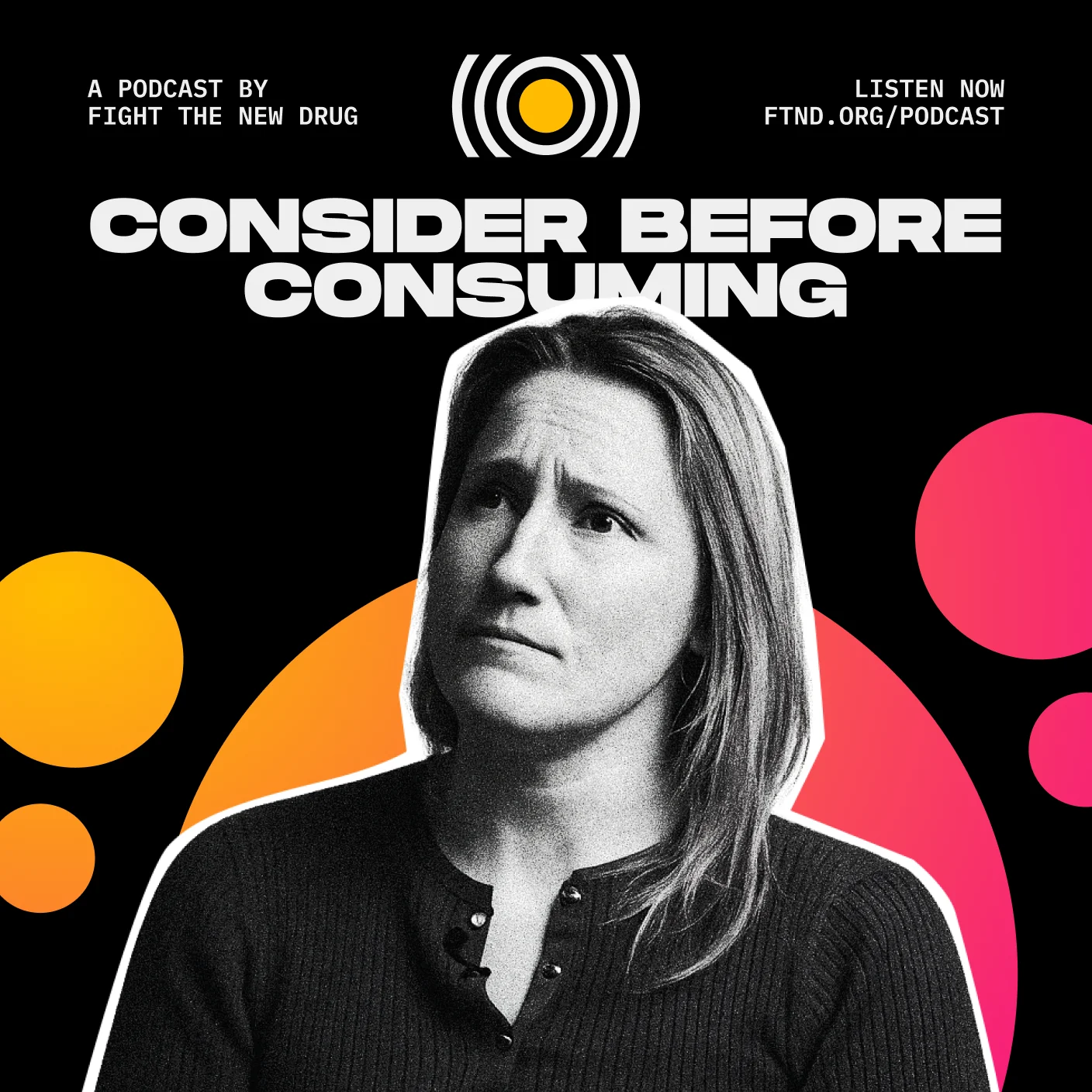
Episode 165
I Was Drugged and Assaulted By My Husband For Years
Available wherever you get your podcasts
This episode includes discussion of sexual abuse and trauma. Listener discretion is advised.
What happens when the person you trust most is secretly violating that trust for years?
In this episode of Consider Before Consuming, Zoe Watts shares her story of discovering that her husband had been drugging and sexually assaulting her while she slept. Zoe opens up about the confusion and disbelief she experienced, why it took time to fully understand what had happened, and the emotional and physical toll the trauma left behind.
Zoe also discusses how abuse within marriage is often minimized or misunderstood, the harmful cultural messages that blur the lines around consent, and the disturbing online communities built around sharing and consuming nonconsensual “sleep content.”
After her story became part of a major CNN investigation into online sexual exploitation, Zoe founded End Eye Check, an advocacy movement focused on raising awareness around drug-facilitated sexual abuse and supporting survivors.
In this episode, we discuss how sexual abuse can hide within long-term relationships, why some survivors struggle to recognize abuse right away, how online communities normalize exploitative content, and what healing can look like after trauma.
FROM THIS EPISODE
EPISODE TRANSCRIPT
Fight the New Drug (01:14)
Can you introduce yourself and share a bit about the work that you’re doing today through End Eye Check?
Zoe Watts (01:21)
Well, yeah, I’m Zoe Watts, and I am a survivor of drug-facilitated rape. It took me a long time to figure out that that’s what I was. I didn’t feel it, I don’t think. I couldn’t figure out, you know, whether I was a victim or a survivor.
And I think me starting up End Eye Check has been valuable to that, which at the moment, as it stands, we’re focusing on an international campaign for those who have experienced a drug facilitated rape. Yeah. And we’re looking to tackle safeguarding laws and legislations, laws that make things difficult for women to come forward with policing and through the judicial system. And basically a re-education, not only in schools and colleges, but those who have a mandatory duty of care to report. So it’s a big feat.
Fight the New Drug (02:24)
Yeah. Yeah, incredible. And your advocacy work today comes from, you know, a deeply personal experience. As you mentioned, you’re a survivor. Can you take us back to when everything first came, you know, to light for you?
Zoe Watts (02:43)
Yeah, that was that was the thing really. I was aware that something wasn’t right, but it wasn’t that something wasn’t right with me or that something wasn’t happening with me. It was my ex-husband. My ex-husband had been assaulting me whilst I was asleep, and on a few occasions, I’d woken up. But he took just enough responsibility to sort of pretend to wake up from a day’s sleep and say, oh gosh, I don’t know what I’m doing. I’m so sorry. You know, I hope this doesn’t happen again.
So through a period of time, he sought out medical treatment, just almost as if he was validating what he was doing. So at the time, I wasn’t aware that I was being sedated, but I had woken up to him having intercourse. Yeah. Only around about 2017, 2018, that he had confessed that what he had been doing all along was purposefully, intentfully premeditating, drugging me in order to have sex with me and take ages.
Fight the New Drug (03:44)
And did you, when you would wake up, fully understand what it was that had happened to you? Or is that kind of a realization that had come later?
Zoe Watts (04:15)
Yeah, I really didn’t compute. I mean, when you’re in a marriage, and you’ve already been with a partner, and we have been together for years, had children, to find that you’ve woken up and you want to experience a trauma, and oh my God, what’s happened to me? But to find a grown man on the end of the bed, like head in hands, going, oh my God, I don’t know what I’ve done, I don’t know what I’ve done.
Not even if it’s duty-bound, but as a wife, you want to protect your husband, and you feel that your husband is protecting you. It never, never in my wildest dreams would I be thinking that this is a purposeful act.
Fight the New Drug (05:02)
And if he’s providing kind of that explanation and that apology and acknowledgement of what had happened, then it leaves you wanting to accept that as your partner and wanting to say, okay, this was a mistake, I think is…
Zoe Watts (05:17)
Yeah, I mean, it wasn’t just me going to the doctors, as I said, it was he took enough responsibility to say, I would never do this to you, Zoe. I wouldn’t want you to wake up and find me doing this. I’m not doing it on purpose. There must be something wrong with me. And he would do all these online quizzes of, was he bipolar? This quiz would give him an 89% chance of him being bipolar. And can he talk to his GP?
Or was he a schizophrenic or did he have a borderline personality disorder? So, he was a very big advocate for that. It looked like from the face of it that I needed to support my husband who was on a quest for getting well.
Fight the New Drug (06:05)
And that kind of speaks to this, but this is something that, regardless of the way that the details of the situation look for so many people who are in a serious relationship or a marriage, a long-term relationship, it can be difficult for them to immediately recognize abuse when it’s happening to them. And why do you think that is for individuals, especially women who find themselves in this set of circumstances?
Zoe Watts (06:38)
I mean, I remember being a 15-year-old girl thinking if anybody ever hurt me, I’d leave it was so simple, very black and white. Yeah, but it doesn’t often happen that way. It doesn’t often happen that you know, you wake up one morning, and you’ve got a black eye, and you can leave. The abuse happens slowly. It’s as if you’re sitting in a bath and the hot water slowly on your body becomes very quickly accustomed to the temperature of which it is in. And for me, that was the case that thing started very early on. And again, he, he took the route of taking just enough responsibility. Oh my god, I can’t believe what happened last night. I’m so sorry. It must be because I’m grieving. I can’t believe that happened last night. It must be because I had a drink.
It’s very different than if you had somebody sat opposite you very callously saying I did what I did because I did it on purpose and I do it again if I could.
You know, it’s just dangerously so taking enough accountability, but to never change. But not to be real, not a genuine accountability, but you feel like you’re supporting somebody that you’re working in a team and therefore they would allow you the same grace. Not that you ever would, but.
Fight the New Drug (07:55)
Right. And especially when it’s someone that you love, right? You want to see the best in them and you want to believe what they’re telling you. And so when this is happening little by little over time, it really is so difficult to see.
And as you mentioned, when you’re not in this situation, it can be so easy to say, well, if this happened to me, I would just…immediately leave, but it’s really not that easy. And I think for people who haven’t found themselves in this situation or a similar situation ever, it’s easy for them on the outside looking in to say, well, why wouldn’t you just walk away? Why would this? But the truth is it’s so much more complicated than that.
And so I’m really grateful that you’re willing to have this conversation with me to help kind of shine a light on the complicated nature of abuse in a marriage, abuse in a long-term relationship, abuse in committed relationships.
I want to ask you a little bit about, you mentioned he would admit to just enough or take responsibility for just enough. When did he confess to what was actually happening?
Zoe Watts (09:08)
That was around about 2017, 2018. We had a church service on the different types of love. And as you said, you wouldn’t believe it anyway. You wouldn’t believe that this person that you’re making the same hopes and dreams with is capable. So when he sat me down and said, I need to talk to you tonight, I thought, oh, okay.
It was unusual for him to initiate a conversation like that, but he did. And I didn’t think anything of it. I carried on the rest of the day, you know, spent time with the children, put them to bed. And that’s when ironically he gave me a cup of tea and sat me down and said, you know, I said I needed to talk to you. Well, here goes.
And I think this is really important to my processing at the time. I’d already been in this situation where I was aware that something was happening, not fully aware. That led to a certain level of security. This is already a man that was telling me what he wanted to do together in our retirement when our children were older. So our future making plans were as promised, and we’d had that for the 17-odd years.
However, he went on to say how he had had an affair while I was pregnant with who at the time was my best friend at the time.
And at that moment, emotionally, mentally, physically, my world had stopped. And instantly my whole body thought, you know, that’s a husband, father and my children, is this something I can get over? Is it skippable, how long does it go on for? And I was in shock from that one confession. I didn’t know what to do with it, but my world stopped.
Then when he came forward and made the other disclosures to me as in boom, boom, boom, boom, just to let you know, I’ve been putting sleeping medication in your last cup of tea at night. was then the next thing that it was almost as if I was deaf. And then I’ve been doing that to tie you down. Okay. What does that mean? I don’t know what to do with that. Why would you, why? I’ve been doing that to take photographs of you.
And he sort of put in a disclaimer, as if to say the photographs were for my benefit. And then he says to have sex with you. And my brain was still stuck on that I had an affair while you were pregnant.
Firstly, which child? How long has it been going on for? Very cleverly done. But these are clever people we’re dealing with. They’re hiding in plain sight.
Fight the New Drug (12:22)
And I think for so many people who haven’t experienced this, they could only really imagine the depth of pain that that would cause and disbelief, right? You’re sitting there in front of a person that you believed to be one way and one type of person and that you knew them and that you understood your relationship. And then just getting disclosure after disclosure after disclosure of all of these things that are so different from what you believed them to be.
I can only imagine how absolutely devastating that experience had to be. And then to go back and kind of replay every single moment leading up to that to truly try to understand what you were dealing with.
Zoe Watts (13:12)
And with the disclosures, he went on to say, but I didn’t know what I was doing. I don’t want to be that way. I’m going to get help. know, it was very cleverly done.
Fight the New Drug (13:25)
Right. And constantly putting you in a position where almost, you know, if he’s a victim in it too, then it’s wrong for you to have a reaction or it doesn’t allow you the space to respond authentically with what you’re feeling in that moment as well, which is, I mean, so unimaginably awful.
And I want to ask a little bit about some of, you know, the emotional and physical effects that you were experiencing before you had fully processed the trauma itself. So, you know, maybe prior to that disclosure and then upon that disclosure and after, what was that process really like for you with that emotional and physical effects of that trauma?
Zoe Watts (14:18)
I think being with somebody in a domestic and sexually abusive relationship, even if you don’t realize it takes a toll on your emotional reserve. And I feel you live almost in that life-free spawn moment. And I’ve learned a lot about that, know, the power of sympathetic and sympathetic now that we’re living. And I recognize now that I was living and up until now still living in that state.
It was, you know, everything was for him and for his needs. My needs or feelings or emotions, they didn’t even come into it. It was as if I was a tool to serve him.
So I think that physiologically, apart from being exhausted, almost as if you go from one battle to the other and you just pick yourself up, dust yourself off, you revisit what that looks like for you as a family. You then have to…settle and then it happens again for waves that just keeps coming.
And just as I regain some sort of normalcy, emotionally, let alone physically you’re hit again as if you’re drowning and that keeps you in a very confused and unstable state whilst trying to parent your children and you recognize it you feel like the abuse is just happening to you.
But at the same time you don’t feel like you’re being abused because you’re looking at this person and while it’s confined to this person, we’re all okay. We’re managing. Yeah. During the time of the disclosure and leading up to it, I was practically just devoted to this man and his well-being. He would threaten suicide. He would suggest that I would leave him as his family did.
Was I gonna be like everybody else that disowned in his life? So there was a huge amount of pressure for me to be that person in his life and subsequently his needs and safety came before my own. I didn’t recognize I wasn’t in an unsafe situation because of course he loved me. He didn’t want to do this. But after this disclosure, my body became poorly.
I’d experienced signs and symptoms before as in recurrent, idiopathic, nonspecific urine infections, regular bouts of thrush, nausea, migraines, confusion, tiredness, which as a mother I put down to parenting four children and life really and having to deal with somebody who was apparently suffering from a mental illness whilst running a business. So that just seemed like the stress.
And you bump into anybody in the supermarket and they tell you how they’re tired and exhausted and can’t remember anything so you don’t think that it’s anything of significance.
After the disclosure I became a recluse. I didn’t know why but I couldn’t cope in a very different way. I couldn’t cope with seeing people, public spaces, sleeping, diet. I wasn’t looking after myself for the first time. I felt unable to manage. But again, the priority was still on him and his next appointment, but I became somebody that was requiring anti-anxiety medications and antidepressants. All the while still living with a man that could equally be raping me every night. And that’s a lot to process. It really is.
And then I think afterwards my body was after the disclosure to my family who called the police. It’s taken years to recognize what happened to my body, why I felt the way I felt and subsequently have been diagnosed with a functioning neurological disorder because my body just crashed, it just gave way.
There was such a pressure on being strong and surviving and getting through this. I didn’t give myself time. And one of the things it affects is my speech. I struggled. I had about a year and half worth of speech and language therapy as I was unable to speak properly. Confusion of words and numbness on my left hand side. So there’s been a real physical demand on my body afterwards.
Fight the New Drug (19:20)
And thank you for sharing all of that. think for so many survivors that we are able to speak with in the work that we do who are so courageous and brave to share their experiences as you have here, that is something we hear over and over again are, you know, the slew of effects that survivors are left with because of the choices someone else made.
And I think that so often people think again, well, why didn’t you just leave or, you know, assuming once the abuser’s out of the situation, everything should just be better. But it’s really taking a deep look at that trauma and how far those effects go, how long you’ve been experiencing them, and how long your body and mind have learned to survive with them, and how deeply that affects, you know, every other aspect of your life.
I want to ask you a little bit about consent and how your understanding of consent changed as you began to process everything that had happened.
Zoe Watts (20:32)
Yeah, when the arrest was made, I remember sitting with the detective at the time and he was fantastic. And I was almost making excuses about what had happened to me. He was taking it seriously. The only person that really had.
And I felt like, you’ve got to remember that you still love these people. I devoted 17, 18 odd years to him. It wasn’t going to go away overnight. And so I think that the police officer had to explain to me that if I was asleep or sedated, I couldn’t consent. And that took me time to process.
It’s different. There’s no right or wrong, there’s no better or worse. But I’ve said this before, you don’t have the same scars. If I had a car crash, I’d be able to point the finger, and say, look at that Wally, he crashed in my car, it’s his fault.
I think that because of what society had taught me, and even afterwards, a lot of people were saying to me, but you slept with him before. So what does it matter? Or maybe if you put out more, Zoe, this wouldn’t have happened. Or maybe if you were a bit more kinky.
So it really blurs the lines of consent. You know, for a woman to have to say, yes, I know I have consented to be with this man many times before, but on these occasions I didn’t, and here is why it’s wrong. But it did take a long time for me to break down.
It helped me because before I wasn’t seeing it as a violation and the crime in which it is. It helped me tremendously when he explained that if I was sedated or even asleep, he said if you were drunk and had passed out on the sofa, you still can’t give consent. And that really did help me.
Fight the New Drug (22:45)
And we’ve covered some of the misconceptions already, but what do you think people often misunderstand about sexual violence that happens within relationships broadly?
Zoe Watts (22:58)
I don’t think they think it can happen. Yeah. Just full stop. You know, that choice is taken away as soon as you’ve committed or already shared your body with that person. It’s like an unspoken rule that you can continue to do so even at times you’re unaware or don’t feel like it. I really think that that is a big issue.
Fight the New Drug (23:21)
Yeah, I think you’re right. And we’ve heard that from people as well. There are a lot of people who, partially because of porn culture and rape culture and all of these messages that our culture is inundated with, who truly believe like, you know, she couldn’t be raped, she was his wife. And it’s like, well, you can be raped within a marriage. You can experience sexual violence and sexual assault and sexual abuse within committed relationships. And as you mentioned, especially even after you’ve consented to sex on another occasion, and you know that what’s been consented to, when it’s been consented to, how it’s being consented to, just because maybe those things have happened one time does not mean they could happen another time. And perhaps most importantly, as you mentioned, if someone is unable to consent because they are unconscious or incapacitated, then that is sexual abuse, sexual violence, and rape, even within a marriage or a committed relationship. And it’s so important that we break any stigma that is happening where people don’t believe that’s true.
Zoe Watts (24:32)
Yeah, I agree.
Fight the New Drug (24:34)
At what point did you decide to involve law enforcement and what led to that decision?
Zoe Watts (24:41)
Well, becoming very poorly, my family were aware that he had had an affair. And I think that’s all they thought it was. They weren’t aware that he had committed essentially now these other crimes. But to me, it wasn’t a crime at the time.
So, I had a few months of that. And I remember I was having a panic attack. So was on the anti-anxiety medications and my sister said to me, look, if you can’t get over this affair, then you might not be able to stay together. You might have to move on. And I thought to myself, well, it’s not just that I’m dealing with. I became so frustrated and so broken that I ended up disclosing to her his other disclosures.
And that’s she very quietly came off the phone and must have rung my mum and my mum rang the police. So that decision to report initially was taken out of my hands.
And I’ve got to say, I felt a bit angry about it. I couldn’t believe that they were making such a big deal out of something that nobody else had. Professionals were aware of, funnily enough. I felt like my choice was taken away for something that was actually safeguarding me.
And that’s how, but it took a couple of months after the arrest and speaking with the officer for him to explain the magnitude of the crimes that have been committed against me that I then decided to prosecute.
Fight the New Drug (26:14)
And, you know, as you mentioned in that moment, you still have love for this person. And so to have your family stepping in in a way that felt like it was taking away your choice to reconcile maybe if that was something that you were on a path toward, but really seeing how much they were protecting you. You know, what was it like navigating reactions or assumptions from other people during that legal process?
Zoe Watts (26:41)
Awful. I had a few very good friends that I’m still friends with today who were my oxygen. Most of the other people sucked it out of me by, you know, launching vicious campaigns. My children were being bullied. He had, you know, posted been he was able to be very vocal on social media to set his version of narrative. But as a victim, you’re so scared to say the truth because it can be used against you in court.
So I would be in shops with the children and I remember this one occasion, this one one just portrait strips of me in the middle of Pets At Home, which is a big like pet store in nationwide here in the UK. And I was standing there with the trolley, kids all around it and there her and her husband and her children were.
And I found it really hard to navigate, very untrusting of who I could talk to, who I could and couldn’t let in my life.
Fight the New Drug (27:47)
Right, because the assumption from all of them based on the narrative he was spinning was that you were making it up or…is that kind of where it came from for them?
Zoe Watts (27:57)
Some of it was that he was just poorly mentally ill and I was stopping him from seeing his children because he was a brilliant dad. He was dating again. So had his new girlfriends would message me that I was making up or the best one was in court and before that, that I wanted him to.
Fight the New Drug (28:21)
Wow. And you know, speaking of being in court, what was it like sitting through a legal process where you had to hear how he tried to explain or justify what he had done?
Zoe Watts (28:32)
Well, I mean, I dreaded it. And that was another reason why I questioned whether to prosecute or not. This wasn’t and it’s awful, awful. It wasn’t one act on one occasion. I was warned that my history of my sex life with this man would be brought into question, of which it was.
I think they said to me something like, well, if you’ve used handcuffs in the past, you know, have you used them? They insinuated that because I’d ever used handcuffs in my entire marriage, that I was basically asking for it. And you just think, you know, you remember every intimate transaction, every conversation, every joke that could be taken out of context. And you just think, my God, I’m not going to get through this.
Because it’s very much like he’s innocent until proven guilty. You’re guilty of accusing until proven innocent.
Fight the New Drug (29:47)
Yeah, which is a devastating way our systems are designed, I think, to prosecute those who do perpetrate harm and really speaks to why so many survivors don’t speak out because they’re met with constant disbelief. And, you know, you were very young when the relationship began. Looking back now, are there dynamics that you understand differently today?
Zoe Watts (30:17)
Yeah, yeah, and I’m still processing that I still think oh god, it comes to something when your eldest son tells you that you were groomed, you know by your father essentially, 11 years older when we met.
Society has changed very much on that front, but it still has a lot of long way to go. But I do think that he found somebody that was young, impressionable, naive, innocent, and use that to his advantage and looking back, his treatment of me and the relationship, as the years went by, it was as if he just pushed the envelope. The level of abuse was able to escalate.You know, at what point, how many years of fantasy did it take him about doing that to me at night before he put it in motion? You you up and choose to do it.
And I think that the porn industry, I’m sure I’ll get a lot of flack for saying this, I’m sure, but it does have a long way to go for them to be strangulation sites, CNC sites. Why is that sort of material even being made? I think there’s definitely a culture that I’m more aware of now that wasn’t ever present in my mind before.
Fight the New Drug (31:40)
There’s certainly an abundance of content on very mainstream porn sites that does perpetuate very harmful stereotypes. But more than that, it displays sexual violence and abuse. And sure, some people could say, it’s acting, or it’s scripted, or whatever that is. But there’s plenty of content that’s not. There’s plenty of content that is glorifying harmful, abusive, violent acts and normalizing them for sexual, as sexual intimacy.
And so many people are seeing pornography at such a young age and that is really reinforcing, you know, these behaviors and making things normal that aren’t normal. And I think it’s really important that you don’t get flack for saying that, at least not on this channel, on this page, because that’s largely why we exist, is to help people understand that. You know, so many people just don’t know that that is, that that’s true.
Before this happened, did you have any awareness of how much, you know, exploitative or non-consensual content material exists online?
Zoe Watts (33:01)
No, not at all. It’s not a realm that I’ve ever dived into, but to have the amount of women that I have had contact through the End Eye Check movement is just crazy. It’s so sad. It’s great to know that we’re developing our own community. And as I said, these men don’t realize they’re creating an army. But at the same time, it’s devastating, absolutely devastating.
Fight the New Drug (33:29)
In your opinion, how can not just pornography but certain online, you know, spaces, forums, communities, how can they shape harmful attitudes around consent and entitlement, or violence, which we’ve spoken about a little bit?
Zoe Watts (33:45)
Stop making it, I think. It’s funny, because… I was having a chat with somebody the other day, and they were asking what the difference was between, say, the Tina Turner movie, What’s Love Got to Do With it? And there’s a rape scene in that. Yeah. But the thought pattern, it’s not just an endless movie. She’s creating her life story, and she’s telling that. And it’s a experience of, you know, strength and hope. Whereas, the porn industry are making material that simulates rape, sexual abuse or violence towards women, not for experience, strength and hope, purely for people to gain sexual gratification from. So in a sense, they’re molding inadvertently a society of people getting off on the torture or rape or strangulation of women. That is very different than telling somebody’s life story of: here’s a young girl, this is what’s happened, but look how she’s coped with it one way or the other. And I think that they do play a major part as well as these platforms play a major part in almost hibernating this culture. And I think it needs to be eradicated.
Fight the New Drug (34:58)
Yeah, that’s really well said. In addition to the content that’s made to supposedly simulate sexual violence or abuse, there is actual content of rape uploaded, of gang rape uploaded. And sadly, as a nonprofit, we have a website. And one of the search terms that leads people to some of our content the most is they’re searching for rape porn as a keyword we see in our Google Analytics, that rape porn is a key word people are often searching. And we have educational content about how harmful that is on our website. And we’re grateful they get there to learn about it. But it’s a very, very common popular genre of pornography that is, as you mentioned, fueling very harmful ideas and perpetuating harmful ideas that fuel sexual violence.
Speaking of these websites and platforms, your story was part of a larger CNN investigation into online communities built around quote unquote sleep content where users shared and consumed videos of unconscious women without their consent. And the investigation, I’m sure many of our listeners have seen this. If you haven’t, we can link to that in our show notes to that CNN, CNN piece. Highly informative, but that investigation also uncovered forums where users exchanged advice about drugging their partners and live streaming the abuse. So not only was this content being uploaded and individuals are learning from it, from watching it, but there were communities of people learning how to commit this type of sexual violence and abuse that you experienced personally.
And more recently, the platform Motherless, which is the one that was primarily noted in that CNN piece, was reportedly taken down by Dutch authorities after the allegations involving the non-consensual abuse material. But what was your reaction when you had heard that news?
Zoe Watts (37:07)
Yeah, I was thrilled. I think it’s really good to take a minute to pause to say that that has been reviewed and there was an investigation on that. I’m very well aware that this is a whack-a-mole situation. Most porn sites have subsections of categories of porn and they don’t know it and those sorts of things. So it’s not slowed this campaign down. Yeah. It’s not going to slow down the awareness or the work that needs to be done in the future.
It shows what we can do where there is the right type of reporting and the right type of social networking. I mean, 25, 30 years ago, a man wouldn’t be able to walk into a pub and say, I think I want a drug and rape my wife. Does anybody want to join me? Unfortunately, there are not the correct and appropriate moderators to these sorts of apps and these sort of platforms, which means that these men are able to easily find each other, build a community and enforce their crimes.
Yes, that is absolutely brilliant and I’m not taking anything away from that, but there’s so much more work to be done.
Fight the New Drug (38:13)
That’s right. And you know, it is a win to have that one site where so much exploitation happened taken down. There is exploitation still happening across platforms all over the internet, as well as offline. And there are communities across the internet where men are still having these conversations. And so there is a lot of work to be done still to eradicate this problem. But it is a win in and of itself, but it’s certainly not something that lets everyone say, okay, we can move on from this. There’s so, so much more work to be done.
And as you’ve become more involved in conversations around these online communities and platforms, what’s it been like to, gosh, repeatedly visit such a painful part of your own story in order to bring awareness to these issues?
Zoe Watts (39:11)
I am, and I’m not saying that this is right, nor am I saying this is helpful, but I’m quite disassociated from my trauma. Yeah, body feels it, it really does. You know, with the FND and the pain and mobility issues and all of that. But I think my brain…it’s as if I’m talking about somebody else. I can relive my story, but, and I’m doing a lot of work on that about connecting the emotion to what has happened to me. And at the moment, have as a coping mechanism, I’ve not been able to connect the two. And I know that at some point in time in this journey that I will be able to connect that. Yeah, but I’m not going to rush myself.
I’m grateful to be able to be a voice to the voiceless. And there are many women that have experienced what I have experienced, don’t feel like that they can speak out. Just to be able to say to one woman, I understand, as sad as it is, I understand. But I think that it’s very personal. Every woman…it’s a very personal situation.
Fight the New Drug (40:32)
And I’m sure you have helped so many women to feel less alone by sharing your experience in your story. Have there been moments for you where, you know, these others sharing their experiences have helped you to feel less alone in what you’ve gone through?
Zoe Watts (40:46)
Absolutely. I when I met Amanda, because it became real that she wasn’t just on the end of a text. Yeah, she she was a she was a person. And I view her and all these other women in a way in which the men who which abuse them did not say are people to be loved and supported and cherished and validated. And that’s something I’m looking to do, you know, with the support of other people to get us all together, you know, to build this army would be absolutely incredible. But it’s hard as well, because I probably feel more emotion reading their stories than I do knowing my own. Crazily.
Fight the New Drug (41:32)
And for any of our listeners, Amanda, we were able to have a conversation with as well recently. She is so incredible. I’m so, so glad to know the two of you have been able to meet in person. And she is also someone who’s experienced a similar situation and her story was shared in that CNN investigation as well. For any of our listeners interested in seeing, you know, that investigation again, we’ll link that in the show notes, as well as a conversation with Amanda as well.
And then going back to something you mentioned is, you know, seeing this trauma from others and feeling for that more than yourself. Why do you think that is? I think that’s something I’ve heard from many survivors as I’ve had these conversations. And I’m curious to know your perspective on why you think that is.
Zoe Watts (42:29)
I think for many years, my own wellbeing, and these were vulnerable young years of me being a young teenage girl. They were always put to one side. So that’s a skill, right? You’ve got to learn that. You’ve got to learn how to put a boundary in, how to put yourself first. And it’s refreshing, but it’s something that I’m learning. And I think that’s really important.
I remember a specialist coming alongside to say, just do one thing a day for yourself. And I thought, God, that sounds so stupid. You know, I’m running around after four children. But she said, just choose one thing, Zoe, for a day for yourself, whether that’s a coffee or a dog walk. And I chose to have a bath, half an hour bath of an evening. So I’d sit down and I only watched the Netflix episodes when I was in that bath. My kids were safe. And after a period of time, really look forward to my bath, just to have that time.
And I think that…I’m learning that my needs are important and that I need to recognize what they are because I’m so used to worrying about somebody else.
So I think that with that disassociation, you know, because I think I would have gone crazy of this thing that’s happened is kind of over there so I can cope. Slowly, it’s getting a bit nearer. I’m understanding on a deeper level, but I think when I hear it for other women, I just, don’t have the capability to even understand how or why somebody would do that to a person. So when I read it, it’s so raw because one, it’s happened to this beautiful woman that I am talking to that just thought she was happily married. And two, it brings my situation a little bit closer.
Fight the New Drug (44:32)
And, you know, as part of a healing journey, I think that makes so much sense where to survive your own situation for so long, you did have to, you know, make sense of things along the way for yourself. And so I think that is a common experience and makes sense that you would have to kind of keep it at bay until you’re able to bring it closer and closer.
You know, in addition to doing that one thing a day for yourself, having that bath, what else has been part of your healing journey, what has your healing journey looked like so far? And I guess to expand on that, if anyone’s in a similar situation, where would you recommend that they start a healing journey?
Zoe Watts (45:17)
I mean, here in the UK, I know you can report, but you can choose whether to prosecute. And I do say that because I reported, but didn’t prosecute straight away. And it served me because my memories were more real. Not real, but fresh. So I think you know that you’ve got that. A lot of women have said, God, I wish I’d have done something. It’s too late for me now.
The fear of if I report this situation is going to be taken out of my hands, because let’s face it, we’re often in a situation that we’re unable to control. So we want to keep control, put it back in the box, you know, as much as we can. But I think that doing, starting to treat yourself and to humanise yourself at a time when you have been dehumanised is vital. Again, it’s…just having a small handful, even one person, that you can just learn to be yourself. Because your identity is lost in with the marriage. When the marriage breaks, you don’t know who you are, you certainly don’t know what your future looks like. Your world has essentially been blown up.
So I think if you have at least one person in whatever capacity, whatever that looks like, whether it is online or tangible, that you can just bounce your thoughts and feelings off, even if it’s in a professional capacity, because we’re very often not confident in our decision making, because we don’t have you got to where we got to. We wouldn’t have allowed it if we’d have known.
So it’s all about starting to gain the confidence back, not on your truth, because that’s subjective, on the truth and stand confident in that. I think that’s really important to move on and to start to process.
Fight the New Drug (47:20)
Yeah, that’s well said. And, you know, for any survivors that you’ve witnessed their journeys through healing as well, what, you know, responses from survivors have really stayed with you? What stories from survivors have really stayed with you as you’ve been on this journey since speaking publicly about your experience?
Zoe Watts (47:46)
I mean, many. I think just the size of the women that are out there, that there’s these women that are just carrying on with their lives, devoted to their husbands and having their children and the impact that they’re maybe unable to work afterwards, you know, they’re struggling to make you parent, the financial abuse that they find that they are left with, which is similar to me.
I just find that they still have the capacity to love, they still have the capacity to want to reach out to me, you know, after what they’ve gone through. They want to be there for me. And I think that, you know, they’ve not let that vile act make them hard. And I think that’s honourable because it’s very easy to go on that spiral.
Some women have drawn strength from their children or looking after an elderly parent. I remember seeing on one social media post this woman and she heard what happened to me and she said, I’m off to talk to my six brothers. And I thought, God, that’s good. You know, she just wanted to have an open conversation with them about what their views were on it. And I think there has been some really courageous women out there and I’ve not forgotten them. I’ve not.
Fight the New Drug (49:17)
Thank you for sharing that. For anyone listening who may feel, you know, maybe they’ve heard this conversation and they’re thinking, hmm, I’ve been experiencing something in my own relationship, in my own marriage, in my own, you know, long-term relationship, and I’m feeling confused about it because, you know, maybe it didn’t feel consensual or it didn’t feel, something didn’t feel right about it. What would you want those women to hear?
Zoe Watts (49:47)
I think for me afterwards I did use various different agencies here within the UK. And it really scared me to know that I was talking to somebody outside of me because it felt like my controlling power was going to be taken away. But they did help with the blurred lines of consent, and they were very good and I don’t know what it’s like over there for you guys but I think that sometimes you have to accept the fact that you might have to think outside of yourself and your own understanding but very importantly to be your own advocate because there are many agencies where they have failed women many times through the police network that women have been failed. And it is a shame that we have to be our own advocate in that respect.
But I think, again, if you find the right agency or the right person to start breaking down what is happening in your life, that your confused reality starts to become a lot clearer. And therefore, if you are informed, you can make an informed decision.
But while you’re living with the irrational. It’s hard to be rational. Because the truth isn’t the truth, if you see what I mean. Yeah. I think that contacting some of these agencies is not as scary as it sounds and they are set up. It’s their bread and butter to talk to women like myself.
Fight the New Drug (51:25)
Yeah, well said. And there certainly are many resources available in the US as well. We will link some of them as well in this video. But for any of our listeners as well, please feel free to reach out to us if you need a resource. There are many, many professional, private resources available to you that can help you. And ultimately, we want anyone who’s in a potentially dangerous situation to have the resources and help that they need to be able to be safe and to be supported in the situation that they are in. Zoe, is there anything that you wanted to share today that we haven’t had a chance to speak about yet?
Zoe Watts (52:12)
No, I don’t think so. I think you’ve highlighted, you know, and given me the opportunity to highlight, you know, essentially what we’re looking to do with the eye check movement because we’re looking to end the eye check and set up campaigns in America. That’s in the works now. It’s getting so big. And British Columbia, Mexico and Australia.
So I think if many women who can support that and come alongside this campaign is fantastic. As I said, it’s too late for me, but the amount of women that it will help, the amount that have come forward is huge. And it’s such a cliche thing to say, you’re not alone. And it’s so sad it doesn’t even want to fall off my tongue, but we’re not alone and we have to draw on each other’s voices as strengths to stand.
Fight the New Drug (53:10)
That’s very well said. And the work of this movement is so important. So thank you, Zoe, for having this conversation with me.
Zoe Watts (54:03)
Thank you so much for having me. I really appreciate that.
Fight the New Drug collaborates with a variety of qualified organizations and individuals with varying personal beliefs, affiliations, and political persuasions. As FTND is a non-religious and non-legislative organization, the personal beliefs, affiliations, and persuasions of any of our team members or of those we collaborate with do not reflect or impact the mission of Fight the New Drug.
MORE RESOURCES FROM FTND





A database of the ever-growing body of research on the harmful effects of porn.