

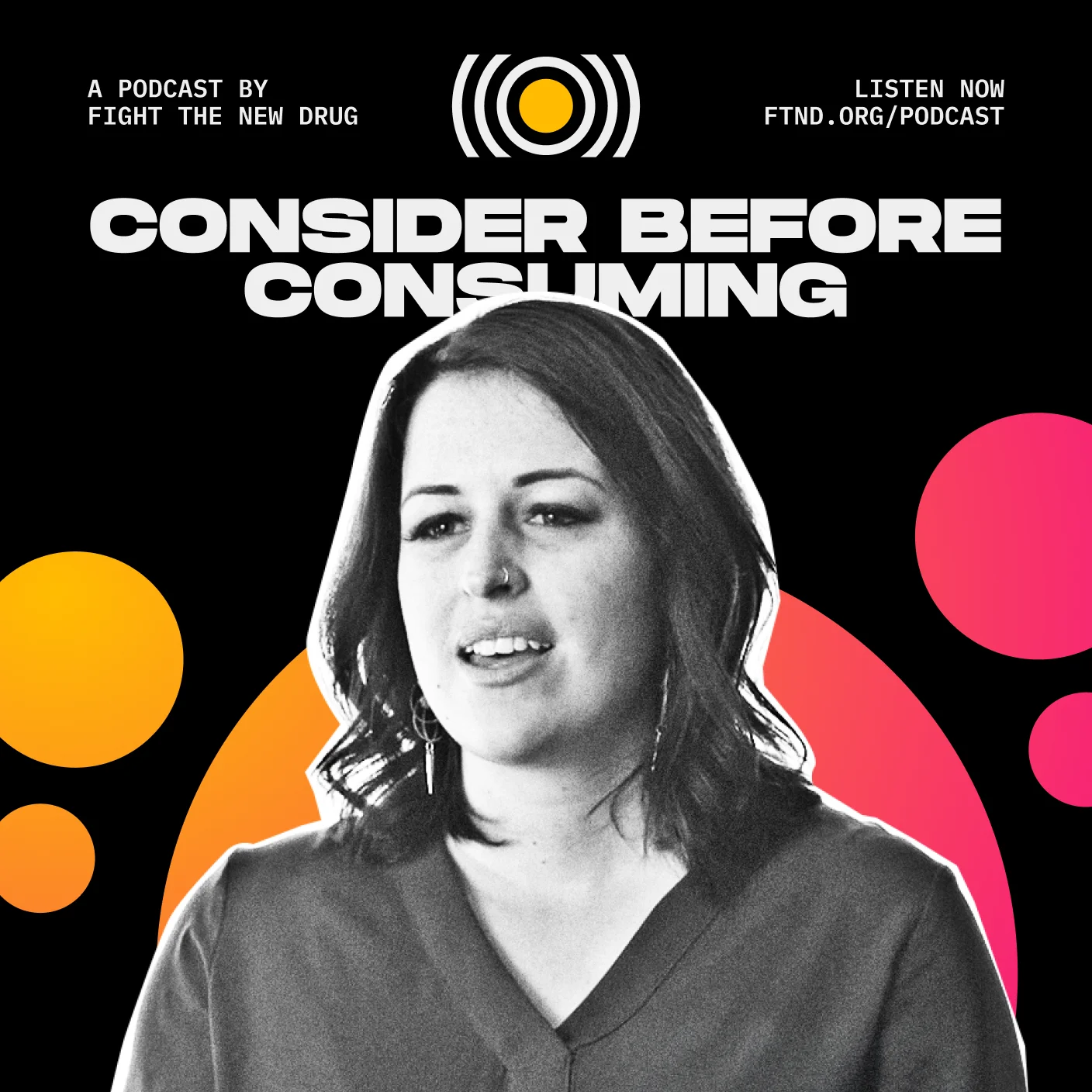
Episode 154
What Kids Are Learning About Sex From Porn
Available wherever you get your podcasts
Trigger Warning:This episode includes discussion of sexual violence, exploitation, and child sexual abuse. Listener discretion is advised.
Heidi Olson is a Sexual Assault Nurse Examiner and the Founder and President of Paradigm Shift Training and Consulting.
Drawing from years of frontline medical experience, Heidi explains why sexual exploitation and trafficking are often missed, how early exposure to pornography is shaping young people’s understanding of sex and consent, and why child-on-child sexual harm is becoming increasingly common.
FROM THIS EPISODE
- Article: How Porn can Fuel Sexual Violence by Lessening Empathy in Consumers
- Podcast: Consider Before Consuming Ep. 17: Heidi Olson
- Connect with Heidi: Paradigm Shift
- RAINN
- CAC Training Materials: Culture Reframed
- Heal Young Minds Conference
EPISODE TRANSCRIPT
Fight the New Drug (00:00)
Well, Heidi, thank you so much for joining me today. We always love having an opportunity to get to partner with you to bring awareness to these issues. For any of our listeners who’ve maybe heard your previous podcast episode, we’re so grateful to have had you on in the past. But for any of our guests who haven’t heard that first episode, can you share a bit about your role and the path that led you to the work that you do now?
Heidi Olson (00:23)
Yeah, absolutely. Thanks so much for having me. It’s always an honor to be on here and I love the work that you all are doing. So I’m a sexual assault nurse examiner, or we’re commonly called a SANE nurse, S-A-N-E, because you know we love our acronyms in the medical world. So if you hear me say that, that’s what I’m referring to. I’ve been a SANE nurse for a little over a decade now, which is crazy that it’s been that long.
Heidi Olson (00:49)
And, you know, it’s been an interesting journey of how I got there and sort of got involved in this work, but the short version of it is that…
The first time I ever had heard of a SANE nurse or a forensic nurse or encountered one was actually when I experienced my own sexual assault in college. And a detective was the first one who had ever said those words to me. And the irony is, I was in nursing school at that time, and I had no idea what a SANE nurse was. And so most people have not heard of forensic nurses unless you have encountered one. Um, and it’s such a niche type of nursing, you know, it’s not uncommon to be like, I didn’t even know this thing existed.
So the short version of what we do as forensic nurses is we’re trained to take care of people who have experienced sexual assault, and part of our job is collecting forensic evidence off of someone’s body after they’ve experienced a sexual assault. But also it’s more than that. People are holistic beings so we want to make sure there’s not any medical issues going on or mental health issues from that type of trauma. So we’re really assessing multiple layers of things.
So the way I got involved with it was I had just moved to Kansas City. Previously, I grew up in New Mexico, worked there as a nurse for five years. I was taking care of a lot of vulnerable patients when I was in New Mexico, but I didn’t have any training on what to do with trauma. We weren’t labeling patients correctly. It was just like, this is a bad kid, juvenile delinquent, whatever, kind of treat them with that attitude. If this is a kid making bad decisions, not at all considering the trauma that was going on. So when I moved to Kansas City, and I saw this job open up with, you know, to be a forensic nurse, I think it kind of pulled at my heartstrings for multiple levels, having my own history of experiencing this, but also knowing I wanted to dive more into understanding trauma and working with vulnerable populations. And so I applied, and they hired me, thankfully, and I actually went on to be the manager of the forensic program at the Children’s Hospital in Kansas City for several years. Then actually, the last few years have just been doing training and consulting on my own. So I’ve taken a little bit of break from being on the front lines, but it’s been a really interesting journey.
Fight the New Drug (02:56)
Yeah.Thank you for sharing all that, Heidi. I am so grateful for the work that you’re doing in this space. I first had an opportunity to interview at the Collision to Unsexual Exploitation Global Summit many, many, many years ago. And it was kind of the first time that I had heard about a sexual assault nurse examiner. And so the perspective you’ve been able to share with us over the years, it’s so important and so needed in this work. So, I’m grateful for your time today to share this with our listeners as well.
When you first began working in this field, what stood out to you about the young people and adults that you were encountering in medical settings?
Heidi Olson (03:33)
Yeah, so the interesting thing is, being a SANE nurse, of course, the learning curve was so high because it’s such a different type of nursing than anything else I had done. So we got tons of education on forensic evidence and the criminal justice system and genital injuries and all these things I’d never learned about before, really as a nurse. But no one was talking about sort of the societal trends, like why the things are happening that we’re seeing. And so what really struck me just immediately after getting off orientation were two things that, to this day, this trend is continuing, so this has not stopped, but the amount of kids that are sexually assaulting other kids is just astronomical and no one was talking about that. I mean, I purely put it together just by encountering it over and over and over and over again as a forensic nurse, so that was really shocking and disturbing to me.
But the other trend that I think I have seen skyrocket just as much is the amount of kids who are being exploited online, but they don’t realize it. It’s so normalized that it is not a big deal to them. They would never use the words exploitation or trafficking to describe what’s going on with them. And yet when we dig down into it, that’s exactly what it is. And so I think both of those trends and those highlights were not things that I was taught about or really that anyone was talking about 10 years ago. And it took a lot of digging into data and reading research and talking to other experts to put the pieces together of like, this is what we’re seeing in this is why, how do we start to make changes?
Fight the New Drug (05:05)
Right. And to your point, I remember when you started sharing about child-on-child sexual abuse you were seeing, and it was something that wasn’t being broadly talked about in this space at the time. We’ve made so much progress on that and bringing awareness to that. But I think it’s still something that there’s a lot of knowledge is missing, kind of from the space for a lot of parents, for a lot of young people. And so that’s something I would love to talk about a little bit more as we go, but to your other point about sexual exploitation and trafficking, you’ve shared some statistics about the percentage of trafficking victims that come into contact with healthcare workers. What makes it so challenging for healthcare workers to recognize when someone might be experiencing exploitation or trafficking?
Heidi Olson (05:51)
Yeah, so I teach about this all of the time now. And so I was just teaching some health care workers last week and, you know, ask them how many of you have ever taken care of someone you thought was being trafficked, and maybe one or two hands out of this, you know, huge class go up. And these are nurses who work in emergency departments, labor and delivery, behavioral health. They’re taking care of very high-risk, very vulnerable patients. You know, one or two out of a huge class says they’ve taken care of someone who’s being trafficked, when to your point, statistics show almost 90% of people who are being trafficked come into contact with a healthcare worker while they’re being trafficked. That means if you know we have thousands and thousands of trafficking victims coming into contact with healthcare workers but we’re only recognizing a small percentage of them, something is wrong, right? There’s something not being connected there and so what I’ve seen with healthcare workers is one, education is just not prioritized, and so you don’t know what you don’t know.
Fight the New Drug (06:41)
Right.
Heidi Olson (06:50)
So if we’re looking for my worldview of trafficking is what I saw in the movies, we’re going to miss our patients every single time because most health care workers think trafficking has to be someone who was abducted off the street, thrown into this white van, and sold into an international sex trafficking ring. It almost never looks like that with our patients. And so it’s the patients that we are taking care of who are high on drugs, who are homeless, who we’re labeling as a juvenile delinquent or prostitute or
Heidi Olson (07:20)
the psych patient, those are the trafficking victims. We see them every day, all day long, but we have not been taught what to look for, to look beneath the surface. And I think sometimes we get jaded with these really complex populations and don’t realize this person in front of me is being exploited. They’re not actually choosing what’s happening to them.
Fight the New Drug (07:39)
Right. And in the work that you’re doing now, you’re training hospitals and clinics. What kind of shifts begin to happen as staff begin to understand what exploitation can look like in a medical environment?
Heidi Olson (07:53)
Yeah, healthcare workers are so fun to teach because they, I would say most of them, right, we’ve all probably had experiences with healthcare workers that maybe we’re not the best, but the majority, they really care about doing the right thing. They want to help. They want to be armed with information to do a good job. And so when I teach, it’s so fun because I see the light bulbs go off. like, oh, I am taking care of this population. I did not realize it. And all of a sudden, victims being identified just goes through the roof if we’re able to especially to teach about interacting with people in a trauma-informed way to build rapport, to offer kindness, it starts to make all the difference in the world in terms of identification with this population. so, yes, we have seen identification skyrocket where we implement screening tools, where we implement protocols, where we do training. Of course, because we’re arming healthcare workers with the right information that they need, identification goes up. And so really it’s
It’s a huge win.
Fight the New Drug (08:53)
Right. And as you’ve helped healthcare teams develop protocols and response systems, what does trust-building look like when someone may not be ready to accept help right away?
Heidi Olson (09:06)
Yeah, I think that’s the other perception around trafficking that can be really challenging, is that people just assume when someone’s being trafficked, they’re going to come into contact with the professional and immediately ask for help. And that never happens. There’s so many, you know, complex dynamics to all of this and trauma bonding that’s gone on. And so most victims don’t see themselves as a victim. And it takes a lot of patience. And I think a lot of understanding complex trauma to really understand why
Heidi Olson (09:34)
they aren’t going to disclose or maybe accept help. But really, what we teach healthcare workers is it’s about treating them with kindness and compassion. Like it’s that simple of slowing down, sitting down when you’re talking to them, making eye contact, giving them choices, seeing them as another human being instead of just this is a box I have to check. They’re getting on my nerves. They’re being difficult. It’s, this is a trauma response that I’m seeing. How do I help create safety? And so really what we’re giving a lot of healthcare workers is here’s tools to learn how to build safety. Most patients are traumatized that are in the hospital, not just trafficking victims. Being in the hospital inherently can be really overwhelming and traumatic. So, you know, how do we create that safety? And a lot of it is just viewing people through this lens of kindness.
Fight the New Drug (10:18)
Right.
You mentioned briefly a moment ago some of the misconceptions about trafficking, that it always looks the way that we see it in the kidnapping and the white van. that certainly can happen. But as you mentioned, the majority of the time, that’s not what these instances really are looking like. Can you help any individuals listening who may be less familiar with what trafficking can actually look like, really understand how this is primarily looking today, how this exploitation is looking today?
Heidi Olson (10:46)
Yeah, so I’m gonna split it into two categories, which is kids versus adults.
So what we have found with kids is most kids who come into contact with health care workers who are being trafficked look totally normal. And by look totally normal, what I mean is you could not line up all of the kids in an emergency department or whatever and be like, that’s the one who’s being trafficked. I can see it with my eyes. They’re going to be dressed appropriately. They maybe are in school. We know about 50 to 60% of people who are being trafficked are being trafficked by a family member or an intimate partner. So we have kids that are being brought in by their parents, I have personally seen this, who are being trafficked by the parent. That’s a kid who’s probably never on a radar in terms of trafficking. So it’s going to look at kids very different, in that we can’t usually pick them out of a crowd, but what we have found with kids is that if we screen them, so if we ask the right questions the right way, so building rapport first and being incredibly compassionate and safe as we’re asking these questions, we get disclosures we never knew were there.
And I think again, where a lot of exploitation and trafficking is moving with kids is online. So we may have a kid who is living with their parents, and their parents don’t even know what’s going on. All of the exploitation is happening on their device, and maybe we’re seeing them for suicidal ideations because of the exploitation that’s happening, and no one’s asking the right questions. So no one has any idea this is going on. And so I think more and more that’s what it looks like. It’s the kid who maybe is, you know, still playing soccer at school and, you know, going through these normal teenage things, and also with having this mental health crisis because of this trauma that’s happening online. So, I’ve seen that more times than I can count. And again, kids don’t have the language, or they don’t even recognize what’s happening to them as exploitation versus adults.
I think, you know, of course, there can definitely be an element of being exploited online for sure. But I think with adults, sometimes we see more of the in-person abuse, the in-person, you know, being sold for sex. And those are going to be because of the amount of trauma that’s happening in those situations; these are going to be patients that present as they’re having a mental breakdown. These are psych patients. These are patients who are addicted to substances. These are patients that are unhoused that we see over and over again all the time in the adult world. But again, I think it’s the mislabel is why we miss it. I would say with adult victims, sometimes it can be a little bit easier to pick out who’s being trafficked in terms of they may have a trafficking tattoo by that point in time or be other indicators that feel a little more like a red flag at this point of them being trafficked for so long. And screening doesn’t work as well with adults because by this point they know, right? I know not to trust anyone. I’m not answering this question. I know what you’re getting at. I’m going to say no, no, no. And so it’s a little bit of a different approach with each population and looks a little bit different, I would say kind of in terms of working with these two populations. But it’s really at the end of the day, the same approach of really seeing them through this lens. If you are human, I care about you. How can we help?
Fight the New Drug (13:45)
Right. And you mentioned a little bit about trafficking. We’ve spoken about ways individuals are exploited online, both kids and adults. What are some other forms of exploitation that tend to be overlooked or misunderstood that you’re seeing today?
Heidi Olson (14:00)
Yeah, so I would say with kids, especially, just the normalization of…pornography. So if you’re under the age of 18, kids cannot consent to creating pornography, sending nude pictures, videos. It is illegal. And kids have no idea. And they don’t realize they’re being exploited when it happens. And so really what I’m seeing in terms of trends is we’re seeing just kids being exposed to porn at younger and younger ages that’s extremely desensitizing. So it’s not a big deal in their head when they go online, and someone asks them for a nude photo or a nude or to film sex or whatever it may be, because they’ve been watching this for years. So they’re really desensitized to this content. Maybe they send a nude photo video to someone. It never just stays with that one person, so it’s getting shared. Now people are inundating these kids on social media of, I saw your video, you’re really hot. If you send me more content, I’ll send money to your Cash App, or I’ll give you tokens for this video game, or whatever it may be. Now we’re talking about a sex act, in for something of monetary value, which, with a minor, by definition is trafficking, do I think that kid I’m taking here is gonna call what happened to them trafficking? No, in fact, what they’re gonna say is something like, I’m awesome, I got money sent to my Cash App because of this thing. All right, so I think that is really turning sort of the culture of exploitation on its head, where not only do kids not see they’re being exploited and harmed and taken advantage of, they think it’s empowering because they’re watching influencers and the and all these different people who are telling them it is completely fine to do this. There are no downsides. Who cares if you’re not 18 yet? And so I think that’s really where it gets confusing, is we’re not even asking about it as professionals. And when we do, we still may not get disclosure. So we may have a kid that’s thinking, this isn’t exploitation. This is fine. I’m choosing to do it.
Fight the New Drug (15:57)
Right, and for any of our listeners, the legal definition of trafficking, as you mentioned, is a commercial sex act induced by force, fraud, or coercion, or in which an individual involved is under the age of 18. So when you say it is illegal to be sending nudes, and many kids don’t know, I think many parents don’t know as well, that any kid who is self-creating, basically self-generating, legally, child pornography and then distributing it to others or sharing a nude they received from their friends, that is legally considered possession and distribution of child pornography. And so this is something that we are seeing all the time. Parents don’t know, kids don’t know. It’s so normalized, as you mentioned. And it’s something that we need to continue to bring awareness to.
Heidi Olson (16:41)
Absolutely. And while I haven’t seen like lot of kids be charged or anything, you know, like that, and I don’t know that that is even necessarily the most helpful road to go down, the reality is it is illegal. And especially when adults now get involved and they’re asking for this content and things like that, I absolutely think they need to be held accountable. And so there’s multiple layers of criminal activity happening that we’re starting to call normal, empowering, no big deal, no downsides to it. Well, we know that’s not true.
Fight the New Drug (16:46)
Right. Yeah.
And this kind of leads back to some of the child-on-child sexual abuse that you mentioned. You know, when you look at cases today where sexual harm is happening between children or teens, what kind of situations or dynamics are you seeing, and how are issues like pornography or the normalization of this type of content, how are those things fueling these situations?
Heidi Olson (17:31)
Yeah, so I think that historically, when a child would sexually assault another child, it’s always the root cause. Everyone says the offender must have been sexually abused themselves because this is not normal sexual behavior for a child. So they learned it somewhere. That has to be the root cause. But as we’re just seeing, again, this epidemic of kids who are being exposed to violent porn at really young ages, it’s not always sexual assault that is or trauma or something like that that is impacting why a child acts out. Now again, let me give the caveat. It can be multi-layered why a child is sexually abusing a child. Like, there could be lots of factors, so let me put that out there.
We absolutely are seeing kids where the root cause is that they are watching pornography over and over and over again. Kids have mirror neurons in their brain. They act out what they see. So of course, it makes perfect logical sense that we’ve got say an eight-year-old who has been looking or a kid who’s exposed to porn at eight years old, and now they’re 1,2 and they’ve been seeing this content for four years. You know, they’re addicted to this content at this point. They’re acting out what they’re seeing to get this chemical release in their brain.
It’s not a far stretch to see how that progression has happened, and we are hearing disclosures about it all the time, but it’s being bared out in research. There are multiple articles that now exist saying, yes, the younger child is exposed to pornography, the more likely they’re going to engage in forced sex or become a juvenile sex offender. Like, there are multiple things that are backing this up as well. And when we talk to professionals across the board, whether it’s teachers, counselors, healthcare workers, forensic interviewers, everyone’s like, yep, these, law enforcement, these trends exist. Kids are seeing pornography, it’s impacting how they’re acting out sexually, and unfortunately, many times it’s resulting in them sexually coercing, abusing, and harming another child because of what they’re seeing.
Fight the New Drug (19:27)
And so often it’s not that they want to cause harm to another child, it’s that this is what they believe sexual behavior is, quote unquote, supposed to look like. Can you speak about that a little bit?
Heidi Olson (19:40)
Absolutely. So I have thought that several times as a forensic nurse, when, you know, a victim’s disclosing to me, and I wonder did this offender even realize what they were doing or were they just following this pornography script and it doesn’t take away any of the harm that happened to the victim. It’s still traumatic, still awful, still criminal.
But as they’re describing it, you can see the template that’s been set for that offender, and they act out step by step what is being seen in porn all the time. So to give you an example, I took care of a 15-year-old female. She had a horrendous assault. The offender was a 15-year-old. She had, like, her assault was so violent. Her genital injury was awful. She couldn’t even sit down. I mean, it was terrible. I will spare you all the graphic details, but, as I was asking her, you know, kind of what leading up to the assault, what had happened, I asked her if she had been strangled by the offender because that’s a very normal act we see. We know this is a highly popular act in pornography. And her response to me was, yeah, I think he was trying to be sexy.
And it stopped me in my tracks because I thought, it’s so…crazy that we have gotten to this point where here this 15-year-old who she could recognize she had been raped, she was able to verbalize that, she could not recognize that strangulation was also a criminal activity that had happened or that that could have harmed her because she’s been so desensitized by pornography that it’s like, this is a thing that everyone always does. This is a part of foreplay or whatever. This part’s okay. And he’s trying to show me he’s sexy in it. But over here, I can recognize the line got crossed. And so we see that with a lot of kids where there are really violent, dgrading sex acts that happen, or even just filming sex acts, distributing them like we talked about earlier, things like that where kids are not naming that as exploitation or harm or abuse because they see it all the time. So it’s absolutely setting a really confusing template for kids.
Fight the New Drug (21:37)
Yeah, it’s so heartbreaking to hear these stories, and unfortunately, we’ve heard so many stories like this as well. We know kids are seeing pornography younger and younger and younger. They don’t have anyone really telling them, hey, this is not a realistic depiction of sex or healthy intimacy. And it’s so normalized from the time that they’re young that it is what they believe they are supposed to experience in a sexual setting or how they are supposed to behave, what they are supposed to tolerate. And we’re seeing that become increasingly violent as we’ve seen pornography become increasingly violent online as well. When kids and teens talk about their first experiences seeing sexual content, how are they describing those moments? And how early is that happening now in your experiences in the work that you’re doing?
Heidi Olson (22:28)
Yeah, think, you know, of course, if you look at research, it’s going to say anywhere from, you know, kids on average are exposed to porn. I’m sure all of you know this, know, ages anywhere from eight to 11, kind of looking at the study you’re looking at, which makes a lot of sense. And it’s heartbreakingly young.
I personally have talked to kids who have been exposed to porn at 3, 4, 5, much, much younger than that. And a lot of times it’s accidental. The first encounter with pornography is accidental. So we took care of a 12-year-old and she disclosed she had first seen pornography at the age of five. And it was because her parents gave her an iPad. There were no filters, parameters, nothing on it. She accidentally stumbled upon pornography the first time, and it piqued her curiosity. So then she went back and to the point that she was describing addiction, essentially saying, I have to look at this content and masturbate to it every single day or else like it feels like my brain’s on fire.
And what had happened is she had met this 16-year-old boy online and he had brutally sexually assaulted her in a parking lot and she could not recognize that it was abuse because again for the last seven years since the age of five she’s been looking at violent porn that this has been acted out on her and it doesn’t seem right in her brain it’s not being translated as this is a violation it’s I’m so desensitized here I can’t name what’s happening to me as abuse and so we’ve got lots of patients like that where it’s an accidental exposure whether it’s you they’re just innocently on their iPad or a phone or whatever it may be and something pops up or a lot of times it’s someone else is showing it to them. So another kid is showing it to them at a sleepover, on the school bus, at lunch, in the locker room, or whatever it may be. So even for kids who maybe don’t have a device, there are other kids who have devices that are showing it to them.
And so I think for many kids, that’s the first sort of seeing this content. And then of course it’s that, that I had all these feelings about it. Like it was kind of exciting and arousing, and I
I feel shame, and I don’t know what to do with it. I don’t know what to make sense of it, and I’m curious, and I want to see it again, and that sort of opens the gates to looking it up after that.
Fight the New Drug (24:35)
Right, and so many parents often think, well, that’s just the kind of one-off scenario. That won’t happen to my kid. That won’t happen to my kid’s friends. That’s not the case. Can you speak to that a little bit?
Heidi Olson (24:48)
Yeah, I think for parents who, and I get why, right? The mentality of it’s not my kid, we check everything that they’re on, we have parameters.
Think about it from a business standpoint. So the younger you expose a child to pornography, the more likely they will be a lifelong user. There is incentive in the porn industry to expose your child to pornography because then they will be a lifelong user. And so even if you do the best job in the world, the odds that your child or teenager are going to see pornography at some point are astronomically high. So I will give you a few examples from my own life in that
I do this work all the time, right? I’m highly aware of all of the, you know, dynamics around all of this. And I’ve still been accidentally exposed to pornography at times. So one time when I was working at the hospital, I typed homeless youth into my work computer. So we’ve got a thousand filters on our computers, right? And all kinds of stuff, cause we’re at the hospital. We don’t want to get, you know, any kind of spam or viruses on the hospital computers. I was just trying to find a picture for a presentation. Porn popped up on my computer, which, first of all, really gross genre for like me typing that in, okay? But second of all, I don’t know how it got past all of the security measures, but that was the first thing that popped up as I was looking for a picture. And so I thought, okay, here I typed in something totally innocent. There was no sexual connotation in it. I’m on a computer with a million different safety parameters in place, and it still happened. How much easier it is for a kid who has their own device in their room at night where maybe there aren’t all of these parameters? It’s getting really easy to get around or for that content to pop up.
But even just in talking to my nieces and nephew, I was talking to my nephew last year. He was 12 at the time. And I was writing an amicus brief for the Supreme Court around all things pornography. And he wanted to know kind of what I was writing about. So in a really age-appropriate way, I told him. And he knew exactly what I was talking about. He’s like, yeah, in second grade, a kid in my class told me when he would get out of class, he was going to go look up naked girls on his iPad.
It wasn’t hard for his 12-year-old brain to say, yeah, I’ve already heard kids talk about this, I know exactly what you’re writing about. And so he’s like, I told him he needs to tell his mom, which I was like, great job, buddy. And obviously, his parents have talked to him about this kind of thing. But the reality is, if it’s happening in my world, with the people I love and the work I’m doing, it’s going to happen to your children most likely, and I don’t want that. That is not something I find joy in, but I think we have to take off our rose-colored glasses to say, likely your child’s gonna encounter this content because it’s everywhere, which makes me sick to my stomach. How do we equip our kids so they know what to do and they are not drawn into the rabbit trail of endless pornography that they’re able to say I know what this is, and I don’t want to look at it. That’s really, I think, what needs to be the goal for us.
Fight the New Drug (27:46)
Yeah, and for so many kids that are existing in this world where culturally among their peers, pornography is so normalized, and so it is shaping their understanding of things like boundaries, intimacy, and consent. When you think about the way those things are being impacted for young people, what stands out to you?
Heidi Olson (28:04)
Yeah, so I did an experiment this summer where I was actually writing a research article about the Bop House and about how that’s impacting kids in terms of…
Fight the New Drug (28:15)
For anyone who doesn’t know what that is, would you mind just giving a brief overview?
Heidi Olson (28:20)
It is this phenomenon, it’s a group of girls, young, like ages 19 to 24, they live in a house together in Florida, and they all create pornography on OnlyFans. They are wildly successful, so they make millions of dollars, and on social media, they post, I mean, not only hyper-sexualized content, but they’re posting all the ways that their life is so amazing, flying on private jets, and they get to do all these cool things.
If you look at the amount of social media traction they have, so if you count all the social media followers from all the girls on all platforms, they have over 90 million social media followers. A lot of those are kids. So think about we have so many kids watching these girls and what they’re learning is that there are no downsides to creating pornography. You can make millions of dollars when you turn 18. Everything seems awesome. Everyone thinks you’re beautiful. You know, like you get to fly in private jets, like, who wouldn’t want to do this?
And so it’s very much grooming kids into this mentality of like, pornography is awesome. There’s no harm in it when the reality is, a research study actually came out this year that’s really fascinating. They talked to webcam performers, and what they found was many of the webcam performers were actually creating content under duress. Meaning, and of course, this makes a lot of sense if you think about it from a commercial standpoint, your subscribers get to call the shots. So you might go onto a website, camming site, and think I’m in control, well they’re not gonna pay you if you don’t do what they want. And so it’s not all rainbows and sunshine, but I digress.
My experiment this summer was I was talking to different teenage kids in my life. So a lot of my friends’ kids, you know, just asking them, you know, with their parents’ permission, do you know what the Bop House is? These are kids from various walks of life, like lots, some go to public schools, some go to private school, some are in very, you know, religious households, some are not, right? Varies kind of across the board. Do you know what the Bop House is? Every single teenager? Yes. Yes. Yes. Yes. Whether they had social media or not, they know about this phenomenon. And so it’s really interesting because I think, you know, 20, 30 years ago, if you had asked a bunch of high schoolers, do you know about these porn stars? It would probably be like, wait, who? What? No, or maybe a few of them. Not every single kid from any type of socioeconomic class. And so what I found with a lot of kids as well is that it’s so normalized and there is no, I think, stigma.
Fight the New Drug (30:35)
Right.
Heidi Olson (30:48)
around it at all. It’s just this is normal. They use porn language to describe everything, and they don’t realize it. And I’ve seen that with a lot of even patients I come in as they’re describing their sex act, their sexual assault. They only know how to describe it in very degrading porn-type terms. Like, even their body parts, they say it in very degrading porn terms. And so, and I think again, they don’t realize the deep impact it’s having culturally on them is that they don’t talk about sex in either anatomical terms or with intimacy or anything like that. It’s all very porn-infused. And to that point, porn is created to generate revenue, to give your brain a dopamine hit.
It’s not generated to teach about intimacy or consent. So kids are watching it to learn about sex, but they’re not learning about anything that’s healthy. They have no idea how to connect, how to communicate, you know, how to say no, how to set boundaries, what consent really looks like. It’s, need to follow what I’m seeing in porn so that I’m acceptable, you know, or I’m doing this thing, and it’s not about, I’m seeing you as a human being and attuning to you. I think there’s also high levels of entitlement that come with pornography, right? It’s about me. You’re an object to me. I’m going to use you. And so I’ve seen a lot of teenage boys where during a sexual assault, that’s very much the mentality, which is like, I don’t care if this is hurting you. I don’t care if this is degrading to you. I don’t care that you’re telling me not to film it. I’m still going to do it because you’re an object to me, and I’m entitled to this.
And so I think there’s lots of layers of how this has been infused into kids’ culture, but it’s everywhere. They use, like I was saying, they use porn terms whether they realize that’s where it’s coming from or not.
Fight the New Drug (32:31)
Right.
In addition to terminology they’re using and entitlement, have you noticed additional shifts in the type of content young people are being exposed to now, even compared to when you started this work many years ago, and the way that that exposure is shaping behavior?
Heidi Olson (32:51)
That’s a good question. I don’t know that we’ve necessarily tracked pornography genre trends when we’ve asked questions around pornography. But I would say, kind of anecdotally, what I’ve heard from different teenagers we’ve worked with or talked to is, I think, again, a lot of them are exposed through hentai. So we hear a lot of, of course, kids who are into anime then start looking at hentai, maybe you’re looking at different genres after that. That’s a huge gateway into all of this as well.
But I think in today’s day and age, because mainstream pornography is so violent, most of what kids are seeing is violence. There isn’t another alternative, really. It’s like kind of this is the first exposure, this is what’s setting your sexual template, this is what’s really normalized. So I would say in terms of kind of how trends are changing with kids, I would say there’s just more and more infusion of creating their own content because that’s been so normalized during many sexual assaults. There is some, in some way, shape or form, something was filmed, a picture was taken, it was shared, you know, it’s on Snapchat, like that almost always with teenagers now is like there’s gonna be some, not only did a sexual assault take place, now there’s this added exploitation of somehow this was filmed, recorded, documented, posted on Facebook, whatever it may be, which adds another layer of trauma for a victim. So I think that’s probably what stands out most to me is just sort of the digitizing the assault now. We see that a lot.
Fight the New Drug (34:20)
Yeah, yeah.
And speaking again to how violent pornography is and normalizing filming violent sexual acts, it makes sense that that is kind of the pipeline that we are seeing. From a developmental perspective, what happens when a child is exposed to sexual content, especially violent sexual content, before they’re ready to process it?
Heidi Olson (34:41)
Yeah, it’s traumatic. It’s trauma. Like really, if we break it down, a definition of trauma I really like is that…when we as humans, whether you’re a kid or an adult, when you’re overwhelmed by something, and you don’t have the internal or the external resources to cope with it, it creates trauma. That’s exactly what happens when we have a child and say no one has talked to them about sex. They have no context for this. They absolutely should never be seeing sexual violence. It’s never gonna be a healthy thing for them. And yet they stumble upon an endless amount of this content that they could watch for hours and hours and hours and hours.
They do not have the internal, they don’t understand what’s happening or external most of the time coping mechanism, meaning they maybe don’t want to say anything, they feel shame, they can’t, you know, maybe they don’t have a caregiver that’s consistently there, and so of course it’s going to create trauma. They’re overwhelmed, and they don’t know what to do with it. If we put it in different terms, imagine we had a 10-year-old, and we were like, you know what’s okay for you to do this afternoon? You can watch someone be raped in real life, right? Say that’s okay. Every adult would be like, that’s traumatizing, that’s not okay, that’s abuse, but it’s okay to do it on your phone? Why? Right? Like, there is no difference in terms of harming a child, so I think…developmentally, you know, of course it’s going to create early sexualization. We see it creating higher rates of anxiety and depression. It creates disturbances in relationships with kids in terms of with their peers, with their families. A lot of kids will become very isolated because they don’t know what to do with this trauma they’re experiencing, and seeing all of this violent porn, so they aren’t interested in the things they previously were, or they start acting out what they’re seeing. So developmentally, really, for a lot of kids, sets them off and down this path of a lot of mental health and even behavioral issues because they were not meant to see that type of content and I would even argue for adults there are multiple things that we’re seeing as a fallout for that as well so it’s not like it’s healthy for adults either but for kids you could definitely argue right there’s so many I would say abusive elements to it that showing a kid pornography falls into that category of abuse
Fight the New Drug (36:59)
Yeah, absolutely. You know, so often I think parents, caregivers, adults fear having conversations about this with young people because they’re afraid to spark curiosity in something that they think maybe they don’t have a curiosity in already. Can you help walk us through the difference between normal curiosity and behavior that signals harm or exposure? And what are some of the things to pay attention to?
Heidi Olson (37:26)
For parents and caregivers, that totally makes sense, right? Like, I think it can be scary, like, how do we have these conversations and do it in a healthy way? We have to talk about this. So that would be my first plea is, you know, we help create protection when we talk about this, but there is a way to do it, you know, that is developmentally appropriate.
That being said, we are sexual beings as humans, and so there are going to be different types of sexual behavior throughout childhood that are very normal. So with little kids, and you know, you can absolutely Google all of this, like seeing the different behavioral or behavior stages, you know in sexual development in kids, but little kids are curious. They’re gonna ask lots of questions about body parts and where babies come from and all those kind of things that’s totally normal, absolutely normal. And even little kids, they might wanna see your body parts. They want me to show you theirs. That does not mean anything has happened to them. They’re just trying to learn, and that’s how they move through the world.
Of course, if we think about kids going through puberty and kind of going into their teenage years, again, it’s gonna be normal that they’re curious about sex. It’s gonna be normal that they’re interested in their peers in a sexual way. That’s not abnormal. That doesn’t mean they’re addicted to pornography or anything like that, right? These are normal things that have existed for all of time where it becomes abnormal. And I will give the caveat, right? Every family is gonna have their own different values around this. And I’m not saying you should not instill those values in your kids, but where different sexual development becomes abnormal, so say with little kids, it can actually be a developmentally normal thing for a little kid to masturbate. They’re self-soothing; they don’t associate it with anything sexual. It’s when you cannot redirect. When you ask them, hey, stop, we’re not gonna do that anymore, and they are obsessed with it, or it’s very compulsive.
It’s never normal for a little kid to be looking at pornography, so that’s definitely an indicator that something’s going on. And it’s never normal for kids to be sexually violent or harmful or coercive towards other kids no matter what developmental stage they’re in that’s not normal behavior It’s not normal when there’s yeah aggression or telling kids to keep secrets or things like that and so I think again you can kind of look at the breakdown online, but of what’s normal and what’s not but there are behaviors that are normal and their behaviors that are not so shouldn’t they get into the Secret keeping the harming the coercive the forcing the manipulating
That being said, we have to have conversations with kids about pornography because, like we talked about, they’re going to see it most likely. I think what’s really important to know is that research has shown if you talk to kids about pornography, it does not make them more curious to go look at it. If anything, it’s empowering them. You know, of hey, ask me anything. This is a safe space, and that’s going to help mitigate instead of them feeling like I don’t understand this thing about sex, let me go Google it.
It’s, I can go talk to mom and dad because we’ve talked about this a million times, and this is a safe space for me. And that’s what we want. We want them to go to their trusted caregivers to have these conversations instead of going to the porn industry.
Fight the New Drug (40:30)
Yeah, well said. I want to ask you because you have such a unique lens into both child-on-child sexual assault as well as trafficking for both children and adults. Are there specific anecdotes or experiences that you’ve had in your work that, anytime you share stories of some of the things that you’ve seen, people are the most surprised to learn or find the most compelling in terms of, wow, we really need to be addressing these issues. I had no idea.
Heidi Olson (41:01)
Yeah, I think most of the things that we’re talking about are shocking to, you know, most people who are not doing frontline work, which makes perfect sense. But I would say really, when I am teaching about trafficking, what I’m pulling in for my healthcare audiences is, Hey, porn is playing a huge role in all of this, is contributing to sex buying, right? We, I’m sure you guys have done plenty of podcasts about that. We know it’s influencing demand. We know that many victims have pornography be created of them.
Like I said, with kids it is creating so much normalization and exploitation that when it happens to them, they do not recognize it. And I think that’s where I see the overwhelm with my audience. It’s like, man, all of our kids have phones. They’re all on social media. Are they seeing porn? no, this is hitting home now. How is this impacting my child? And so I think that’s kind of where I start to see the like the faces change in presentations or in trafficking, is like, no, now this feels real because my kids at risk because they have a device. And so I think that that’s important to connect those dots between anyone can be exploited if they have a device. Unfortunately, even kids who are growing up with lots of protective factors. I think it’s sometimes surprising to audiences that they don’t realize that there’s trafficking happening in the porn industry. I think it’s almost like if someone’s consenting to this thing, then there’s never gonna be criminal activity, which we all know that’s not true.
And I think also for a lot of people it’s surprising that when we talk about these trends they think trafficking it’s the abduction thing and then when we’re like no it’s actually way more subtle it’s the kid who’s coming in saying they sent a nude photo you know and got money for it that’s really shifting the paradigm for people so yeah I think a lot of things we’ve talked about are kind of the things that are eye-opening for community members and just professionals learning about this.
Fight the New Drug (42:53)
Yeah, I’m so grateful you said that because I think so many people think of pornography as an issue over here, and trafficking as an issue over here, or sexual abuse as an issue separately. And I think it’s really important to just note how interconnected all of these things are. And pornography is culturally so, so normalized, even though for many people we would say, know, sex trafficking is absolutely not okay. But pornography, it’s so normalized that they don’t realize how closely linked these two issues are within an industry, within an exploitative industry. So, especially in all the work you’ve done and having story after story that you could certainly share about these harms, I think it’s really important to note that some of the things you see most consistently surprise people are just the idea that pornography is exploitative, right?
Heidi Olson (43:45)
Yes.
Fight the New Drug (43:47)
Having these devices are causing additional exploitation in ways that so many people don’t realize. And I think that’s important that we all continue to do this work to bring awareness to those things. If communities, schools, or families want to be part of addressing this issue, what is one meaningful place to start?
Heidi Olson (44:05)
Yeah, it’s kind of what we’ve already alluded to, but we have to talk about it. We have to talk to kids about it. And the beauty with kids, and I love working with kids, they are so open to having conversations, and it can actually be really empowering for everyone involved. Like, okay, that wasn’t that scary. And guess what? They already know what I’m talking about, how do we work together, and how do I build trust with them? And so it’s actually, I think, really rewarding to be able to empower adults with, here’s how you talk to kids and it does not have to be a big deal.
And that’s what I’ve been working with healthcare workers on. If you guys are…taking care of kids who are seeing porn all the time. Why are we not asking them questions about it and about exploitation? And it does not have to be this big scary thing. They’re already seeing it. So we might as well call it out and have a conversation if we’re already talking about reproductive health and everything else. So I think no matter what profession or if you’re a parent or a community member, to do it in a non-judgmental way, right? We want them to feel safe. And there’s tons of great resources out there about how to talk to kids about pornography, those conversations and it doesn’t need to be a big deal. Just a little short conversation here and there, and on the drive here, and on a walk here, and at dinner here. So they’re constantly just getting little reminders, and you’re opening the door to say, I’m here if you see anything.
Fight the New Drug (45:22)
Right. You know, it’s such a good reminder because so often we speak with adults who are parents or caregivers or educators or medical professionals who are more uncomfortable talking about these things than the young people that we speak to in schools that we present to. Young people want someone they trust to be helping answer their questions. And this is the generation who with any question they have, they go to an internet search
Heidi Olson (45:38)
Yes.
Fight the New Drug (45:51)
browser, they ask AI, right? They have the ability to answer their questions with technology, and those answers will inherently be likely more explicit or provide less context a lot of the time than the answers they could get from a trusted adult. And as you mentioned earlier, building those relationships, so it’s not a one-time discussion, but it’s an ongoing conversation at the dinner table in the car, whenever something comes up that they have a question about, knowing they have a safe person to ask. So, such a good reminder that as adults, we often feel more uncomfortable talking about these issues than young people do. And we hear that from them often. So, encouragement to look up some of those resources that can help with navigating these conversations in a safe, healthy, and productive way. And then choosing to take the step to have them. It’s really…all we can do is try, and it does get more comfortable the more that we practice.
For any of our listeners who want to learn more and bring training into their communities, what’s the best way to connect with you?
Heidi Olson (46:46)
Yeah, so there’s two ways. One, I’m on LinkedIn. If you’re on there, you can look me up under my name, Heidi Olson. Another great way to get ahold of me is my website. It’s www.paradigmshifttc.com, and you can schedule a meeting with me, and I am happy to help with anything. If you have questions, you wanna pick my brain, if you have a complex situation you wanna talk through, whatever it may be, please reach out. I am happy to help if I can.
Fight the New Drug (47:22)
Thank you so much, Heidi. We’re so grateful for your work in this space. And I wanted to just ask you, in the work that you’ve done, you are seeing some of the darkest or heaviest instances of sexual abuse, sexual assault. What gives you hope as you continue on in this work?
Heidi Olson (47:38)
Yeah, that’s such a great question. I think what gives me hope is just seeing the beauty that exists with the patients that I’ve worked with and the families and the parents and the kids, and meaning even when there’s been something so tragic and hard, it’s like as human beings, we still have this spirit, you know, of, we want to keep moving forward and heal and process. And so I think it’s been such a gift to me to see patients in really hard situations that are…yeah, just the resiliency and the redemption that kind of happens down the road. You know, I’m seeing in the initial crisis, but hearing stories later on how they’re doing well. So, I think for me, what gives me hope is knowing I know I cannot fix every complicated thing that exists in the world. And even with patients I’ve had, that’s not my job or role. You know, but knowing I can create safety in the moment for them to feel safe is a good thing. And to know that we’re not gonna be stuck in that moment of trauma, right? We can choose and heal, and things can get better. And I would say even from my own life, right? Like it’s just me seeing that story progress of experiencing trauma at 20 and seeing my life, you know, 20 years later in such a different place is hopeful. So hopefully that makes sense. But just, I think the human resilience and spirit to keep persevering gives me hope, and kids are incredible. They’re so amazing. I love working with them. That feels like a gift.
Fight the New Drug (49:04)
Yeah, I think that’s such a beautiful reminder to any of us in this work and anyone following this movement or looking to make a difference in your own communities that each one of us can help be part of the solution on these issues. And just a reminder also to any of our listeners, if you’ve experienced a sexual assault or sexual violence, there are resources available to you.
Heidi, do you have recommendations for the path someone might follow if they find themselves in that situation?
Heidi Olson (49:33)
Yeah, absolutely. So there’s different hotline numbers that you can call that are open 24-7. So the national one is called RAINN, and you can talk to someone anonymously. They can kind of help guide what to do if you want to report or not report, you know, kind of the different avenues that you can go down and talk through pros and cons. I think that’s a really good place to start with sexual assault or even in your own community. You can look up, you know, sexual assaults, resources or advocacy and it’s going to be similar, just probably, more locally based where they likely will have crisis hotlines. That’s definitely, I think, kind of the best place to go where you can start to get some support and talk through pros and cons of next steps. Yeah, there are a lot of incredible people who are doing this work who are really great at holding space and advocating, and so yeah, absolutely reach out to some of those resources.
Fight the New Drug (50:24)
Yeah, well said and reaching out can help you find the right resources for the circumstance that you might be experiencing to make sure that you have the support and care that you need as you navigate that.
Is there anything else you wanted to share today that we haven’t spoken about yet?
Heidi Olson (50:38)
Yeah, I want to give a shout-out to two exciting things that I think will be helpful, especially for any professionals who are listening. So one, I worked on a really amazing two-year-long project with a group called Culture ReFramed, and our work is now published. And so if you go onto their website, what we’ve created, it’s under materials for CACs or Child Advocacy Centers, but it’s materials that are for professionals. So how do you talk to kids about pornography? Why should you talk to them about pornography? One-pagers you can hand to parents or to patients, and screening questions that you can ask. And we created it with a huge multidisciplinary team from people around the United States. And so it’s a really incredible resource. I would say one of a kind. We’ve never found anything like it. And it’s free. So that’s a really great thing for professionals to use in terms of with patients, clients, kind of any kids you’re working with that you think are struggling with problematic porn use. And then the other thing is I’m currently in the process of helping create a conference. Next year it’s called Heal Young Minds with several professionals as well. It’s geared towards frontline responders of connecting the dots between kids are seeing pornography, how is that impacting them, and how do we intervene. And so feel free to go to healyoungminds.com or contact me for more information.
Fight the New Drug (51:56)
Amazing. Thank you so much for sharing those, Heidi. And for all of the work that you’ve done and continue to do in this space, we are so grateful for you and your efforts. And we encourage any of our listeners to check out the resources you’ve shared to learn more.
Heidi Olson (52:09)
Thanks so much.
Fight the New Drug collaborates with a variety of qualified organizations and individuals with varying personal beliefs, affiliations, and political persuasions. As FTND is a non-religious and non-legislative organization, the personal beliefs, affiliations, and persuasions of any of our team members or of those we collaborate with do not reflect or impact the mission of Fight the New Drug.
MORE RESOURCES FROM FTND





A database of the ever-growing body of research on the harmful effects of porn.