

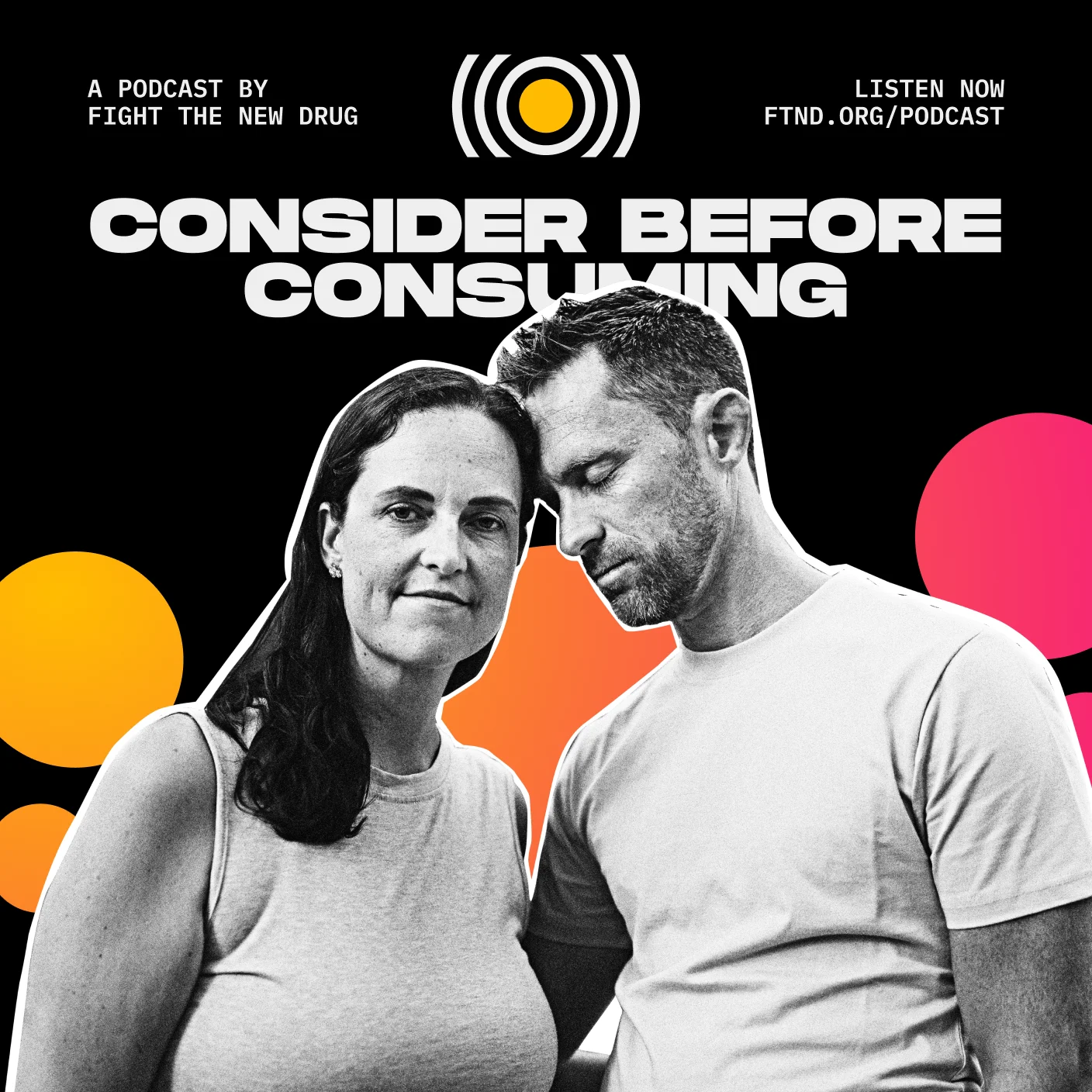
Episode 156
How Porn Thrived in Secrecy in Our Marriage
Available wherever you get your podcasts
In this episode of Consider Before Consuming, Richard and Heather share how pornography quietly impacted their marriage and what it took to begin healing together.
Richard reflects on his early exposure to porn, how his use escalated over time, and how things shifted when he began engaging with performers online and realized that one woman he interacted with was being coerced into the industry. Heather shares her perspective as a partner, including the changes she noticed before the truth came out and how disclosure affected trust and intimacy.
Together, they talk about secrecy, honesty, recovery, and why bringing pornography into the open became a turning point for both their marriage and their healing.
FROM THIS EPISODE
EPISODE TRANSCRIPT
Fight The New Drug (00:00)
Well, thank you both for joining me. I’m really honored and grateful and excited to get to have this conversation with you today. Can you just tell us a little bit about who you are as we dive in?
Richard and Heather (00:11)
Yeah, sure. Well, let me first say that I feel extremely privileged to be sitting with you today, all the way here in South Africa. I think it’s a testament to the work that you guys do, the fact that it’s got some real global reach. And so I’m just so privileged to be here with my wife today. I am Richard, based in Cape Town in South Africa. I grew up here.
Richard and Heather (00:39)
I have lived abroad for a bit; I’ve lived in Scotland for a while. I love the outdoors, I love trail running, being at the beach, being on the mountain. We have two teenage kids, boy and a girl. And yeah, what else?
You can take away everything I get to go for it. I’m basically not the female version of him, but we both grew up in Cape Town.
We actually went to the same boys’ and girls’ separate schools and met overseas in Norwich in the UK, even though we were in the same year in high school. And yeah, we’ve got a lot of shared history with our friendship groups over the years and we found out after we got together. It’s a small world. It is.
Fight The New Drug (01:26)
That’s amazing. Well, thank you both for being here. Richard, I want to ask you a little bit about when you think back to your early years. What was your upbringing like? How did conversations about sex and pornography fit into that environment?
Richard and Heather (01:43)
Yeah, so like I said, I grew up in Cape Town. I had, well, I have a very loving family. My mom and dad were together until my dad passed away in 2020. They’d been married for nearly 40 years by that stage. I have three younger sisters. Thank goodness for that, because I went to an all-boys school from right from grade zero all the way through. And so that was definitely helpful to be able to understand how to relate to.
My upbringing was very loving. There was no neglect, was no divorce trauma, no abuse, nothing like that. None of the things that you would traditionally expect to lead to somebody needing to seek out pornography or be exposed to pornography earlier than they should, which ironically sort of almost played into my shame cycle when I did end up seeing and becoming addicted to pornography. I started to wonder like, why would I get hooked on this when I had such an upbringing?
In terms of the conversations about sex and pornography, I think because it was a fairly traditional upbringing, perhaps there was like one conversation about sex, the talk, you know, that my dad had with me in the garage, where he just laid it all out and told me all the things that I needed to know. Probably too late because I had already seen pornography for the first time by then. And then that was a one-and-done. We didn’t talk about it again. So, no sort of disrespect or shame on them for the way that they handled it. That was just the way that they believed that they should deal with it. yeah, I’ve learned since then, being a parent that it has to be an ongoing conversation that you have with your kids, not just a one-and-done.
Fight The New Drug (03:40)
That’s very well said. And we’re going to talk about your story today. So I will direct a lot of questions at you. Heather, we’re also so grateful that you’re here. And feel free to chime in any time as well. But I just want to point out something you mentioned was that you had kind of a lovely childhood and no quote-unquote reason to have fallen into this. And I think that really speaks to how normalized this is and how much so many people are experiencing.
Richard and Heather (03:46)
Hmm.
Fight The New Drug (04:10)
regardless of the circumstances that they find themselves in. And so I think it’s so important to be having these conversations and sharing stories like this. Having that sex talk one time is a very common experience that so many people have, so I think it’s powerful and important that you’re sharing this today, so thank you.
Do you remember your first exposure to pornography, and what stood out to you most about that experience at the time?
Richard and Heather (04:36)
Yeah, definitely I do. So I was about 14 at the time. I was walking home from school, and somebody had thrown out a bunch of magazines into a recycling pile outside their house. One of those was a pornographic magazine, and so I picked it up. Curiosity caught my eye. Curiosity piqued, and I took it home. And I think the two overwhelming feelings that I can remember from that first experience was that it was like deeply intoxicating Just seeing these things for the first time as a 14 year old, know, like the hormones are raging You don’t know don’t quite can’t quite grasp what you’re looking at.
But the other thing that was interesting was that it felt like a safe space if that’s I know that probably sounds a bit weird, but it felt like a space that I could go to where the rest of the world’s troubles kind of faded away. And I think that was a theme that we’ll carry through in this whole story as we unfold. But I think that was the main thing for me. It felt like a safe space where I could just escape the world.
Fight The New Drug (05:49)
And as you got older and technology made it easier to access pornography, how did your relationship to porn change?
Richard and Heather (05:57)
Yeah, that’s a very good question. So in my early teenage years, it was limited to incidental curiosity, right? There was no ways I was going to go to the shop and buy another porn magazine because, you know, like I just, I didn’t want to be seen at the shop and I didn’t want to, like, spend money that I shouldn’t be spending. But I was able to keep that curiosity alive with, like, seemingly innocuous substitutes. Things like Sports Illustrated magazine or an FHM magazine, which were less obvious, right?
But then as the internet came online in my later teens, I started to have more access to more anonymous forms of pornography. And I remember renting one or two sort of soft porn movies from the video store when my family was out.
And then I also remember that by that stage I had kind of free access to the family computer and, yes it was in a general space within the home, it wasn’t in my bedroom, but once the whole family was asleep I kind of had free access to scroll for hours and, genuinely, I can remember that feeling of having looked at, I don’t know, thousands of images. Like, they would be burned into my brain as I fell asleep. Like, they would just be playing on repeat these things that I had seen. And nothing else does that, right? Like, I can go and watch a movie or I can go and look at thousands of pictures of great food, but it doesn’t burn into your brain like that. So that’s something that I remember quite clearly.
Once I got to university, I was exposed now to servers and hard drives full of downloaded content and it’s the first time it felt like I had actually access to anything that I wanted to see.
And by this stage I had kind of started to work out the type of pornography that I enjoyed watching and this didn’t actually really change over the years. It’s a bit of a strange one because I know that as people consume more the addiction tends to take them one of two ways. People will look at maybe more aggressive or violent or just taboo forms of pornography. For me, it was just more content. I just wanted to see more and more and more more of the same. I think maybe if I’m honest though, if it had been left unchecked for a few more years, it might have gone that way, which is a little bit scary.
Richard and Heather (08:34)
By the time I got to adulthood, I had worked out exactly what I wanted to see. And I even started to work out which actresses I wanted to see. And again, if I’m honest, it almost felt like I was beginning to form these fake, I can’t even call them relationships, like obsessions with certain…
Richard and Heather (08:57)
porn actresses that I’d seen. And then the final shift in my consumption as technology advanced was when I discovered live interactive platforms, right? And where I became obsessed with the fact that there was a real-time interactive novelty thrown into the mix. I I became far less interested at that point in the traditional, like, recorded sort of studio porn; I was turning to that almost every time.
Fight The New Drug (09:29)
Do you remember at what point this kind of progressed from something that you consumed occasionally into something that felt difficult to control?
Richard and Heather (09:38)
Yeah, so it’s difficult to pinpoint like a moment, but there was definitely a there was a time when I think that happened, right? So I mentioned earlier that I moved to live in Scotland for a little while. I was there for four years. But the move itself was very, very stressful. I was 23 at the time. I had never really lived away from home. It was my first chance at like being independent and like sort of finding work and making something of myself.
And so I moved over there with two friends, and we literally had no idea where we were going to stay. We had, I think, 600 pounds in our back pocket, and we needed to find a place to stay, get jobs and settle down. And that was unbelievably stressful.
I’ve learned that my body handles stress a little differently to some people. So I don’t feel anxious in my mind, but I’ll be like my stomach will be nauseous, right? So for years, actually, I had those initial years of being over there. I had this morning nausea every single day. And I think porn was a place that I could turn to that was familiar in this extremely unfamiliar environment, where even the language…they were speaking English, right? But you’ve heard some Scottish people, it’s difficult to understand them at times. And no disrespect to any of them, I love the Scottish people, but I definitely initially struggled to understand them. But yes, I think I became dependent on my pornography use when I was in this unfamiliar space and I was using it to just have that safe space.
Fight The New Drug (11:24)
Right. And with that culture shock and that stress, it makes sense that pornography is the thing that you took with you that was familiar from your previous set of circumstances. So I think that’s something many people experience as well. When you entered into a committed relationship and later marriage, how did porn fit into that part of your life?
Richard and Heather (11:32)
Yeah.
So ironically, and I’ve heard this story from a few people that I’ve spoken to, ironically, I believe that once I got married, I wouldn’t need pornography anymore. I think that’s a fairly common lie that people believe. But I quickly realized that this wasn’t the case. I hadn’t fully understood the reasons that I was turning to porn by this stage. And so this was a very naive belief.
If anything, being married actually fueled my use of pornography, I think. As fantasies began to build, I even tried to introduce porn into our bedroom. I remember on a few occasions when this became a reality, it left us both feeling very empty and unfulfilled. And unfortunately, the euphoric recall of those times would have me forgetting the feelings of unfulfillment and emptiness, and have me falling back into the same traps over and over again.
Fight The New Drug (12:51)
Heather, I would love to ask you, before everything was out in the open, what changes did you notice in Richard or in your relationship that made you feel like something maybe wasn’t right?
Richard and Heather (13:04)
Yeah, so initially, I mean, as Richard said, he’s had this he had had this problem since before we met. But I noticed it seemed to ramp up with Covid and him starting to work remotely, probably being alone a lot of the time. There was a big ramp-up around that time as well. And I started to notice he became emotionally withdrawn. He had such a short fuse with the kids. And I mean, he’s an amazing dad, but he would get angry with them for the smallest thing.
And I found myself having to kind of shield them from him. I only now realize that that was his anger at himself playing out in the family. But I felt like there was a moment, there was one moment where we had had a discussion or a disagreement about something, and we never fight by shouting at each other. It’s just not how we engage. But it felt like he just didn’t care. Whatever it was we were talking about, I can’t even remember. But I remember coming away from that conversation thinking, does he even want to be married to me anymore?
And was just so soul-destroying to realize, I think my marriage is falling apart, but I don’t know why. And this was shortly before he came out with his story.
Fight The New Drug (14:14)
And Richard, what made it difficult for you to be fully honest about the extent of your struggle, even with people close to you like Heather?
Richard and Heather (14:24)
Wow, that’s a great question. And I think it’s multifaceted, the answer. So if I’m honest, like the way that pornography made me feel, the safe space. I felt momentarily accepted. I felt momentarily validated, momentarily seen, and then all of the stresses of life faded into the background. But that feeling was so fleeting, and it always left me feeling empty and utterly depraved. And ultimately, our brains are wired to recall the good feelings. I mentioned it already, like that euphoric recall was there, and it would have me returning to the screen over and over again. And many, I attempted many times to put porn aside, right? And I believed that after so many attempts of putting it aside and trying different things to get rid of this…behavior in my life. believe that it would be inevitable that I was going to disappoint anybody that I told about this issue. I’m going to tell them about it, I’m going to come out, and maybe that will give me a little bit of a boost to stay clean for whatever, a week, a month, a year even, but at some point I’m going to disappoint them again. And that I think also, I didn’t want to disappoint people.
The other part, and this is maybe a little bit of a South African nuance, is I was clinging to the belief that I should solve it by myself. So we have a saying here in South Africa, a bourre marque plan. And that’s effectively Afrikaans for I’ll make a plan, I’ll overcome this difficulty myself, and I must find a way to solve it myself. It’s quite ingrained in our culture, and I’ve grown up with this mindset all around me.
The last thing I’ll say about this is that I believed that I would be seen by those closest to me as a pervert, as somebody to avoid. I believed that my family and friends would be disgusted by me and that they would distance themselves from me.
I believe that friends with daughters would view me as a predator, and having a daughter myself, this was a terrifying thought to even have. And I think all of these things combined to create an environment where I believed I just couldn’t and shouldn’t share any part of my struggle with anyone.
Fight The New Drug (16:51)
If we can go back a little bit, you had mentioned you started to seek out more interactive or real-time forms of online sexual content. What led you to seek that out more?
Richard and Heather (17:05)
I think the timing of it was it was around COVID, and I was starting to work from home remotely. So now I don’t have any colleagues around. So there’s a bit of loneliness. There’s also a bit more freedom with what I can and can’t do on my screen. Boredom probably played into it as well. Honestly, it was the novelty of it. And I think that probably was the progression, you know, we talked about the progression to two different types of pornography, it was the novelty, the thrill of real-time interactions.
I remember the, we’ll call it a dopamine hit, I remember the hit that I would get when somebody would just say hi to me, you know? And I wasn’t a paying customer on any of these platforms; I never put any money into it, but there was almost like this thrill when somebody would just say hi to me during the day. And maybe that even turned into a challenge to find someone willing to chat with me.
And then I think, sorry, last thing I’ll say, just the sheer variety of people on these webcam platforms is crazy. And they’re real, I mean, like I’ll say real, it’s not pre-filmed sort of makeup porn. It feels like it’s a more, like a real experience, I guess.
Fight The New Drug (18:33)
And when you were engaging with these performers, what did you believe was happening on the other side of the screen?
Richard and Heather (18:40)
So a few things. I believed first of all that this form of, I guess, camming was a way for young women to take an opportunity to give themselves a head start in life. I believed that they were there because they chose to do so willingly. I believed that they were having fun doing what they were doing. And then lastly, I believed that they could make lots of money doing what they were doing in a relatively safe and risk-free environment.
Fight The New Drug (19:11)
And I think that’s a really common experience that a lot of consumers have. Was there a specific interaction or realization that caused you to see that reality differently?
Richard and Heather (19:23)
Yeah, definitely, but it wasn’t one specific interaction or realization. It was over time, I met a lady on this platform. She’s from Colombia. And I started chatting freely with her, even though, like I said, I wasn’t paying. And she seemed willing to chat to me.
And as we interacted and chatted over time, I started to notice a few things that shifted that reality of my beliefs. The first was that I noticed she really wasn’t making a lot of money in tips during her shifts. I also noticed that her room was usually quite quiet. There was only like maybe three or four people in there. And I noticed that she was actually working ridiculously long hours. I’m talking like 15-hour shifts regularly, and one shift that I can remember was actually a 30-hour shift, which is crazy, right?
And then, and I think like I mentioned before, I work remotely and so sort of interacting with people on a webcam, I’d have like a knack or an intuition to be able to read body language that you wouldn’t be able to see perhaps if you were in person with someone.
And so I just started to notice subtle changes in her demeanor. I even saw her crying at one point after spending time with a paying customer in a private show. So those realities started to come crashing down.
And then, as we interacted further and actually got to know each other a little bit better, I remember asking her about what her reality was.
And she opened up in messages that she actually deleted very quickly. So obviously, there’s like there was someone watching, or she didn’t want to get caught saying these things that she was being asked to do things, or coerced to do things that she wasn’t really comfortable doing or didn’t want to do behind the camera. And she also shared that her employers had made her sign a contract which involved her forfeiting all her identification documents to them. So it’s really now starting to feel like a trafficking situation. And she even mentioned that she was being forced to work such long hours because she wasn’t making enough in tips to pay for her studio rental.
And all of these things combined with the fact that it was around that same time I stumbled upon your guys’ podcasts. And saw that bit that you guys did about OnlyFans and the reality of what’s happening there, it just meant that I saw it completely differently and saw what was actually happening on the other side of the screen.
Fight The New Drug (22:25)
And how did that affect you emotionally to learn that the women you’ve been chatting with, you know, maybe weren’t participating freely, you know, or consensually?
Richard and Heather (22:38)
Yep, I guess I was broken for her in the situation that she found herself in. But then I think for the very first time I felt completely disgusted at myself. I felt disgusted at the fact that my presence in her room was driving the demand for her to even be there. I felt anxious for her future. I felt anxious for…what she was going through and at one point I even remember trying to think of ways, this is me like awake at night at two o’clock in the morning thinking about these things when my family is sleeping around me unsure of what’s going on with me but I remember being awake at night trying to think of ways that I could help her to learn a skill to be able to get out of the situation she was in and it was completely exhausting to go through that and I was really robbing my emotional time from my family, which wasn’t fair. Yeah, it was very difficult to walk that line of anxiety about her, and then also stealing time and emotional energy from my family.
Fight The New Drug (23:54)
What eventually led you to open up to someone about what was really going on with you?
Richard and Heather (23:58)
I think I could see the degradation of my mental state happening. I really started to see those things that Heather was mentioning. I was angry a lot of the time, but I started to lose joy in the simple things that I have always loved, like being outdoors and going to the beach and running on the mountain and spending time walking with my dogs and walking with my family, going for hikes, going camping, all of those sorts of things. I just didn’t really want to do those things anymore.
Then I also sat one afternoon and, in my head, just played this movie forward. Like, where is this going? Where, what’s gonna happen next? Lik,e I’m gonna get caught at some point looking at the things I’m looking at. I can’t hide this forever. Then what’s gonna happen? My marriage is gonna fall apart. The kids are gonna, I don’t know, they’re gonna not want to be around their dad and then you know the movie plays forward from there, and so that was quite scary.
And then obviously the reality of what I had come to learn about the industry really, and then I think the final thing, final nail in the coffin that made me think I’ve really got to talk to someone about this was just hearing more of your guys’ podcasts and the constant message that you’ve got to tell someone. You’ve got to tell someone. You cannot fight this alone. You cannot keep it a secret. It’s not going to go away if you keep it a secret.
Fight The New Drug (25:37)
And how did that first honest conversation change things for you internally?
Richard and Heather (25:43)
So the person that I told was somebody that I’ve known for years. I think that’s important. And he’s in a similar stage of life to me, and he has some relatable struggles that I know about. So I really hope that he would be understanding and caring. But that first conversation was still terrifying.
So we run together almost every Sunday morning we go for a run and the conversation usually flows pretty freely. I mean, I guess about as freely as two introverts out of breath running up a hill can be, right? But for the two weeks leading up to that, I remember it was basically just complete silence. Like I was trying to find a moment to tell him what was going on. And it just became unbearably awkward at one point. And I just blurted that. I told him the whole story. And he just listened. He actively listened to what I had to say. There was no judgment. He asked some pertinent questions, which really got me thinking about certain things. And I think that for me was the first time that I had this glimmer of hope that I could tell more people. Just the way that he was so understanding and non-judgmental, and let me know that he could relate to what I was going through.
Fight The New Drug (27:09)
And what was it like to tell the full truth to Heather? What fears did you carry into that conversation?
Richard and Heather (27:13)
So if I thought that conversation with my friend was terrifying, telling Heather was even more, right? Because of high stakes, right? We had been married for 17 years by that point. And I knew that there was a chance that this would be too much for her to hear and to endure. I knew that my unfaithfulness had reached a point where she could rightly walk away from our marriage. But I also knew that it would be deeply hurtful for her to hear the whole truth.
And I love her very much, and I wanted to protect her from the hurt that I was causing through my actions and my addiction. And at the same time, I also knew that I needed her day-to-day support if I was going to endure this battle long-term. And so, like caught in this dilemma, I needed her to understand why I was withdrawing from the family as well, and that it was genuinely…and that it genuinely wasn’t what I wanted for our marriage. The other fear, of course, was that I couldn’t promise that I wouldn’t fall again. And I’ve had a few stumbles since that first conversation. My ongoing recovery is definitely not like a linear, not linear. And some days are a real struggle, but it’s been far easier for me to share those now, as they happen, and now that we understand each other so much better.
Fight The New Drug (28:47)
And Heather, as Richard began to share more honestly, how did you start to understand what had been happening beneath the surface?
Richard and Heather (28:58)
I think long-term, it was a relief. Obviously not initially, but coming out the other side to know that I hadn’t lost the man I loved. The last year or so before he told the full story, it felt like he’d lost interest in me, as I’d said before. I even thought maybe he was suffering from depression. As he’d mentioned, he’d withdrawn from things he loved.
Richard and Heather (29:24)
And I started to see that he’d been struggling with this addiction all along, and I’ve been sucking the life out of him, sucking him deeper and deeper into this absolute despair. But starting to understand that kind of gave me a glimmer of hope to see that, OK, it’s this that’s causing the problem. Yeah, maybe we can work on this and work on it together.
Fight The New Drug (29:45)
I would love to ask both of you, how did this experience affect the way that you saw your marriage and the sense of safety within it?
Richard and Heather (29:53)
I’ll go first now because obviously the trust was broken initially with the infidelity and it’s took it’s taken a while to get to a point where I can honestly say we’re past that stage of hurt and betrayal but it took a lot of soul-searching and deep digging and deep conversations it did make me think back over some of our closest intimate moments over the nearly 20 years of marriage, and thinking was that a reenactment of something he saw or was he trying to bring that in or and that that moment those thoughts still come into my into my consciousness and and nowadays when they do we talk about them but obviously in those initial days of unpacking it together there was so much swirling around in our brains.
Yeah, from my side, I mean, I was just grateful to be given that second chance, right? To be forgiven and to be able to really unpack what had happened and then move forward from there. I feel like we’re in a very safe space now where we can talk about things as they come up. And honestly, the depth of the conversations that we’ve had since this came to light has been far…it’s far deeper than we’ve ever gone in our relationship prior to this. I don’t want to say it was a good thing, but it certainly shook us up. We probably needed that.
Fight The New Drug (31:29)
And for both of you, what did Rebuilding Trust look like once everything was out in the open?
Richard and Heather (31:36)
I think what was very important in the beginning was that Richard went for counselling with a counsellor that specifically works with addiction recovery. And I had my own counselling as the spouse of an addict to understand what addiction was and what he was going through, and to understand the thought process and the cycle of shame and all the things. And then to bring that back together, we went for counselling together a few months later.
And our counselor was amazing in asking the right questions that got us talking. She didn’t sit there telling us what to do or what to say. She would just throw a question into the room. And I remember one particular conversation. don’t even remember the question, but I remember Richard’s answer surprised me because I had no idea he was thinking like that.
So the counseling was great for bringing us to bring thoughts to our own forefront of thought, that we wouldn’t necessarily say in conversations. And then I think from my side to be able to rebuild that trust, was a tricky line to walk, right? So as Heather mentioned, I went for counseling with an addiction specialist, psychologist. And his advice to me was that you need to be honest, but you need to be careful about the level of detail that you’re honest with.
And so he said to me, a good piece of advice was that I should tell as much truth as I feel like Heather needs to hear, so that she’s got the whole like broad picture story, and then leave it in her court to ask any further details that she wants to know. So, saving her from the gory details, but then if she wants to hear what actually went on, or like or get into the nitty-gritty, then she can ask me, and then I’m going to be completely honest about it.
So that was probably a good piece of advice that I got from the counselor to just start to rebuild that trust and leave the ball in Heather’s court.
Fight The New Drug (33:40)
And I know you both have mentioned the place that you’re in now, and I want to congratulate you on the work that you’ve done to get to the place that you’re in now. But I do want to ask Heather, many partners who’ve kind of been in your position, it’s difficult to sit through their partner telling the story of what they’ve gone through, because there are maybe more details than you want to hear, for example, in this conversation that we’re having right now, where you’re not asking the questions.I’m asking the questions, and if you do feel comfortable sharing, I would be interested to know what your experience is like in moments like this, in conversations like this.
Richard and Heather (34:17)
Well, I think I’ve pretty much heard the whole story as far as what Richard has told me now. I didn’t want to know the gory, gory details, but I have asked questions about his engagements with, particularly the girl in Colombia, for example, because I think I didn’t want to get hit with any surprises down the line.
There’s definitely moments where he told the story a beginning and then counseling, and things happened, and then something else would come out, and it would hurt all over again, even though it hadn’t just happened. And there’s been several moments like that where he’ll say, I thought of something I want you to know, but I don’t want to hurt you. And it does hurt, but I’ve actually learned to embrace that hurt because I know that it’s part of the recovery process and
Yeah, mean, it’s not, luckily, I know we’re very lucky that from about a year ago, year and a half ago, he hasn’t had any major And so we haven’t had to navigate a massive fresh wound. It’s more uncovering things that have happened that I didn’t know about. But yeah, it hurts going through it, but there’s nothing that hurts me to the point where I’m like, you’re, I can’t do this anymore. Yeah.
Fight The New Drug (35:37)
And thank you for sharing that. I think it’s something, you know, many partners experience. And Richard, what’s your experience like hearing Heather say that?
Richard and Heather (35:46)
So every time I have something to share with Heather, I’m worried that it’s going to sting. And so I always ask her, please tell me if something that I say stings, like even if it’s just like, oh, I didn’t know that.
But she has been so graceful in the way that she’s handled all of the information that I’ve given her. And I think just the questions that she’s asked have been timed right, I think. So over time, we’ve unpacked this. It didn’t all come crashing down in one big explosion. There definitely was that very open and honest initial conversation, but we’ve slowly unpacked the details over time.
Fight The New Drug (36:36)
Thank you both for sharing that. I think where many couples in a similar position find themselves is struggling to start navigating intimacy again. And how did you navigate that in a way that felt honest and safe for you both?
Richard and Heather (36:51)
Well again, it was conversations, lots and lots of them. Richard was very good at allowing me to ask questions that in any other scenario would have been like, why would you even say that? Even to the point where I could ask him, what have you viewed today? He actually asked me to ask outright, direct questions because if I just said, how’s the fight going? He would say fine. Cause he’s going to cover it, cover himself.
But if there were any questions or something that was nagging at me, particularly in intimacy, where, let’s say you wanted to introduce something into the bedroom, I might actually ask, is this something you’ve seen? Is this something that’s coming from that history? And we’ve been able to unpack it and discuss it. So there’s safety in that. And I think the flip side of that is he’s almost been too scared to bring things into the bedroom because he doesn’t want anything.
to come from that side. Yeah, we had to kind of do a full reset of what our intimacy looked like. And I basically said to Heather, you lead for a while. Like, you tell us, or you tell me what you want and we’ll go from there and we’ll work it out from there.
Fight The New Drug (38:13)
Thank you for sharing that. It sounds like, kind of a commitment to transparency and honesty, both ways and allowing a lot of space and safety has helped you both in kind of this healing journey.
Fight The New Drug (38:26)
Once you committed to recovery, what steps made that process feel sustainable for you?
Richard and Heather (38:32)
Okay, I think we’ve already talked a little bit about those initial steps that I took. So seeing the psychologist, I installed the first thing he said to me actually, was you need to get some sort of software installed on your phone and just start to slow down your access to porn. Because I’m in tech, like I can, if I want to, I can see it, but I need things to slow me down and give me the chance to breathe and just take a moment and like work out if I really want to see what I want to see.
And so that happened. And then over time, I had to delete just a number of social media platforms that I was using. And the algorithms had me, right? Like, Instagram is no longer something that I interact with at all. I think mainly because that was the platform that I broke out of the camming platform to chat to this Colombian lady.
Yeah, so that’s kind of the initial steps that I took, but long-term and ongoing, I found and joined a community of guys who are going through similar struggles. It’s called STOP, which stands for Standing Together to Oppose Pornography. it’s just a community that’s based in Cape Town, set up by a guy who I’ve now become really good friends with. He’s been running it for about 30 years. And we just meet weekly on a Monday evening we meet and we just share the battles and the victories with each other that’s been super helpful.
Like initially obviously I was the supported one, I was needing a lot of support and it’s kind of grown over time to the point now where I guess I’m in a better space and there are some guys who are coming along who are really struggling and so I’ve moved more from like this supported to kind of a lead leadership or supporting role.
And then I think another important point is that not only that group, but having one or two people from the group that I can meet with for coffee. So, to go in a little bit deeper and just uncover some things that perhaps aren’t shared in a group setting. I found that super helpful. And then, as I said, spent quite a lot of time, not just being part of the community, but like giving back. So I helped them rebuild their website last year. I’ve printed a whole bunch of business cards that we’ve put all over the community.
The leader called him a Jack Russell Terrier. Once he got his teeth into that, he just didn’t stop. Yeah. Focus the addiction somewhere, something else to put his focus on.
Yeah. So I think that’s been quite helpful, not just being part, but like actively part of growing this.
Richard and Heather (41:14)
And so now we’re at a stage, we’re starting a new year, we’ve strategized how are we going to help people to really take it to the next level?
Fight The New Drug (41:25)
That’s a really beautiful progression in a recovery story to be able to find that community of support and help others to overcome something that you have been able to continue working to overcome. What differences did you notice in your relationships or daily life now compared to before recovery?
Richard and Heather (41:45)
Okay, I’ll try and unpack that because there’s a lot. Without exception, though, all of my relationships have deepened. Friends, family. I’ve had friends who now feel safe enough to share their struggles. Not necessarily with pornography, but similar struggles, right? Everybody’s got some experience in life that they’re dealing with. And it’s been very healing to me and to them to be able to open up about those struggles and to see that nobody’s got it waxed, right? Like, there’s the social media view of how people are doing, and then there’s the real view. And that’s just been very encouraging to dig a little bit deep beneath the surface of the small talk that sometimes takes years. I’ve got friends who I’ve literally had small talk with for 10 years and this has been a chance to deepen that relationship.
And then I think another one is that I’ve been able to share my recovery journey with my kids, and that’s been super rewarding. They get to see that I don’t have it all together as a parent and that I need their grace and their forgiveness when I get things wrong as well as we figure it out together. My kids have even been able to share this journey with some of their friends from school.
In fact, I heard my son saying just probably two hours ago, he said to a friend of his that he’s playing online with, guess what my dad’s doing, know? Told him the story. So that’s been really cool and hopefully that’ll give them an avenue also to just know that there is some damage to what they’re seeing. When they see it, right? Not if, when.
And then in my marriage, well, I mean, we’ve spoken about it in the last two years have been the most difficult but also the most rewarding as we understand each other better than ever before. And the level of intimacy that we’ve been able to reach just from having these intense and real conversations has strengthened our relationship more than you can even imagine. And then in terms of my daily life, I’m starting to get those passions back again, those joys, those little things. So I find joy in being outdoors again.
It didn’t come back as quickly as I expected it to, though, right? So it’s been about a year and a half. And I’m now only just starting to really enjoy those things that I loved before.
My son’s suddenly become keen on fishing. And so now I need to figure out fishing because I know nothing about fishing. So he and I are learning that together.
And then I’ve tried to get back into trail running, which was something I really enjoyed. But on my first jaunt, I really injured my ankle and so I’ve realized that it’s no longer porn and shame that are keeping me away from the trails. It’s just my aging body. So yeah.
And then probably just one other quick example of the joy that I’m getting from being outdoors again. Just this last weekend, my family and we went away with some friends and we spent the whole day swimming and jumping off rocks into a mountain pool.
And that’s just something that, like when I was deep in the grips of pornography, I would have found no joy in that. I would have been thinking like, how can I get away from here? Why is the internet so bad and how can I see my next thing? So those are memories that the kids are now gonna have that I would have robbed them of.
Fight The New Drug (45:26)
I would love to ask you a similar question. You’ve spoken a little bit about how your relationship, you’re talking about deeper things and more vulnerable things, but how has your daily life, maybe or your marriage changed since this has been brought to the light or been shared more openly and publicly and vulnerably?
Richard and Heather (45:49)
Well, I’ve got my man back. It’s good to have him. Definitely daily life, I’ve noticed that we’re more in tune with one another. There’s moments in the chaos of two teenagers, two dogs, three cats, three rats, our house is a zoo. We’ll just catch a look at each other, and there’s a connection that definitely wasn’t there before.
And I feel like we are just so much more in tune with one another and able to just…I can sense when he’s feeling down now, he can sense when I’m feeling down, whereas before there was a bit of a wall there. And as Richard said earlier, as tough as this journey has been, it’s been so incredibly worth it just for the deep conversations that have happened. I mean, if we could take the porn aspect out of it, it’d be amazing. But just the depth of our marriage has been so worth going through this tough time in the last few years.
Fight The New Drug (46:49)
For listeners who may be struggling alone or in silence, either personally or in their relationships, what do you want them to hear in this story? Your story.
Richard and Heather (47:01)
Well, yeah, from my perspective as the spouse of a porn user, if you are sitting there and you don’t want to share your story because you don’t want to hurt your significant other, I think I would have been far more hurt if I’d found out the hard way. I’m so grateful that Richard came to the point where he saw the industry for what it was. He saw the disgust and shame and decided to tell someone and speak up.It’s not worth keeping it to yourself, especially if you’re wanting to keep your marriage, to keep your love alive.
Yeah. And then from my side, think two things. The first is, and it’s been reiterated over and over again, tell somebody. somebody that you trust. Tell somebody that you know who would be able to relate to you in some way and start to break that false belief that you will be shunned and you’ll be outcast and just tell someone.
And then the second one is that what you see on the screen is not always what is actually happening. Like, there are some very terrible things happening out there in the reality of this porn industry.
And just, yeah, I’ve got to realize that it’s not what it seems. People are being really hurt and damaged, and it’s a horrible, horrible industry to be in or to be involved in in any way.
Fight The New Drug (48:46)
Is there anything either of you wanted to speak about that you haven’t had the chance to share yet today?
Richard and Heather (48:53)
I think I’m hopeful. I’m hopeful for two reasons. The first is that I think on a macro level we are starting to see the tide change a little bit. We’re seeing regulation around the porn industry happening at like a governmental level, and a lot of studies are being done into the damage that it does to individuals and to the relationships around them.
Yeah, and we’re starting to hear those stories of people who’ve been involved. So, like those voices are becoming a little bit louder and louder and louder. So that from a macro level gives me a bit of hope. But then on a micro level, every week, like I said, I’m attending these weekly meetings, right. And every week, I hear stories of guys who are willing to put in the hard yards to be able to combat this.
And it’s not easy. Some of the stories that they have to tell are really difficult to hear and to walk through, but there’s progress. So I can see the individuals making progress and I can see that the world is hopefully moving in the right direction. Slowly but surely.
Fight The New Drug (50:08)
That’s beautifully said. And my final question for you was going to be about what gives you hope and I’m so grateful that you shared that, and I want to thank you for being a voice that is undoubtedly giving other listeners hope right now.
You had mentioned that when you were in the throes of this struggle, you heard from this podcast about the harms of pornography, and I want to commend you both on the courage it takes to sit…publicly and vulnerably and share your story and something that has been a journey for both of you to navigate in different ways and know that sharing your story is helping to change the conversation, is helping to remove the taboo, is helping others to be able to overcome this challenge as I’m deeply grateful that you’ve given us your time today. Thank you.
Richard and Heather (51:00)
Thank you. Natale, it’s been a real privilege to be with you today. Thank you so much.
Fight The New Drug (51:05)
Thank you.
Fight the New Drug collaborates with a variety of qualified organizations and individuals with varying personal beliefs, affiliations, and political persuasions. As FTND is a non-religious and non-legislative organization, the personal beliefs, affiliations, and persuasions of any of our team members or of those we collaborate with do not reflect or impact the mission of Fight the New Drug.
MORE RESOURCES FROM FTND





A database of the ever-growing body of research on the harmful effects of porn.