

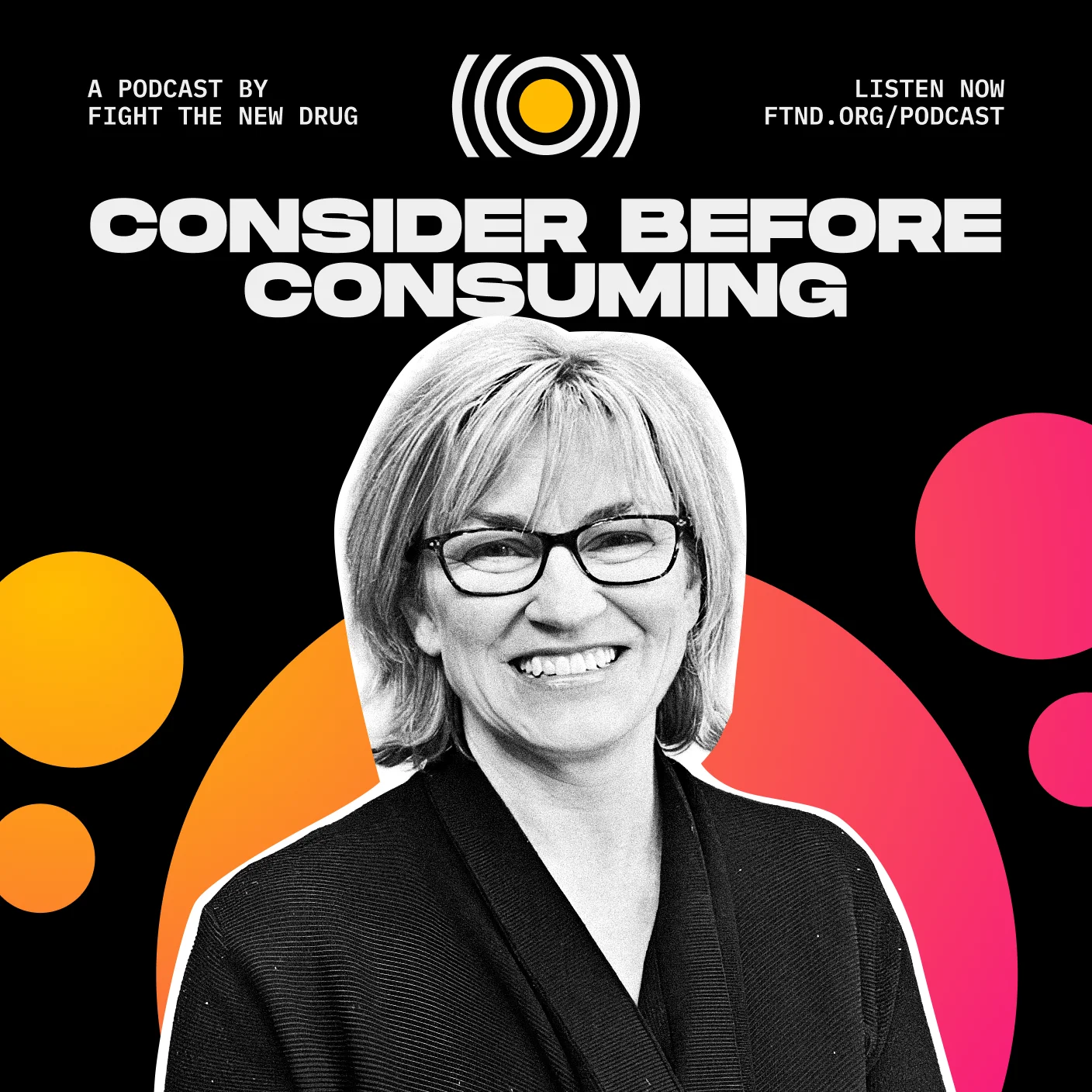
Episode 167
How Algorithms Are Shaping Sexual Expectations
Available wherever you get your podcasts
This episode contains discussions of sexual violence and child sexual abuse. Listener discretion is advised.
Clare McGlynn is a professor of law at Durham University and an expert on violence against women and girls.
Clare has spent years researching the ways pornography, technology, and online platforms shape culture, influence sexual norms, and contribute to harmful attitudes and behaviors. In this conversation, we discuss how algorithms influence what people see on porn platforms, why certain themes and behaviors have become increasingly common in mainstream pornography, and what that means for how people understand sex, consent, and relationships.
Why has choking become so common among young people? Does pornography influence attitudes toward consent? What is “sleep porn,” and why is it allowed on mainstream platforms? How are AI chatbots and deepfakes creating entirely new forms of abuse? Clare helps unpack these questions while exploring the broader cultural impact of pornography and emerging technologies.
We also discuss the growing popularity of “barely legal” content, the normalization of rough sex, and why technologies like AI and virtual reality may be amplifying harms that already exist online.
FROM THIS EPISODE
EPISODE TRANSCRIPT
Fight The New Drug (00:00)
Well, Clare, thank you so much for joining me today. I’m looking forward to having this conversation with you. Can you introduce yourself and the work that you do as an expert on violence against women and girls, telling us a little bit about yourself and how you got into this work?
Clare McGlynn (00:14)
Yeah, thank you very much for having me on the podcast today. I’m Clare McGlynn and I’m a professor of law at Durham University in the UK. My expertise is around violence against women and girls and particularly online abuse and the legal regulation of pornography.
What I’ve done really for the last 10 years or so is I’ve seen how there’s so many gaps in the law and the law just fails women so many times. And what my work is doing is trying to identify those gaps and then work with others to strengthen the law to better protect women and girls.
Fight The New Drug (00:51)
It’s amazing and this work is so needed the work that we do at Fight the New Drug, educating on harmful effects of pornography, violence against women and girls is certainly a large part of the scope that we address.
When you look at the current digital landscape, you’ve talked about how porn today operates more like a tech industry than something niche. How do algorithms shape what people see on porn platforms? And why does that matter for the kind of content that becomes quote unquote normal?
Clare McGlynn (01:20)
I think this is a really important point you raise. think it’s really vital that we understand that the porn landscape today is so different from what it was 10 or 20 years ago. And the algorithms are key to that, as you say, because 20 years or so ago, an individual would maybe think about what sort of pornography do I want to watch? And they then have to go out and find it. And it would take quite a lot of effort. But now, the pornography that most people watch is what’s fed to them by the algorithms of these big porn companies and all of their aim and motivation is to make money. So you get them trying to keep you engaged in the platform and they do that by feeding you more extreme content, more abusive content, very different content. And just like with social media, this is what we get fed. So it’s not necessarily an individual choice. So I think that’s what’s really important to understand. It’s the very large companies choosing what we want to see. And then we’re almost getting sucked into it. But the thing is, and you’ve probably found this in your work, people don’t really like to acknowledge that. Everyone likes to think that, especially in pornography, they’re looking at what they really like and what they want to see. And if you say to them, that’s actually just what the big platforms are wanting you to watch. doesn’t feel right and it doesn’t feel good. So it’s sometimes quite a challenging message to get across.
Fight The New Drug (02:57)
Right. And it’s so interesting because so many people accept that that’s true for social media, where they understand the algorithms rhythms a bit more. But there is a gap that we’ve seen as well in understanding how that is true within pornography. And we’ll talk about this a little bit more in a moment. But when we consider the age that so many people are exposed to pornography today, algorithms are dictating sexual templates rather than the other way around, as you have mentioned.
You’ve written about recurring patterns in mainstream porn today. What are some of the most common patterns that you’re seeing?
Clare McGlynn (03:33)
So I think that’s, so when we talk about the patterns, I think that follows from what we’ve just been discussing as well, because instead of mainstream pornography being this kind of vast range of all sorts of different types of pornography, in fact, it’s a relatively narrow focus and narrow scope. I mean, I guess my work focuses on what we might call some of the more extreme material. Patterns, you know, material around family relationships and incest around adult actors who are made to look like very young girls. Some of the material around strangulation. Sometimes people call it choking particularly. And then I guess there’s the whole range of kind of rape porn or non-consensual porn.
So, but I mean, that’s just, you know, scratching the surface. I suppose rough sex, rough porn, would be another kind of category really that could actually cover quite a lot of what I’ve just described. But some of that will include the material, you know, to do with like spitting and gagging and, you know, the facials, lots of that sort of, yeah, material.
Fight The New Drug (04:51)
Right, and so many people often think of those kind of categories as niche things, but really what we are seeing is they are patterns. They are patterns that we’re seeing across so much pornographic content that is so easily accessible online, which is different from pre-internet pornography. It really has escalated and changed in such a dramatic way.
I want to go back to choking, specifically what you mentioned a moment ago. You’ve pointed out in your work that choking is often introduced without warning in real life encounters. And that’s something that we’ve heard about as well from individuals who have been, you know, on a first date with someone and they kiss and the teenagers and then the boy chokes the girl and says, well, I thought that’s what she wanted because this is something that has been presented to them as normal. What does that tell us about how people are interpreting cues or expectations in the moment?
Clare McGlynn (05:50)
Yeah, so I think this is a really interesting issue, especially when we talk about it in relation to younger people and maybe even teenagers, because some of the data, I mean, there’s a survey from the United Kingdom that around a third to a half of those who are engaged in choking or strangulation aren’t seeking consent in advance for that activity. Now, on the one hand, that is shocking. It’s really concerning.
But on the other hand, it’s also not surprising when you think about just how common it is, because in pornography, it’s presented as just like an ordinary, another kind of standard part of sexual activity, not something that is so particularly serious you need to discuss and get consent in advance.
So I guess what I mean is I…it’s not that I understand when people, that’s mostly men, don’t ask for consent. It’s more just that in the cultural world we’re living of mainstream pornography, it’s kind of understandable. But I guess the other point about that is that for many women as well though, they say they feel uncomfortable in this, you know, being choked or strangled, but it’s still consensual, you know?
So it’s not that many women are saying, I was, you know, forced or assaulted, but they’re saying they’re uncomfortable and they didn’t really want it. And for me, what this tells me is that consent is not the be-all and end-all around sexual activity. You know, consent is like a minimum floor. You need consent, but consent doesn’t actually tell us what is ethical, what is good, what is positive, and any of those other things one might look for in sexual activity, for example.
So I think people often talk about going to the dentist or something. In a sense, I can consent to getting my teeth drilled in the dentist, but I don’t really want it. So I’m still consenting, but it’s not actually wanted. And I think we maybe need to think about consent in that way in some of these contexts.
Fight The New Drug (08:09)
Yeah, and I think there’s, I’d love your take on the idea that some women, especially young girls, will consent to having an intimate experience with a partner. And so, because they consented to having an intimate sexual experience, there’s this idea that they’ve blanket consented to any and every act that may occur in that instance. And, you know, someone’s idea of what they’re consenting to might be kissing or making out, and then suddenly they’re being choked or something they certainly didn’t consent to, but they’ve consented to this experience. And if that just is what they believe is part of it without knowing, especially for young girls, think that’s where things get really messy in terms of understanding consent within those instances. What are your thoughts about that?
Clare McGlynn (08:50)
I think you’re right. And I think what it means is we don’t have, and many young people don’t have as rich enough an understanding that consent isn’t just something that, yeah, you give it, say the beginning of an encounter, and that’s it forever after. It does need to be something that’s ongoing. You’re checking in with your partner about what’s happening there.
I think it also goes to, when we’ve just talked about rough sex. There’s research that’s done with, you know, younger people, when you say, what do you mean by rough sex? And people give all sorts of different answers, you know, because it’s such a huge sort of category. But what that means is that even if you had a discussion with someone about, you know, rough sex or like, that means so many different things to different people that, you know, you’d need to, or what ought to happen is deeper engagement in what that actually means because yeah, what rough sex means, I mean, let alone whether, that’s, you know, so much of that can be problematic, but even putting that to one side for now, you know, there’s just no agreement on what that actually is.
Yeah, so I mean, some of that’s about education, isn’t it? It’s about trying to get young people to better understand what consent is, although like I say, then going beyond just the minimum consent to what what does someone actually want to do?
Fight The New Drug (10:32)
Right. And I’m glad that you brought up terminology specifically because you’ve written about how using language like choking can actually soften what’s happening physically. So how does that kind of language shape how people process the experience afterward?
Clare McGlynn (10:51)
Yes, so many people, you know, before me have talked about this, this, yeah, the use of the term choking, which is what’s really common. But actually, what we’re talking about is strangulation. And I think that term is not used because frankly, it sounds it sounds concerning, doesn’t it? And what you call someone who engages in that? You call them a strangler.
And we’re used to that term being used in kind of scary movies, isn’t it? So choking is kind of used almost to minimize it in a way. I think what that, it just adds to the sense that this is okay and this is normal. And then if you are, a young woman who afterwards is thinking, this is really uncomfortable. I really don’t like this. But it’s called choking, and everyone talks about choke me on TikTok, or frankly, you go onto Amazon, and it’s choke me daddy t-shirts and all the rest of it. Am I supposed to actually want and enjoy this? And I think the language of choking doesn’t help us in that debate. We need to try and talk about strangulation, frankly.
Fight The New Drug (12:08)
Right. And for someone who maybe thinks those two terms are interchangeable, can you describe the difference between the two?
Clare McGlynn (12:15)
Yeah, so strangulation is the technical term for the external pressure on the neck. Whereas choking is, describes getting something stuck in your throat. So, you if you, you you eat, you eat something and you’re coughing, that’s choking. Whereas, yeah, the external pressure on the neck is the strangulation. So that’s the, that’s the medical difference between, between the two.
Fight The New Drug (12:43)
Right. And that really is a very significant difference in what someone’s experiencing, especially without any discussion about it or knowledge about it prior to it occurring. You know, we’re just seeing rates of this type of pornographic content and the influence it’s having on individuals increase pretty dramatically. And so it is really important that we’re having these nuanced conversations about what that is.
I want to ask you about…there’s a recent study that assesses rates of self-reported sexual aggression of men, and that highlights behaviors like persistence or continuing to escalate physically, even when there isn’t clear verbal agreement. It says that 91.5% of 18 to 34-year-old men, quote, “reported having recently used at least one of the strategies to get a woman to have sex who they knew did not want sex and had not consented. Most of the occasions, 65% resulted in successfully forcing the woman into sex.” End quote.
So in your view, what’s shaping whether those behaviors are seen as normal versus crossing a line?
Clare McGlynn (13:50)
Well, yes, without a doubt. I mean, the pornography and the pornographic landscape is quite likely shaping those behaviors because what we see in mainstream pornography, and it’s important to keep emphasizing that in a way, isn’t it? This is the, I’m talking about the pornography that’s on the largest porn sites that’s fed to millions of people every day. Non-consent is a key part of that.
Whether you might be talking about sleep…waking someone up after the sleeping or someone who’s perhaps drugged or you know sexual activity starts without consent and then the the woman is seen to to enjoy it so it’s, and it and the kind of…sorry what else that that study is emphasizing is the kind of it’s it’s aggression it’s the pressure it’s the you know the the consistent pressure that eventually you’ll get there
And of course, that’s a key facet of a lot of pornography. In other words, even when the women are seen to object at first, eventually they love it. That’s the kind of story. And so again, in a way, that’s what men are taking on board.
Now, if you were talking about much younger men, I’d be slightly more understanding in the sense of, you know, they’ve not yet developed a sense of what, more of what’s right and wrong. by the time we’re getting to, you know, older men, late teens and into their twenties, and they’re, they’re using these strategies, they know what they’re doing. You know, they do, even though they’re getting the norms and the ideas from porn, they still know what they’re doing. It’s a really disturbing study in that sense.
Fight The New Drug (15:37)
Yeah, you brought up the concept of sleep porn, and there has been more attention recently on sleep porn and voyeuristic content. What do you think allows that kind of content to exist on mainstream platforms without pushback?
Clare McGlynn (15:52)
It’s very interesting, isn’t it? I think there’s a sense that sleep porn is not actually rape porn, but that’s what I would call it. So there’s been lots of, you know, working campaigns around to get, you know, to criticize rape porn. And actually, on some of the mainstream sites, you can’t actually search now for rape porn. It will bring up a kind of error message. But what you can find is this sort of material you’re talking about, sleep porn. So they’re asleep, and you wake them up with sexual activity. I mean, I suppose it’s cyclical. So you see that in porn. So people don’t take it as seriously as if it’s rape. They don’t take it as seriously as if it is rape. And so you see it on the porn sites.
And I think what I find most surprising about it as well is that some of the largest porn sites have terms and conditions and have this where they actually mention it and they say that it’s not allowed unless the actor wakes up within a reasonable time frame. And I think, do you know what? No sexual offence law I know says it’s only rape if you don’t wake her up within a reasonable time. It’s always rape if you have sex with someone when they’re asleep because they’ve not consented. And yeah, I don’t understand it.
You’re right that there’s slightly more attention on this now, particularly in Europe following case in France of Gisele Pelico, whose husband drugged her and large numbers of men had sex with her while she, raped her rather, while she was asleep. And he was looking at, you know, her ex-husband was looking at sleep porn and talked about that in advance.
So there is more recognition now, I think, about that reality of what’s happening to many women. But for some reason, yeah, it’s still on those websites. And there’s all sorts of versions, you know, it’s kind of be asleep, sleep. There are also things called time stop porn where, you know, the woman kind of stops and freezes, and the man can do anything to her, which is just a kind of another variation of it, really.
Fight The New Drug (18:16)
And I think with these things, you know, with Gisèle’s case and, you know, the recent CNN piece that has covered drug-facilitated rape, essentially, stories about how many different women have experienced these horrific, horrific things with a partner they trusted, and then, you know, finding out what has been happening to them that they’re not even aware of because they are drugged or medicated to the point where…and they know something has happened to them, but they don’t know what. And certainly, there is an influence from pornography. And in many cases, those women are being filmed by their partners, and then that content is being uploaded to sites.
And so we’ve seen a lot of media attention around that recently, following that piece where there was for a week or two, there was uproar online from people who were learning about this for the first time, and learning about websites, and, you know, the ways that communities of men were encouraging each other to participate in this behavior, and then it kind of dissipates again, you know, people are up in arms about it and then kind of forget and it doesn’t, it’s not going away, it’s not that we’ve tackled the issue and it’s gone now. So, what would your advice be for anyone who kind of learns about these things and is shocked and then, you know, forgets and moves on?
Clare McGlynn (19:25)
Yeah. Well, at one level, it’s understandable that some people do move on because living with an understanding, as you know from your work, working every day, and the reality of this sort of thing happening is really hard. So at one level, I kind of understand why some people do want to move on. And also for many women as well, it’s almost a safety mechanism.
Who of us wants to really think that this is happening on such a mass scale? And in fact, that it is, you know, the men around us who could be doing this. So, yeah, I guess that’s just to say I can understand why people would want to move on. But at a political level, it’s unacceptable, isn’t it? It’s…our politicians need to act, and our regulators need to act because this is happening at scale, and it’s on them to take action, whether that’s relating to the sexual assaults, whether it’s the websites that are taking and sharing this material, prosecuting men where they can find them, but also then targeting this kind of material being on mainstream porn sites.
Fight The New Drug (21:05)
Right, that’s very well said. I wanna ask you a little bit about the kind of legal processes and responses to types of events. So you’ve written about cases where, quote-unquote, rough sex is used as a legal defense. And how does the framing of plausible deniability shape what juries or the public see as credible or acceptable in those situations?
Clare McGlynn (21:31)
Yeah, so we’ve seen this in many countries, again around the world, a kind of development over the last 20 years. For example, women have died at the hands of men whose defense is: this was just rough sex gone wrong. In other words, they weren’t therefore responsible. It was an accident in a sense. And the problem is, as you highlight, is that over recent years, that defense has become more plausible because people are more used to the rough sex being normal. And so they’re more used to the idea that in fact, it could have been rough sex gone wrong. And of course, that might just be the case in some instances; it’s possible. I’m not saying it’s not possible, but what we’ve seen is an alarming rise in the use of that kind of defense. And what you have is the closer the criminal trial just kind of almost mirrors the stories that you’ve seen in mainstream pornography. And so juries sitting there are not thinking, my God, that is extraordinary behavior. They’re thinking, well, they’re probably not even rationalizing it this way, but it just sounds like, you know, almost everyday normal sexual activity. yeah, it’s played into those debates in really difficult and harmful ways. And we’ve had cases in the United Kingdom where some of the acts have been so vicious and extraordinary, but the men have still been let off. We never really know why, because we can’t investigate what the jury thinks. But without a doubt, there’s a real concern that this normalisation of rough sex online is part of that issue, without a doubt.
Fight The New Drug (23:25)
Right. And the idea too, that if, you know, if that can even be used as a legal defense, it takes away the responsibility to get consent, to have those conversations when engaging in any kind of sexual encounter, but especially that is, you know, maybe more physically violent or more risky. And if it’s like, well, I can just, you know, say it was an accident, if something goes wrong, it removes the responsibility and accountability of having sexual encounters in a safe way, in a responsible way, seeking enthusiastic consent, seeking, you know, continued conversation about what is, what is happening. And that’s really concerning as younger people are having this normalized for them.
When you look at figures like Piper Rockelle or Lil Tay or other quote, barely legal only fan stars, where there are questions around sexualization or grooming, what stands out to you about how audiences respond or seek out that kind of content?
Clare McGlynn (24:32)
So there’s a number of issues I think you’re raising there. This kind of barely legal content, I find deeply troubling. It’s one of the types of pornography that I think is most disturbing and actually kind of most unacceptable in a way. We have been doing a lot of work around that in the UK over the last number of months.
In my book, I try and go into quite a bit of detail about this because I just don’t think people understand what we’re talking about when we are saying these are, they are actors who are 18 or over, but look, some of them are incredibly young. So on the mainstream sites, I don’t know about the, know, some of the videos on OnlyFans because I, you know, I’ve not been able to access, I’ve not accessed that material.
But I can talk about what’s on the mainstream pornography sites, and they are images of very young-looking girls, 13, you know, they might, the girls might look 12, 13 years old. They’re in children’s underwear, children’s bedclothes, surrounded by children’s toys. The language is, you know, childified, and many of these scenarios are, you know, the kind of older men sneaking into, you know, late night into this child’s bedroom and, and raping them. And because the actors are 18, this is legal in, you know, well, has been, it’s about to stop being legal in the UK and in, many countries. And it’s just, it’s mimicking child sexual abuse. I mean, that’s what it’s doing. And it’s legitimizing you gaining sexual gratification from sex with a 12 or 13-year-old-looking girl. And what I find staggering is that that is just not automatically assumed and recognized and that, of course, that’s problematic, so we shouldn’t allow it. But that doesn’t seem to be the approach. But like I say in the UK, have just the law is just about to change that kind of pornography will no longer be lawful.
Fight The New Drug (26:41)
Yeah, which is it’s really incredible. And, you know, as you mentioned, so many people just accept this idea that, well, everyone involved is over the age of 18. So this is totally fine. And actually, in many cases, there’s no way for them to guarantee that the person on the other side of the screen is over the age of 18. Even if they see something on a more mainstream stream site where they get to assume and say, well, you know, this is got to be legitimate, there’s no way for them to guarantee the age of the person on the other side of the screen, especially when they’re looking younger and younger, especially when we know that pornographic content exists of individuals who were trafficked into this set of circumstances or, you know, it was someone who was under the age of 18 and forced into a scenario where this is what was filmed of them. That’s one piece of this.
And the other is it’s alarming that even if someone can say, well, they’re over the age of 18, but they look 12, and they’re meant to be infantilized, they’re meant to be encouraging this type of behavior or relationship. You know, when people are existing in the real world, not everyone over the age of 18 looks 12. And so if that’s what they’re looking for, going to find that in a 12-year-old, right? And so I guess I want to ask you what impact does having this type of content or pushing this type of content have on people, how people interpret youth and attraction and boundaries?
Clare McGlynn (28:15)
Yeah, so I think this content, yeah, well, normalises and legitimises child sexual abuse. It, in terms of boundaries, it removes those boundaries, I think frankly, doesn’t it? Because it sends a message that it’s not as harmful, because many of these videos are about, you know, so I’ve talked about the ones, you know, waking up a sleeping girl, but some of the other videos like that are where these very young-looking girls are very enthusiastic about having sex with much older men. So this plays into some of the kind of modus operandi, know, the way in which child sexual abusers act. And so it reduces those boundaries, and it blurs any of those lines of consent.
But what I think it also does is that what we’ve seen from work with those who work with child sex offenders and who work in the area of child sexual abuse and sexual abuse images, what they see when I’ve been speaking to them is that it used to be the case that you would have a, well, there is, there is a small group of men who have a very direct sexual interest in children, in what you might call paedophiles. But with the growth of the internet and this type of pornography, you’ve got a whole nother group of men as well who didn’t necessarily even set out to look for child sexual abuse material or these very young-looking girl images, but that’s what they end up at because they’re pushed that content or it becomes more extreme or they get more desensitized. And then what we have is there’s some research that suggests, you know, about 40% of men who’ve watched some of this type of material, then go on to try and make contact with children.
It doesn’t say that they’re then assaulting them, but they’re trying to then engage with children. So this is a real risk. So this type of content, I think, really raises the risk of child sexual abuse and child sexual abuse material. But it also for everyone else, it legitimizes it and normalizes it so that we just don’t take it as seriously. We’re not as bothered when there’s high rates of it, we’re not as bothered when the police don’t investigate it, we’re not as bothered when the government doesn’t put any money into children’s charities, you know, et cetera. It then filters into all sorts of aspects of our culture and our life.
Fight The New Drug (30:49)
Right. And we know that for young people as well. We know young people are seeing pornography. know this content is easily accessible. And in some cases, it’s used deliberately to groom young people to say, see, this is totally normal. So not only is it normalizing that behavior instigation from a perpetrator and adults, but it’s normalizing the behavior to children who don’t know any differently yet, and they’re being groomed to accept this child sexual abuse as well. it’s causing a lot of harm in ways that I think…
Sometimes adults will watch pornography and say, well, you know, I’m an adult. I can tell that this person’s over 18, even though they’re looking younger. So I can make this educated decision. But young people can’t always decide for that, and nor can adults, quite frankly. And so think it is really, really important to sound the alarm on this. And I am so glad to hear, you know, actions have been taken where you’re at to make this type of content illegal moving forward.
Clare McGlynn (31:54)
Yeah, absolutely. And you’re absolutely right about young people as well. They won’t necessarily be able to tell, as well as adults, you’re right. Not necessarily being able to tell the difference. I mean, some of these actors are well-known porn actors. So some people watching them do know that this person is over 18. But even if you know that they’re over 18, it’s still a message that it’s legitimate and okay to gain sexual arousal from watching sex with someone pretending to be 12 or 13 years old.
Fight The New Drug (32:28)
Yeah. Looking a little bit at where technology has gone with tools like X’s Grok or other AI chatbots, we’ve already seen harmful non-consensual content circulate before guardrails were in place. What does that reveal about how reactive versus preventative these systems are?
Clare McGlynn (32:52)
I think we know across the board, whether we’re talking about social media, porn platforms, and with AI, that they’re only ever reactive to public outcry and legal cases. They do not take action to prevent and reduce harms. And the Grok case is just one of the worst in that sense, because it was so obvious that, if you introduce the image capability into Grok, it was going to be used in that way. And they just simply did not put in place any guard, well, sufficient guard rails to stop it from happening. And it’s, well, it is really, it’s really concerning. And what’s interesting as well about that case, because obviously, Grok is an AI chatbot.
So we’re seeing the development from deepfakes, and then into AI, because what also happened in lots of the Grok cases is, although in many of them, you do have an individual at the one end who says to Grok, know, like, please undress her, if you like, and it’ll then produce the undressed image. But what Grok was also doing was sometimes adding to that image in other kind of sexual ways. So it was doing it itself almost. This was the chatbot.
So we have those cases in which a prompt was: surround this woman by a group of men. And it did surround her with a group of men, but also made her nude. you’ve got the chatbots. And I’ve done some research just recently talking about how this is like chatbot driven violence against women and girls. Cause it’s the chatbot that is because of how it’s been programmed is driving this type of abuse.
And I think this is a very concerning development we’re going to see with AI becoming so common and so dominant. This is what we’ve seen in other areas of social media as well, isn’t it? Many of these large platforms only ever act and change the rules once the alarm bells have been sounded. And the people who most suffer from that tend to be women and girls, and sometimes other minority and marginalized groups.
Fight The New Drug (35:14)
Right. And you’ve looked at, as you mentioned, how these chatbots are essentially reshaping violence against women and girls. Where do you see how these systems are introducing entirely new dynamics versus intensifying ones that were already there?
Clare McGlynn (35:30)
Yeah, so one of the particular areas, and it connects to our discussions around pornography, is what my colleagues and I have been talking about. We call it chatbots simulated violence against women and girls because, you know, many of you may know that you can now create characters on some of these chatbots.
For example, there’s platforms like Character AI or Chub AI, and you get a choice of how you design your character. And in some of these platforms, you have a drop-down menu, for example, and you can choose that your character is going to engage in incest or sexual violence or child sexual abuse. And your character could be a 12-year-old girl. And then the individuals are then engaging sexually with these characters that they’ve just developed.
And I mean, I’m deeply concerned about this because this is again an area that seems to be going under the radar. There have been some reports, for example, in the Washington Post and New York Times, particularly when Meta introduced a chatbot, and one of the characters they allowed and created was called Submissive School Girl. And this does cause some outcry, and that’s since been changed. But Character AI, you can still create these deeply troubling characters. And so you’re simulating these forms of abuse.
Now, much of that is text-based at the moment, but I would anticipate very quickly in a few years, we’re going to be talking about creating characters that are probably very lifelike and could actually also resemble real people. But then you’re engaging in a sexual chat with them, you might then…I don’t know, record it, video it, share it online. It’s deeply disturbing. And I don’t think any of our legislators are yet acting on what’s happening here. And we need to have a conversation as well. We need to decide what are we going to do about this? Do we think it’s acceptable that you can engage, create a chat person, a chatbot that’s like a 12-year-old girl, and engage with her sexually? Is that okay?
Fight The New Drug (37:50)
Yeah, I mean, certainly not. And something I want to ask you about, because it’s something we’ve heard before, is this idea that, well, if someone who would perpetrate sexual violence against a child has another outlet to do that where they’re not actually perpetrating against a child, then we’ll eliminate that problem. And what would your response to that be?
Clare McGlynn (38:13)
I just don’t think that adds up. There’s no evidence to prove that that’s the case. And I think it’s quite the opposite, frankly, and especially when we’re talking about chatbots, because what we’re already learning about chatbots in a very short space of time is they’re so immersive, you know, they really, and any of us probably using even chat GPT get this, you know, when they tell us we’ve asked them a very good question, you know, and we get sucked into it, you know, and we start talking to the chat bot a little bit. And so they’re very immersive. They’re very intense. And so if you’re then engaging in any of these discussions, and of course, we’ve seen the repercussions sometimes with, you know, the suicide of young people and adults, and AI psychosis is very easy to get sucked in. And so I think if you’re engaging in chat with one of these chatbots that is say, sexually violent or is you know reproducing incest, I think that’s going to just fuel that interest rather than try and eradicate it.
Fight The New Drug (39:25)
Right. Looking ahead, what concerns you most about more immersive technologies like virtual reality in this space?
Clare McGlynn (39:36)
So I think virtual reality and the chatbots now are obviously going to begin to merge, and virtual reality as well is one of the fastest-growing areas of pornography. And that’s because it is also sold on the idea of being more intense and more immersive and therefore almost more real. So it adds that extra dimension. You’re not just watching. So with virtual reality, you’re not just watching porn on a screen, but you’re kind of in it. You’re kind of living it. And the other thing to remember about virtual reality, in case people don’t realize, you can get physical sensations from it. So there’s this technology, it’s called haptic technology, and it can be gloves, it can actually be a whole body suit. And when the other person in a virtual reality game, for example, goes to like touch you, you can actually feel it on yourself. It might sound peculiar if you’ve never used it, but so this physical touch in virtual reality. And so if we’re talking about engaging in this very real feeling, immersive, intense pornography, you’re actually, you’re kind of living it more as well in a way. And so sure, that might be fine for a lot of areas, but again.
And my concern is when that is about sexually violent, non-consensual, or incest, child sexual abuse stories. And it then feeling that much more intense and real, I find that deeply, deeply disturbing.
Fight The New Drug (41:14)
Absolutely, and as you mentioned earlier, what we do know from research about pornography, and frequent or compulsive pornography consumption is that individuals, because of the algorithms, because of the vast array of content available to people over time, tend to seek out this content more often and more hardcore versions of this content to kind of get that same release, which is what often leads individuals to transition from something they’ve consumed in pornography to acting that out in real life. And so if that same research were to apply in this instance, where something has been so visceral and so real for someone, it is certainly concerning to think of what could come of that next.
When you zoom out, what feels most misunderstood about how pornography is not just behavior, but how people interpret their own experiences?
Clare McGlynn (41:58)
Yeah, yeah, definitely. That’s such a good question. I think what’s most misunderstood, from what I’ve been looking at and writing about, terming what I’m looking at, patriarchal porn. And that’s the porn on these mainstream sites that’s the most popular, the most commonly accessed.
And I describe it as patriarchal porn because it does reproduce these ideas of male dominance, men’s priorities, men dominating women, women basically accepting and liking almost anything. And my point is that that’s not just in porn, but that is what’s sustaining what I see as a patriarchal world we’re still living in. And it’s not that every single man dominates every single woman. It’s about, at a structural level, that there is still no equality between women and men. And I think that’s what people misunderstand. They think porn is just this world of, you watch a bit of pornography, and then you step back into the real world. And I just don’t think it’s like that. I think your ideas and your way of thinking about the world is shaped by pornography that then impacts on your daily life. How do you react to your neighbour, to your boss who might be a woman, to anyone you encounter, your family members. It impacts on those behaviours, I think, and I think that’s what’s not understood enough.
Fight The New Drug (43:50)
Right. It’s not a separate; this happens over here privately, and no one else is affected, and then I exist in the world. know, research has shown us this, and I mean, we’ve spoken with…our nonprofit’s been around for 17 years, we’ve spoken with tens of thousands of individuals, many of whom have struggled with pornography, compulsive pornography habits themselves, or something that escalated into affairs or acting out in a sexually violent way. The common thread between all of them is how much pornography shaped their view of the world externally, including their view of women, and how much they learned to see women as objects rather than people as objects for their sexual gratification. And that really is what is modeled in mainstream pornography. So when you mention it affects the systems that we live in in this world, it’s so true. It affects the way that, you know, women are sexualized in media broadly, and certainly there are male victims of sexual violence and abuse, and men are sexualized in media as well, but when we look at the statistics of sexual violence against women, women are largely victims and men are largely perpetrators. And so it is something that we have to look upstream at this root cause of pornography to truly understand.
Clare McGlynn (44:57)
Yeah, I think you’re absolutely right, 100%. And I think, one of the other things that I think actually another point that I think isn’t understood enough is that even outside some of the really violent content I’ve been talking about, there’s, when I look at some of this and you know, doing the research for the book, I think one thing that comes across to me is that although this is supposed to be about sexual arousal, it’s not. It’s not even that the men look like they’re sexually aroused because I think there’s a sense of loathing from some men of women in many of these videos. It’s not an exciting thrill. It’s real. And you use the word visceral, visceral loathing of women. And that comes across in so many of these kinds of videos. And yeah, I can think of some in particular, but that’s…
So again, I’m just trying to reinforce that idea that it’s not just about, it’s not just about sexual arousal. It isn’t, it is about, you know, exercising power, eroticizing power exercised by men over women in a lot of these videos.
Fight The New Drug (46:32)
Yeah, that’s very well said. If someone listening wants to think more critically about what they’re seeing and unlearn some of these patterns, where’s a good place to start?
Clare McGlynn (46:43)
My book. Yeah, sorry.
Fight The New Drug (46:51)
No, please, please tell us about your book. I would love our listeners to know. That was a perfect answer.
Clare McGlynn (46:59)
There’s so many places that people can go to learn more about this. There’s so many organizations like yourself. There’s organizations in many countries that are trying to raise awareness about this. And that includes organizations that directly target pornography, but also many women’s organizations that I’ve worked with again over the years. No one understands these links to pornography.
The book that I’ve just written that just published, called Exposed, tries to set out what’s really out there on these platforms and then what we can do about it. So it’s trying to see what is the truly awful stuff that’s there, how we got there, talking about these big porn platforms, and then what we can do about it.
And I wrote it because there are many of us having these conversations and, know, organisations like yourselves doing this work, but mat– it still doesn’t feel like it’s enough of a national or international conversation or understanding of what’s really going on. So I wanted to just play my part in that. So I’d hope that any reader of that book would gain a better understanding of what’s going on and some ideas and suggestions about how we might, yeah, take some steps to try and challenge what’s happening.
Fight The New Drug (48:23)
Right, and I’m so glad you mentioned your book. It really does cover these issues in such a helpful and articulate way, but I want to ask you, in doing the research, preparing for your book, releasing that, what do you think is kind of the most compelling…information for someone who’s maybe new, entirely new to learning about this topic, or has never seen pornography as something that is, you know, connected to violence against women, or who doesn’t understand the degree to which violence against women and girls is affecting our societies. What are you, whether it’s statistics or stories, what do you really feel is the most compelling thing that came out of that for you?
Clare McGlynn (49:08)
Gosh, it’s difficult to pin down, to be honest, I think, unfortunately, some of the research studies and statistics are important. Whether that’s about research I did, which showed how common sexually violent material is on the mainstream porn sites, or some of the studies following young people showing the real risk of porn use for those going on to commit sexually violent acts. But the stories are powerful too. It’s when young women, I’ve spoken to a number of young women in my work, and they feel this sense of unease or just uncomfortable, and things don’t feel right, but they think it’s only them, without realizing it’s not just them. It’s because of these messages that are being fed to them.
Yeah, I’m sorry. don’t think I’ve got a straightforward answer. I…because it’s a very complicated topic, isn’t it? Let’s face it. Yeah.
Fight The New Drug (50:14)
No, it is. It is, and I appreciate that answer. I do think it’s, really spoke to all of the facets that we often speak to in the work that we do is, you know, the research is so compelling, and there’s research about this side of this and about this side of this, and then stories about this side of this. And this is such a complicated issue that it affects so much more than people think. So many more areas of our society, of the way we view gender, of the way that we coexist, the way we think about sexual violence, we think about sexual experiences in general, about healthy sex, about relationships, about, you know, even domestic violence or situations. It really is such a robust topic.
Clare McGlynn (50:58)
Yeah.
Fight The New Drug (51:05)
Even, you know, we’ve heard from individuals who worked with law enforcement in the United States that were actually related to, you know, pursuing violent gangs or, you know, focusing on drugs. And in almost every instance, they encountered individuals who were violent. Pornography was part of the equation for them. And that’s something I think about so often, because I think for many people that would feel really untethered; this is really something that’s just at the root of so many different ways people are affected by this. So it makes sense you couldn’t think of an individual instance when you wrote an entire book to really convey the most compelling information. You mentioned earlier that being in the weeds of this all the time is heavy and can be so difficult. And certainly writing a book about this and doing the work that you do…
Clare McGlynn (51:44)
Yes.
Fight The New Drug (52:02)
You’re in the weeds of that a lot. What gives you hope when you think about the future? What gives you hope that these patterns can shift?
Clare McGlynn (52:12)
So I think the very idea of hope, I think is really important. And that’s what I hang on to. The writer, Rebecca Solnit, talks a lot about how we need hope. And she talks about hope, well, she doesn’t use these phrases, this is my phrasing of it, but hope being like a political act. In other words, we don’t give in to despair, because our opponents, whether they’re the large porn platforms, the social media giants, they want us to feel hopeless, as if there’s no point in acting, there’s no point in doing anything, because that’s great for them. They would win with that. So having hope that we can make some changes is absolutely critical because it is, yes, it’s a political act that we’re going to carry on, and we’re going to keep making those changes because we can.
You know, we can and every, it might not be on the scale we want to. And I can certainly see one of the more challenging aspects of writing the book is realizing that over 20, 30 years in this space, we’ve not moved far enough. We have moved, but not far enough. You can, I can feel despair without a doubt. And looking at some of this porn does make you feel despair, but I do try and balance that with hope because in the work you’re doing, you’re helping individuals, I’m supporting individuals. Each individual makes a difference that we can help, and we are making some strides and some gains, and we have to just keep hoping for that.
Fight The New Drug (53:53)
Right. And I love just to reinforce that idea. You know, these major mainstream porn giants really, they do benefit by normalizing this to a degree that it’s actually you’re not normal if you have a problem with pornography. It’s so normalized. And so they do want individuals who are working to combat these harms to feel alone in this. But we are a movement with millions of people over, you know, nearly two decades now. And as you mentioned earlier, there are so many organizations working on so many different facets of these issues. There are so many people doing their part individually, having one conversation here that can change, you know, the outcome of something down the road. And the ripple effect of that is really, really significant. And so it’s so important for all of us, I think, to remember we had a podcast guest on once that said, when I asked him this question, he said this is a human problem with a human solution. And I think about it so often because it really is something that we can actually make a difference about. But it does take all of us to kind of stay aware and engage and push for that change that we believe can happen.
Clare McGlynn (54:54)
Yeah. Yeah,100%.
Fight The New Drug (55:10)
Well, Clare, thank you so much for joining me today. Your book is so wonderful, and I would love to continue this conversation for several hours to utilize your expertise on these topics. I would encourage any of our listeners to look into your resources. Is there anywhere you want to direct our listeners today to learn more about your work?
Clare McGlynn (55:31)
So I have a website that is www.claremycglynn.com. I’m also on Instagram. I try to use TikTok. I’m not as successful on TikTok, I would like to say. But yeah, Instagram or LinkedIn, I’m there, and they can follow some of my work and ideas, and obviously, the book that’s just come out. Yeah.
Fight The New Drug (55:56)
Wonderful. Well, thank you so much. for our we encourage you to continue considering before consuming. And for more conversations like this, please like and subscribe.
Fight the New Drug collaborates with a variety of qualified organizations and individuals with varying personal beliefs, affiliations, and political persuasions. As FTND is a non-religious and non-legislative organization, the personal beliefs, affiliations, and persuasions of any of our team members or of those we collaborate with do not reflect or impact the mission of Fight the New Drug.
MORE RESOURCES FROM FTND





A database of the ever-growing body of research on the harmful effects of porn.