

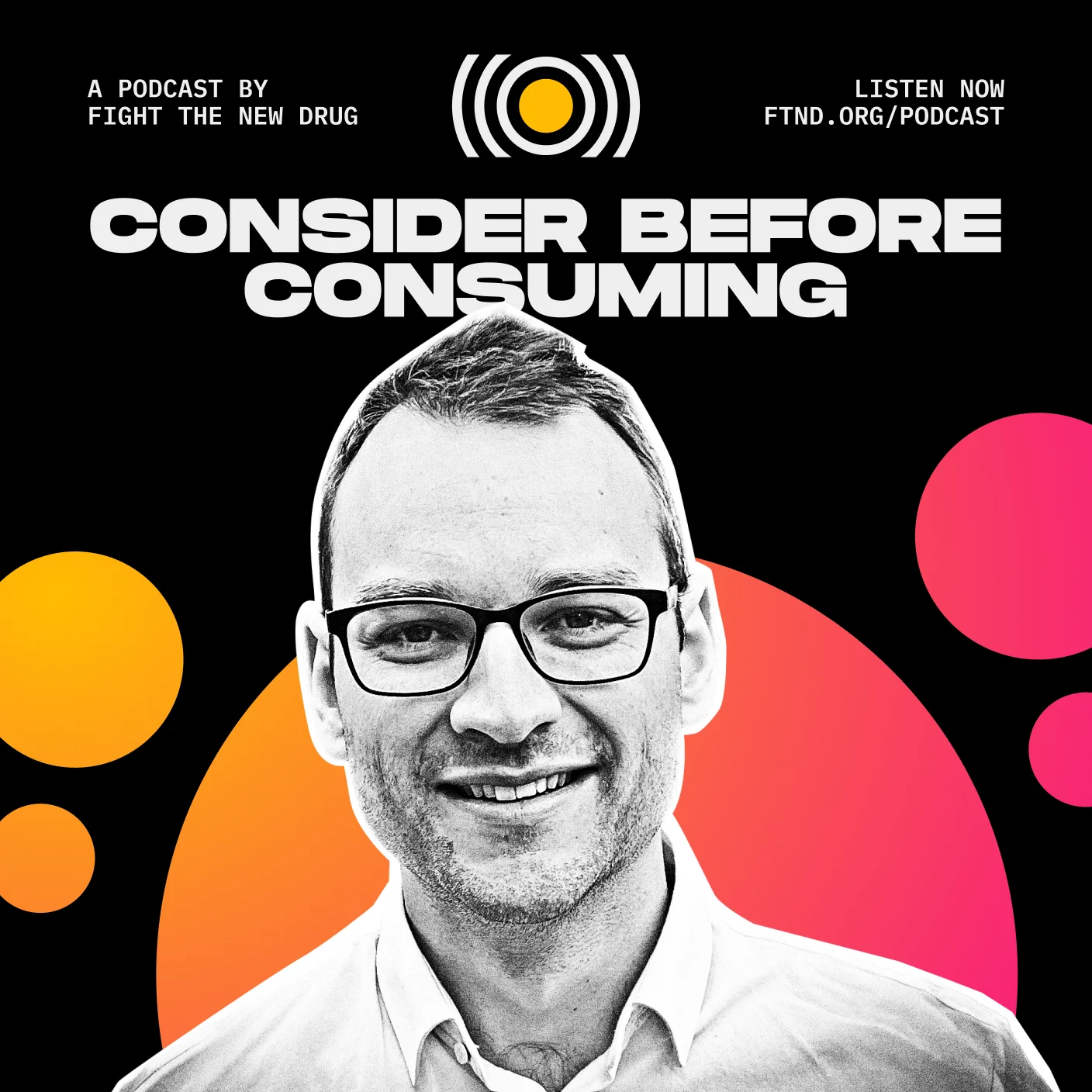
Episode 164
How Porn Affects Connection in Relationships
Available wherever you get your podcasts
In this episode of Consider Before Consuming, we’re joined by Dr. Nicholas Lawless, a clinical psychologist and couples therapist, to explore how pornography can impact connection in relationships.
Does porn affect relationships? Can porn change how you see your partner? Is watching porn considered cheating? Why does porn sometimes feel like a betrayal?
Dr. Lawless shares what he’s seen in both research and real-life couples—how shifts in attention and expectations can lead to disconnection over time, and what it looks like to rebuild connection.
If you’re wondering whether porn is affecting your relationship, or how to reconnect if something feels off, this episode offers a clear, practical perspective.
FROM THIS EPISODE
- Articles: How Porn Can Impact Relationships
- Documentary: Brain, Heart, World
- Dr. Lawless’ Practice: DRT Psychology
EPISODE TRANSCRIPT
Fight The New Drug (00:00)
Well, Nick, thank you so much for joining me today on Consider Before Consuming. To get started, can you share with our listeners a little bit about who you are and the work that you do?
Dr Nicholas Lawless (00:10)
Sure, thanks, Natale. My name’s Nick. I am a clinical psychologist and couples therapist running my own private practice in Melbourne, Australia. I work a lot with individuals who struggle with all forms of sexual addiction, pornography included.
I use that term loosely, knowing that it’s not a technical diagnosis. Compulsive sexual behaviour disorder is what we’d be kind of actually talking about clinically, but people don’t know what that means. So, sexual addiction is kind of what we refer to it colloquially as.
I also work a lot with couples who are struggling in this area. Be that one of them has, you know, been struggling with pornography use or some other form of sexual addiction and the other one’s just found out, betrayal, trauma, et cetera. So, I’m in this space a lot, infidelity in general, because it often branches into that space. And just this year started to work with groups as well, of men struggling with sexual addiction, which is new for me, but has been very powerful.
Fight The New Drug (01:22)
Amazing, you’re really seeing this issue, how pornography affects relationships from all facets. I’m so excited to get to have this conversation with you today. Before we dive into talking about some of the research you’ve done and your experience, what first drew you to studying romantic relationships and the role that pornography can play in them?
Dr Nicholas Lawless (01:43)
Sure. When I was kind of trying to work out what career I wanted to, what path I wanted to head down, I wanted to do something that would make a real difference to the world, to people’s lives. And I was trying to think, you know, what’s the way I can make the biggest impact? Essentially was my thought process. I went, people’s mental health, right? Like, yep.
I could be a doctor or something and help people with their broken legs. But, you know, you could be really happy with your broken leg. I mean, yeah, it impacts you absolutely, and whatnot, but you know there are lots of people that are physically very well and very miserable regardless. I went okay, psychology is kind of the path and went down that path and you know the many years of study and whatnot.
But I also had a particular kind of… towards working with couples because when I’m thinking about mental health I’m thinking well what impacts mental health more than anything else? Relationships and in particular romantic relationships. We know kind of the biggest predictor of people’s mental health, quality of life.
So I wanted to get into this couple therapy space and I finally got qualified and I was working individuals but then couples as well, what I found a lot of… couples who were using a lot of porn and having next to or no sex. And so this high porn no sex kind of dynamic seemed to be playing out across almost all the couples that I was seeing and at that point I was not in any way specifically, you know, specializing in this field or this area more than anybody else, and so when I got the opportunity to do a PhD it happened to be, you know, I was working relationship researcher so I was like great I want to be a part of this and then he said what do you want to kind of do your your thesis on it was like well I’m really curious about the interplay between porn and sex and relationship functioning sexual functioning in general and how this impacts relationships overall. So that’s kind how I ended up in that space.
Fight The New Drug (03:54)
Yeah, and your relationship research and the work that you’ve done studying couples is so important, and I’m excited for our listeners to get to hear a little bit about that. So can you tell us a bit about what you’ve learned about outside influences or some of the most common ways that outside influences are affecting relationships?
Dr Nicholas Lawless (04:17)
From my research perspective, one of the things that I looked at was people’s sexual system and how that is kind of wired to operate in a relationship. And essentially the theory goes that, you know, we have this sexual system in built in us for the purpose of relationship, as well as procreation, obviously, and reproduction and the continuation of the human race.
But it’s more than that. It’s more than just, you know, baby making. There is a real unitive aspect sex in general. And so one of the things that I was curious about, particularly given that background with the no sex and the high porn was what’s going on with people’s sexual system here? And how does that play out in terms of relationships?
So when we started to look at arousal, which is like an indicator that your sexual system is activated, we started to kind of go okay, well, you know it’s clearly being activated by porn which is sexually arousing material. It’s not being activated by the partner, given the lack of sex that these people are having. So does it still play out the same? How does that mess with the unitive aspect of this sexual system? And so that’s where the research started.
Fight The New Drug (05:45)
Yeah, you often describe relationships as moving either toward connection or toward disconnection. Are some of the more subtle ways that couples might start drifting toward disconnection without even realizing it?
Dr Nicholas Lawless (06:02)
I really want to highlight a word that was used in the Brain Heart World series that you guys put out there, which I thought was fantastic, and which, by the way, I watched after all of this kind of research that I was doing, but which I think fit really beautifully with it. And that was the word focus.
And I think when people’s focus starts to shift away from their partner and towards whatever it might be, you know, that might be work, it might be, you know, the kids, you know, so often that happens when kids come along and people’s focus shifts or in the instance of porn, porn, right? Or, you know, anybody else that they find attractive. That’s where things start to kind of fall off, and the disconnection starts to grow.
So if you start to notice that focus, like, you’re not really thinking a whole lot about your partner or they’re starting to feel a little bit unseen or forgotten or unheard, not really important warning signs, you know, that’s when you start to do something about it.
Fight The New Drug (07:14)
Yeah, it’s like the grass is greenest where you water it, right? Where your attention is going, that’s where the impact is gonna be. Yeah, and for any of our listeners who haven’t heard of our Brain Heart World documentary series that Nick mentioned, we talk about how love is focus and how pornography is something that can pull you away from that focus, you can watch that for free online at brainheartworld.org or on our website, fightthenewdrug.org, as well.
Dr Nicholas Lawless (07:22)
Absolutely. And just a quick plug. You haven’t set me up for this or anything, but I do highly recommend that. I think it was really, really good. Again, listening to it after doing all this research, it was really refreshing to go, like there’s nothing that you said in any of that that was wrong. It all fit with the research and everything that’s out there. And it’s actually very engaging. It’s pretty high quality production. So yeah, you did a good job with that.
Fight The New Drug (08:07)
Yeah. Well, thank you. Thank you so much for that. And I hope our listeners will take this opportunity to watch that and look into some of your research as well. We just talked about disconnection and how porn and where your focus is can pull you away. On the flip side of that, what tends to help couples stay connected or rebuild that sense of connection?
Dr Nicholas Lawless (08:28)
Hmm. Yeah, well, let’s roll with the same idea, right? This, this idea of focus, right? turning your attention back towards each other. and I would, I would say this, there’s something about, when you turn your focus away, there is a sense of like, missing out on something, in a relationship. Like you’re not, you’re not sharing everything when your attention turns to other things.
One of the things that we can do when it comes to, you know, just connection, for instance, is just talking. And that sounds really basic, but the amount of couples that don’t talk or don’t talk about anything meaningful, more specifically, is a recipe for disconnection. So to actually start to connect, to start to open up, and you see that a lot in couple therapy, when people start to actually go like, wow, I had no idea that this was going on for you. Like that’s how you saw things, that this is what was going on. All of a sudden,vyou have something to connect over. You can actually see the person for who they are in their entirety. So look, that’s a very basic starting point, but I think it’s worth starting there.
Fight The New Drug (09:37)
Yeah, I think it is too, because I think so often when we have these conversations of where people are feeling like, OK, I’m not having intimacy in my relationship. I’m not having sex in my relationship. Don’t zoom all the way out to think of where that disconnection might be starting. And so I think it’s worth mentioning, just a lot of that has nothing to do with sex, actually, or intimacy, but that connection and building that safety and intimacy elsewhere.
Dr Nicholas Lawless (09:52)
Absolutely, absolutely. And I mean, you see it all the time with couples, this dynamic between, know, like, don’t want to have sex with you because, you know, I don’t feel emotionally connected to you, it doesn’t feel safe. And yeah, too often we go, okay, well, I don’t know how to do that bit, so I’ll just go on and try and meet my needs elsewhere.
Fight The New Drug (10:26)
Yeah. Why do you think the idea of how our attention can be directed either toward our partner or away from our partner hasn’t been talked about more in conversations around porn and relationships?
Dr Nicholas Lawless (10:42)
It’s a good question. I think there is the intersection between different domains of research, if you like, different fields. There’s a number of fields that coalesced around my topic, which did make it quite confusing at times and hard to integrate it all.
Because you know it’s romantic relationship literature, isn’t it? What’s kind of social psychology? Actually, it’s kind of the sex literature right? Well, it’s all of them, and usually researchers kind of fall in one of those camps more than the others, and so there’s a bit of biology kind of going on, there’s a bit of psychology, there’s definitely some social elements to it.
That’s where I think maybe there’s been a bit of a lack of trying to kind of bring those fields together because I wasn’t especially wedded to either one of those to begin with you know I was fresh if you like I think I didn’t really notice that there was actually any sort of a difficulty there until I was right in it and well I kept going obviously with once I was there but I think that might be part of the reason why we haven’t really tied it all together like this before.
Fight The New Drug (11:55)
Yeah, that makes sense. In your research, you also talk about how porn can shape expectations. What kinds of expectations are people picking up, often without realizing it, from pornography? And how can those expectations start to create tension or dissatisfaction in real relationships?
Dr Nicholas Lawless (12:14)
Absolutely. So, where do we start? There’s so many different expectations that kind of come from porn.
Yeah, look, the broader ones that I won’t go into a whole lot of detail with, you know, we know that, you know, violence in pornography feeds into expectations and attitudes and also behaviors when it comes to how appropriate violence is in real relationships and sexual contexts. We know that infidelity is a big thing as well. It’s such a fantasy for so many people that it becomes like it’s a full genre, when it comes to pornography, and that can feed into real relationships absolutely.
But I think more broadly than that, right, for those people who kind of go okay, well, I’m not looking at the violent stuff, I don’t look at infidelity, you know, I just look at the good stuff, the healthy stuff, the more natural stuff that kind of thing. There is still a focus on self, just by virtue of what you’re doing with the porn.
So take away whatever’s being shown by it in the content. You are using these other people for your own gain. And that is not a very healthy approach to relationships from the get-go. So just by virtue of that, that’s one thing that I’ve mentioned. But over and above that, there’s this emphasis when it comes to…pornography and everything that’s kind of depicted in it, that the focus is on, it’s not on the relationship, right? That’s the reality. The focus is on the mechanics, the performance, the practical, literal act or acts that are being depicted for people’s sexual gratification rather than…the relationship, the connection, the unitive aspect that we were talking about before. There is a lack of that.
And so when it comes to actual real sexual relationships, right, that the expectation is not there, that we’re going to feel close and connected, and we’re going to talk about things beforehand and, you know, build some emotional safety. It’s kind of like, no, when, when I want this, you’re going to be there, and we’re going to have sex, and it’s going to be mind-blowingly, you know, pleasurable, and everyone’s going to love everything that, you know, happens, no matter how full on or extreme it might be.
Yeah, I mean, I could keep going, but I think I branched into a few different topics there.
Fight The New Drug (14:54)
I wanna double click into one of the topics you brought up. Something really important about your research is that you talk about, you know, a lot of the other research about pornography’s harms speaks to the content in pornography, speaks to, as you mentioned, that it’s violent, that it’s graphic. We know how that influences young people. We know how that influences expectations. But something really important about your research is that, as you mentioned, content aside, the act of engaging with pornography can still harm relationships. Can you dive a little deeper into that idea for us?
Dr Nicholas Lawless (15:29)
Absolutely, I would love to. Yeah, I mean, it comes back to, we kind of alluded to it before without really getting into it, and I appreciate that I didn’t realize that at the what my research kind of looked at is that when you are aroused by people that are not your partner and…in some instances, and obviously every time we use porn or being aroused by someone that’s not our partner. That very arousal has an impact on the relationship. And it does that because that sexual system that we spoke about before, of which sexual arousal is just a part, it is directed towards the target of that sexual arousal.
So…it’s not a case that, you know, you get aroused by porn, and then you can go, okay, I’m just going to direct all of that arousal towards my partner. You know, that’s a plausible explanation, but we tested it literally in the research. We had hypotheses around that. And that’s certainly not what we found across multiple studies and many hundreds of people. What we found is that when you are aroused by somebody that’s not your partner, your focus, your attention, your motivations, your behavior is directed towards the object of your sexual arousal, the sexually arousing stimulus. And obviously, in the case of porn, that’s not your partner, that’s away from your partner. The way that I kind of frame it sometimes for people is that you can always think of sexual arousal like a magnet.
And if you point, if it’s kind of being pointed towards porn or anybody else, that’s not your partner for that matter, it will pull you towards those people and therefore away from your partner. Whereas we found on the opposite, right, direct it towards your partner, and it’ll actually draw you towards them, which is obviously what people want in a romantic relationship.
Fight The New Drug (17:32)
I’m so curious from your perspective, with the research you’ve done, we are often asked, ” Is pornography cheating? Is watching pornography cheating?” And we have a response to that that we’ve shared. But I would be curious to know how you would respond to that with this idea of connection and disconnection, what your thoughts are there.
Dr Nicholas Lawless (17:52)
Yeah, certainly. I would have a lot of partners that would be very much arguing that watching porn is cheating, and they’re dealing with betrayal trauma as a result. So that’s very, very real. And I certainly don’t want to take away from that at all.
I would be suggesting that if you are not, anytime you are throwing in your efforts, your energies, your attention, your focus, your time into things that are not going to be good for the relationship, then in some way you’re doing the relationship a disservice, absolutely. And if those things are things that… you know, in your understanding of your relationship, should be kind of solely for your relationship, i.e., like your sexual system, right? If you go, you know, I wouldn’t want my sexual system directed towards anybody else, like, because that’s unique for us, like that’s why we’re in this relationship. Then if you’re watching porn, you’re doing that. So absolutely, I think in those instances, it would be akin to cheating.
And to give a comparison, maybe just for those who feel uncomfortable about that response, maybe. So let’s say there’s a couple where one of them has a very close emotional connection with someone of the opposite sex. They’re a heterosexual couple and share a lot, right? They share their feelings. They spend a lot of time talking and connecting and whatnot. That, to some people, will be okay. The other person will feel okay with that. That doesn’t necessarily mean it’s not having a negative impact on the relationship.
So that’s the other thing, whether we call it cheating or not, that doesn’t mean it’s not having a negative impact on the relationship. In the same way as that emotional connection with somebody, when, ideally, we want that emotional connection with your partner possibly having a negative impact on the relationship without you even realizing it.
Fight The New Drug (19:44)
Right.
Dr Nicholas Lawless (19:58)
Even if the partner doesn’t have an issue with it. And I see that a lot as well, where couples come in, and they go, well, everybody uses porn, don’t they? That kind of thing. I can’t be upset at them for it, can I? Or, you know, it doesn’t bother me kind of thing. That doesn’t mean that it’s not actually pulling you away from your partner.
Fight The New Drug (20:18)
Yeah, I would love to, just for anyone who feels like maybe porn hasn’t really affected their relationship, what are some of those things that they may not be considering?
Dr Nicholas Lawless (20:29)
Yeah, absolutely. Essentially, what we found with my research, and that doesn’t mean there’s not other things there, but these are the things that we saw play out with couples.
When you use porn, the more aroused you are by it, the more often you are aroused by it, the more likely you are to pay attention to attractive alternatives. And that’s a technical term for other people that aren’t your partner. The more likely you are to see those people as viable. options, so you’d like to actually consider them as like a relationship partner or a sexual partner, the more likely you are to engage in infidelity, surprise, surprise, given those first two I just mentioned.
So straight away, sexually, we know that. We also know you’re more likely to sexually objectify other people that aren’t your partner.
Outside of the sexual component, though, you’re actually more likely to engage in destructive conflict with your partner. You’re more likely to be kind of aggressive and domineering. And again, that’s not about a content thing. That’s just by virtue of like there’s a disconnection.
process going on more likely to neglect your partner’s feelings and needs. Those things are obviously outside of the bedroom, right? There’s nothing sexual per se about those things, but that is one of the things that we found.
So we actually did this really cool study, which is yet to be published, but hopefully in the not-too-distant future, where essentially we were able to, given all of the stats that we were able to kind of come up with in the analyses that we ran, we did something called a causal mediation analysis, where essentially we can, because of what we do with the stats behind the scenes, can replicate an experiment that we couldn’t possibly run in the real world, where we were able to go, okay, so if we increase people’s arousal to porn by X amount on this scale, what happens?
At the next time point to their engagement in these relationship disconnection processes. And then what happens at a later time point, following that to their relationship well-being overall, so their relationship quality and stability, and sexual satisfaction.
And what we found is that you increase that porn arousal at baseline. A month later, there is an increase in relationship disconnection processes, the ones that I just mentioned. And then a month after that, there is a decrease in relationship well-being. So, this causes that over time.
Because of the statistical analyses and the way that it’s able to control for so many different variables. I can’t remember how many we had now, nine different control variables, something like that. You’re able to kind of say with some level of confidence that this caused this, which caused that. An increase in porn arousal increases your relationship disconnection processes, your engagement in those behaviors, which will have a flow-on effect on your relationship well-being down the track.
Fight The New Drug (23:55)
Yeah, which is so important because so many people think it’s the disconnection in their relationship that drives them to pornography in the first place, because, you know, well, they don’t, my partner doesn’t want to be intimate with me, so I’ll seek it out somewhere else. So that, for many people, is the reason they believe they’re consuming pornography in the first place. And then it’s just interesting to see that actually it’s kind of a cyclical process, but…but certainly that consumption is fueling this disconnection, which is just keeping us in that cycle.
Dr Nicholas Lawless (24:27)
Yeah, absolutely. And it’s true that it can go the other way. And it’s not something that I looked at in my research per se as to how does the relationship well-being being not great feed into porn arousal, for instance. But it’s certainly something that we kind of considered and put out there as, absolutely, that’s a viable thing as well. And it is something that I see in my practice when things, you know, people come in, and they go, you know, like I wasn’t using porn at all and then, you know, we stopped having sex, and then I started using porn again. So it’s possible, it can absolutely happen, go the other way, but that doesn’t take away from the fact that yes, it then just builds on the disconnection; it doesn’t make it better.
Fight The New Drug (25:12)
Right, and also, you know, really taking that one step further to say, okay, well, if you stopped having sex, why did you stop having sex likely? Because there was some disconnection in the first place. And so it’s really going back to this idea that you said many times, relationships are either your actions are moving you toward connection or toward disconnection. And so if we keep building on the disconnection and getting further and further, then we’ll find ourselves in that very disconnected place.
And when we look at what we know about the way pornography affects the brain, with a compulsive habit with frequent consumption. It’s often those watching pornography will need it more often and a more hardcore version of it to kind of get that same gratification or that same arousal in the brain. And so with that escalating and then this continued behavior, fueling this disconnection, it’s certainly, as you mentioned, harming the relationship.
Dr Nicholas Lawless (26:10)
Yeah, it’s just adding more pain on in some respects, right? In the same way as you know, you’re struggling to emotionally connect. So let’s just, you know, get smashed. And that’ll help me kind of with my emotions. Well, sure, it’ll help you in that moment with your emotions, but it will not help your connection over time. In fact, it’s just adding more issues to the relationship, not less.
Fight The New Drug (26:36)
When someone starts to recognize that there is that disconnection in their relationship, what are some of the first steps they can take to reverse that?
Dr Nicholas Lawless (26:45)
I mentioned before talking, and it’s the first thing that I would be starting with. Talking to your partner about how you’re feeling, the fact that you are feeling disconnected in the first place. The second thing, and this is like, okay, talk to your partner. Sometimes that’s enough. They didn’t realize, they didn’t know you could come up with kind of a solution to reconnect.
If you…don’t know what the heck to do about it though, right? You share it with them and they go, well now what? That’s where I would suggest like therapy. And that might be individual therapy if you feel like a lot of it is kind of on you and kind of your own experiences, like maybe you struggle with, you know, emotional regulation or emotional expression.
Maybe you’ve got a really long-standing compulsive behavior going on here to porn or something else. Or maybe it’s couple therapy when you go, actually, neither of us really know how to do this. We just want to work on kind of the dynamic and how we can reconnect. I see it happen all the time. Like it’s definitely possible. You just got to be willing to actually do the work, do what it takes.
Fight The New Drug (28:04)
Yeah. In your research, are there any specific statistics or measurements that we haven’t spoken about yet that you think are really interesting that you want to be sure to share today?
Dr Nicholas Lawless (28:16)
Yeah, absolutely. So I mean, we’ve shared about kind of what happens or what the research found as far as when there’s porn involved and the disconnection and the impact, negative impact on relationship well-being.
What we also tested at the same time was what happens when we increase arousal to your partner, like this isn’t about how the sexual system kind of goes wrong, and it’s all about the bad stuff. This is like, well, what is it kind of intended for, and how does that play out in relationships, too? And obviously, we’re relational creatures, and so we had a look at that and how that impacts. So, increasing sexual arousal at baseline, a month later, increased what we call the relationship connection processes. And then a month after that, an increase in relationship well-being, and again the same kind of definitions for those first two, but those relationship connection processes this is interesting because again stuff in the bedroom and stuff out of the bedroom.
So some of the stuff in the bedroom, so the frequency with which you had sex, the pleasure with which you had sex, the extent to which you were thinking about the other person and their experience of sex. So what we call like communal, sexual communal strength, were some of the sexual kind of aspects that were part of that relationship connection process. But on top of that, your capacity to engage in constructive conflict, you know, your willingness to compromise, your perception of the other person, and that might sound like an outcome rather than a process per se, but what we think about our partner is actually a process.
It’s something that we can change, or you know, for the better or for the worse. What we found is that the more aroused you are, yeah, sure you find them more sexually attractive. We found that absolutely, you actually perceive them as more warm and also intelligent.
Like this is having an overall positive impact on how you view your partner, your thoughts about your partner.
And then yes, you’re more likely to want to spend time together, meet their needs, be kind to them, et cetera. A number of in-bedroom and out-of-bedroom processes that are all leading to connection, trying to maintain, enhance that relationship with them, that unity of aspect, it played out when it came to the stats, very much so. And of course, the more you’re doing those things, the better your relationship is in the end.
Fight The New Drug (31:02)
Which is so great to have research on that because so often, we’re focused on these are the harms and this is the negative spiral it can put your relationship in. It’s so nice to be able to say these are very real, tangible, that not consuming pornography can help your relationship and strengthen your relationship and your connection, which is really wonderful to have. Yeah.
Dr Nicholas Lawless (31:18)
That’s it, it’s not all bad news.
Some people, depending on kind of what they hear me talk about, either in a therapy context or outside of that, like might get the impression that I’m like anti-sex. Far from it. Like, sex is a fantastic, wonderful thing that so often means I do sex therapy with people trying to help them have better sex. That is…not just because sex is good in and of itself, but because it’s just so fundamental to relationship well-being, which is what we’re all about.
Fight The New Drug (31:59)
Yeah, we often say about our organization, obviously, we’re specifically focused on educating and raising awareness on the harmful effects of pornography. But we often say we’re anti pornography because we’re pro sex. It’s because we’re pro-healthy intimacy and healthy relationships that we are anti pornography because we know the ways that it harms relationships, and more and more research, as yours has just, continues to validate.
But we’ve known from research and personal experiences for decades, pre-internet, but especially in this digital age that we’re in today, people are experiencing really significant negative effects from this. And there are wonderful positive effects of overcoming and not allowing or not having pornography be something that has control within your life and influence within your life.
Dr Nicholas Lawless (32:48)
Absolutely.
Fight The New Drug (32:50)
And we say that with all of the and compassion for how difficult a struggle with pornography can be certainly, which is something we also speak about often, and know that there are resources available to those struggling or partners of those struggling as well to make sure that everyone is taken care of in the ways that they need to be throughout these journeys.
Dr Nicholas Lawless (33:09)
Absolutely, absolutely. And maybe just building on that. Yes, there are resources out there to help those people that are struggling in this space. And more than that, to kind of go a little bit further, and in the same ways it can happen with other forms of infidelity. This, like identifying this and working through it in a relationship, can actually be the catalyst for a much greater relationship than you even thought was possible.
The amount of times that somebody has, like a couple, has come in and gone like, our relationship is better now than it was prior to the affair, better than it ever has been. Even though there’s this massive hurt, you know, and struggle and, you know, we’ve got to overcome all of that and process all of that, that’s all true. Like, it’s not to take away from that at all. But to say like, there is, this isn’t just like, so we’ll get back baseline kind of thing.
Like, there is an opportunity here to be more intimate, more known, more seen than ever before if you know you’re able to make the most of those resources and like I say, do the work.
Fight The New Drug (34:20)
And that’s something we hear often from couples who have overcome this together, or individuals who’ve experienced that within their relationship, while also noting we’ve certainly heard from individuals who this impacted their relationship in ways that they were not safe for, unable to pursue healing, or both partners were unwilling to do the work in the same way, whatever that looks like, and to know that that is also okay, right? There’s not a right or wrong way for anyone to navigate this, but certainly noting that peeling back those layers and having honesty can, you know finally bring transparency on everything can certainly be that foundational starting point to build a stronger relationship within for those who choose.
Dr Nicholas Lawless (35:03)
Yeah, absolutely. Very true. And yeah, we’re, I mean, we’re, we’re wounded in relationships and we’re healed in relationships and whether that’s that relationship, like you say, you know, it might not be depending on the circumstance, but there’s, there’s so much goodness that can come from, you know, starting the journey and working through it with someone, be that a therapist or your partner or all of the above that, yeah, it’s, there’s definitely hope.
Fight The New Drug (35:30)
Yeah. Can I ask you about non-romantic relationships? What do you see in how those relationships are affected? Friendships, parent-child relationships, you know, types of relationships that are non-romantic, how are those impacted by pornography?
Dr Nicholas Lawless (35:47)
Yeah, so disclaimer that, you know, I didn’t research this at all. So this is more, you know, just anecdotally from my clinical experience, rather than anything that I looked at with the research.
I think there is a tendency towards…or what I often see with individuals that are using this. So they’re not in a relationship, they just come in, and they’re either, they know they’re struggling with it, and they’re trying to do something about it, or they don’t know, and they’re here for something else, and we happen to go, oh wow, you use a fair bit of porn. Okay, like what’s going on there?
So often it’s being used as a coping mechanism, an emotion regulation tool, which, you know, it’s a very powerful one of those, version of those, but it…it’s not helping people to learn how to regulate their emotions. It’s just medicating it, essentially. You don’t actually build tolerance to be able to sit with or healthily express that emotion in any form of relationship, be that your siblings, your friends, or your parents, kind of it just kind of helps to numb.
And that in and of itself is the root of so many relational difficulties with different people. Because either you’re numbing and disconnected or when you’re not able to do that, you are totally dysregulated. And so, not necessarily the nicest person to be around. It’s not super great for relationships when you just cannot handle anything emotional. And so I think it certainly plays in in that sense.
It also plays in similar ways like we spoke about those relationship disconnection processes, and yeah, we’re looking at it in the context of those in relationships many of those things…not necessarily unique to relationships, sexual objectification of others, for instance. It’s very hard, and I’ve had many people report this to me, that it’s very hard to have a good relationship with, again, I’m talking heterosexual people here, with the opposite sex when you’re undressing them in your mind, right? When you only see them for their sexual value and nothing else. You don’t see them as a…you see them as an object and that will impact your relationship with them, your capacity to connect with them, your capacity to love them, empathize with them, etc.
Fight The New Drug (38:22)
Yeah. Thank you for sharing that. Is there anything else from your anecdotal experience working with so many clients or perspective that you have through this research and the work that you’ve done that you’d like to share before we wrap up today?
Dr Nicholas Lawless (38:39)
Yeah, there are a lot of people who…probably the biggest conversation that I have with people in this space, outside of what we’ve already spoken about today, are those who don’t think that their porn use is relevant to their mental health or their relationships. They can’t see the connection, they don’t see there’s a problem with it, they think it’s fine, they don’t think it’s impacting them, all those things.
To those people, again, based on the research. Like, my research was not looking at what people thought, but about how it impacted their relationship. When you look at that research, and there is literature out there that looks at people’s perceptions of the impact of surprise, surprise, people don’t think it’s a terrible thing for the most part when they’re using it, and they don’t want to stop using it. There’d be a whole lot of cognitive dissonance going on there if they did.
So they start to go, hang on, people don’t think there’s anything wrong with this. Well, yeah, that’s true. People don’t often think there’s anything wrong with this until you know they experience the impact of it, and usually that’s in a relationship context to some extent. Or because it’s just gotten so extreme that they start to go, or they listen to a podcast like this and go, yeah, actually, maybe this is affecting me. But one thing that I challenge people to do when they’re in that circumstance is to try to stop using porn.
And because most of them haven’t, why would they? If there’s not a problem and they like it and you know, they’ve, you know, that’s just a part of their life.
The amount of people that I’ve said that to and they’ve come back and gone, I couldn’t do it. Like, it’s clearly having an impact on you if you can’t live without this thing. Why not? What’s going on? Let’s address that.
And so if you don’t think that this is impacting you at all, try and live without it. And if your life doesn’t change at all, maybe it’s, maybe you’re, you know, maybe you’re right. Maybe it’s not impacting you. That again, that doesn’t mean it’s not impacting other people, and you know, based on that impact of, you know, porn on society, et cetera, like.
Why do it then if it’s not really having an impact, positive or negative? What you’ll probably find is when you stop, you’ll start to notice things change, right? And either you’ll really struggle, or you’ll go, wow, like I’m so much more free. I have so much more capacity to think about stuff. I’m more productive at work. You know, I’m more attracted to my partner. Like, wow, we’re having such a great relationship now.
The proof will be in the pudding. So go get the evidence, kind of for and against, but you never get the evidence if you don’t try.
And it was actually, it’s a bit of a bugbear of mine. Maybe this is getting a bit geeky here, but coming from a research perspective. When you’re looking at these studies that kind of try and assess what porn addiction is and how prevalent it is and whatnot, usually those studies are based on people reporting how much they struggle when they’re not using porn. But it presupposes, it assumes that you’ve actually tried to stop using porn.
And I think the numbers would be far different to what they find because they find that, you know, the levels of pornography addiction or problematic pornography use are quite low in the general population. But I think if the whole population tried to stop, those numbers would be far higher. It’s just that if you haven’t stopped, well, then I wouldn’t have a problem. That’s what everybody says. So go and try it and see how it goes for you.
Fight The New Drug (42:25)
Yeah, I think that’s great advice. And certainly, what you’ve mentioned, we have heard from many people how their lives have improved and how they have felt so much more free without pornography, having so much control in their lives, and having healthier coping mechanisms for emotions and all of those things. Again, noting we also know how difficult it can be to overcome a struggle with pornography.
Dr Nicholas Lawless (42:48)
Absolutely. Absolutely. So yeah, it’s not to say, you know, stop using and you’ll be able to stop using, no worries, and it won’t have an impact, but yeah, stop using, you’ll work out whether you can do it easily or not. And if you can’t, well then there’s help.
Fight The New Drug (43:02)
Yeah, absolutely.
Is there anything else that you wanted to share that we haven’t spoken about yet before I ask you our final question about hope? Okay. What do you hope our listeners take away from your research and from this conversation when it comes to building healthy and connected relationships?
Dr Nicholas Lawless (43:09)
So the answer is kind of twofold here. The first part is that if pornography use or any kind of sexual acting out behaviour is present in your life, in your relationship, then it is probably having an impact on that feeling of disconnection between the two of you. Or even if you don’t even notice that there’s a feeling of disconnection, it’s still probably there that you’re just not picking up on. Whether you realise or not, whether your partner has an issue with it or not, whether you have an issue with it or not. So give it a try, not, and again, the proof will be in the pudding, get the evidence for or against that. And then the second kind of aspect to that is, I would hope that again, you’re taking that sex is a really great thing. The sexual system is actually super duper powerful when it comes to relationship well-being.
It’s just got to be directed in the right way. And so we want to kind of turn that magnet back towards our partner and make sure that, you know, everything within us is being kind of funneled in that direction so that we can make the most of that relationship. It’s absolutely 100% worth it.
Fight The New Drug (44:40)
Yeah. Well, thank you so much for joining, Nick. I’m so grateful we were able to connect with you and share this conversation with our listeners. Do you want to share if anyone wants to learn more about your research or your work? Do you want to share where they can do that?
Dr Nicholas Lawless (44:55)
Sure, research. Look, just Googling my name will come up with some of the published studies that are already out there.
As far as other resources, et cetera, you know, Googling my name will also come up with, you know, my practice details, et cetera, so they can contact me through email and whatnot if they would like additional resources, that kind of thing. But you’ll find plenty of it online, just looking up the name.
But yeah, thank you for having me, and thank you for the work that you guys are doing as well. Thanks so much.
Fight the New Drug collaborates with a variety of qualified organizations and individuals with varying personal beliefs, affiliations, and political persuasions. As FTND is a non-religious and non-legislative organization, the personal beliefs, affiliations, and persuasions of any of our team members or of those we collaborate with do not reflect or impact the mission of Fight the New Drug.
MORE RESOURCES FROM FTND





A database of the ever-growing body of research on the harmful effects of porn.