

Episode 161
How Young People Are Learning About Sex (And What They’re Getting Wrong)
Available wherever you get your podcasts
This episode includes discussion of sexual violence, coercion, and experiences of assault among young people. Listener discretion is advised.
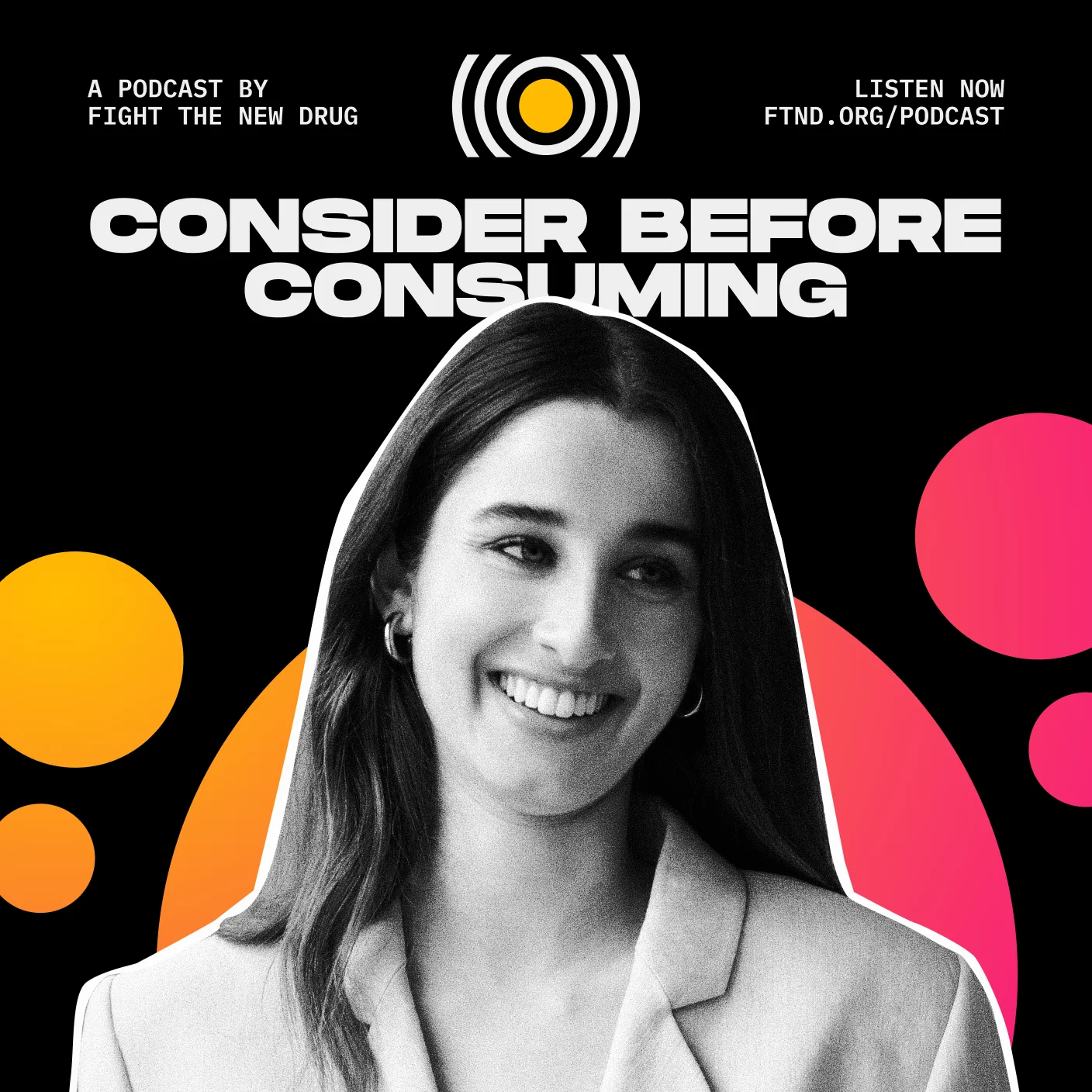
In this episode of Consider Before Consuming, we sit down with Chanel Contos, founder of Teach Us Consent, to talk about how one Instagram post led to thousands of young people sharing their experiences, and ultimately helped drive mandated consent education across Australia. Chanel shares what it was like reading through testimony after testimony of peer-on-peer sexual violence, and how those stories revealed patterns around coercion, misunderstanding, and the way many young people are navigating sex without a clear understanding of consent.
We also explore what’s shaping young people’s expectations around sex and relationships today. How are teens actually learning about intimacy? What role does pornography play in shaping ideas about consent, boundaries, and what’s considered “normal”? And why are rates of youth-perpetrated sexual harm rising in some areas, even as other forms of abuse decline? Chanel breaks down how early, age-appropriate consent education can help address these gaps, and what it looks like to teach consent in a way that builds empathy, communication, and respect from a young age.
FROM THIS EPISODE
EPISODE TRANSCRIPT
Fight The New Drug (00:00)
Well, Chanel, thank you so much for joining me today on Consider for Consuming. We’re so excited to have you here. Can you start by?
Chanel (00:06)
So great to be here. Been big fans of your work for a while from across the globe.
Fight The New Drug (00:12)
Thank you. Can you start by telling us a bit about yourself and the work that you do?
Chanel (00:16)
Yeah, so I’m Chanel Contos. I’m the founder of Teach Us Consent. And Teach Us Consent was originally a grassroots campaign in Australia that was responsible for mandating consent education in all Australian schools from kindergarten until year 10 in an age appropriate way. And that started through a testimony page where people could submit testimonies of sexual assault that happened while at school age.
And we named the school and graduating year of both perpetrator and victim. They’re high schools, which I think made it like really impactful in terms of feeling close to home, but not individually scapegoating anyone for this structural issue that is widespread, pervasive, and normalised sexual violence.
And 50,000 people signed that petition as well. And it was a year of advocacy, and so much went on and lots of other people in the sector doing incredible work to draw attention to this issue. And yeah, then the campaign was successful. So that was amazing.
And then since then, we’re now, Teach Us Consent is now an organization that has mainly been in Australia, but we’re actually about to launch in the US, which is really exciting. And we provide online digital consent education in a holistic way, covering like all different topics from pornography to algorithms to gender norms and expectations. And we have like a mix of content that’s always relevant and probably always will be relevant, and then also content that kind of latches on to culturally significant moments that are happening in pop culture amongst youth. Then we also in Australia do a lot of policy and legislative work in terms of reforms. So yeah, big summary, but that’s who I am.
Fight The New Drug (02:00)
No, it’s incredible. Conversations about consent are so important. Growing up, what kind of conversations did you have around relationships, sex, and consent?
Chanel (02:12)
I guess not many useful ones. I feel like through media, and also I guess the environment I was raised in, there were a lot of comments and conversations about relationships that very much posed it as something that like I should avoid until I was older, and that’s something that boys would probably want from me and that I shouldn’t give into them.
I think there was a lot of purity culture surrounding those conversations for me in my upbringing. My parents are Greek and I think that definitely has played into the way me more than some of my other friends experience these sort of conversations.
And then in school, so I went to an all-girls high school, and at the age of like 15, 16, I was 15, but my peers were 16 because I was young for the year. We received consent education for the first time, and it was like quite a mind-blowing experience to be like, what? You know, this counts as sexual assault, and this is needed in order for it to not be sexual assault. And it really redefined a lot of the ways we thought about our experiences and ourselves. And I think that was like a starting point for wanting to run Teach Us Consent as well. Like knowing exactly what that feeling felt like.
Fight The New Drug (03:32)
I think that’s a common experience people have when they learn for the first time about consent, which happens at various ages for lots of people. Teach Us Consent started after you shared an Instagram post. Can you share what that post was and what led you to make it?
Chanel (03:48)
Yeah, so the post was very specific. It was: Have you or has anyone close to you ever been sexually assaulted by someone who went to an all-boys school in Sydney?
And I have lots of reasons for talking about all-boys schools, one of them being that Australia has a very like segregated education system, and we have the highest proportion of single-sex education institutions in high-income countries, and I do strongly believe that that does contribute to our rape culture and the, again, strict expectations and attitudes towards gender and sexuality that are experienced by so many around Australia.
But it very quickly turned into a national petition to mandate consent education in all Australian schools. But posting that initial question on Instagram was, to be honest, a moment of extreme anger and frustration.
So I was studying my master’s at UCL in gender education and international development at the time. And I think just learning quite explicitly about the benefits of an impact that consent education can have on preventing sexual violence and promoting healthy intimacy. A lot of the context, because it was an international development master’s, I guess a lot of it was to do with low-income countries or like the global south.
And there was kind of this hypocrisy in it, thinking like, Australia, like, we’re meant to be one of the most gender-equal countries in the world. We’re meant to, yeah, like things are meant to be good here, but actually, all of these issues are just as pervasive, if not actually more pervasive in certain spaces. And I think I wanted to apply that knowledge of the solution being consent education to my context.
When I started Teach Us Consent and the campaign, it wasn’t even cool that when I started it, when I posted the Instagram story, my intention was just to get like the nearby schools to start teaching consent education because where I’m from in Sydney, it’s, everyone kind of knows everyone. It’s like quite small on a peninsula. Like all the people know each other from different schools. And that was the intention, except responses were coming in from all over Australia, which is why we made it a national petition.
Fight The New Drug (06:02)
You kind of shared, you know, what you expected was just this kind of closer circle, and then seeing the response that you got. What was that experience like for you to hear those stories coming in and see those comments?
Chanel (06:17)
It was really overwhelming. I mean, I say we collected and published 7,000 testimonies of sexual assault, but it was actually many more than that. That’s just how many we could kind of physically read and collect. And also so many mistakes were made in those early days of like data transfer and moving from Instagram to a Google Doc, to a Google Form, to a website. It was really carnage.
It was obviously deeply upsetting to read those testimonies. That was something that any volunteer with Teach Us Consent, I think, also struggled with. It’s probably not normal to ingest thousands of testimonies of sexual assault. Sexual assault and rape in a handful of weeks, but it was just so powerful. And to just see the repetitiveness of the same themes coming through time and time again just made it even more obvious what the solution was, and the fact that this can be addressed, because to read 7,000 testimonies and have that really intricate understanding of the rape culture, there’s just so obviously a handful of things where things were going drastically wrong that could be intervened in.
Fight The New Drug (07:34)
What did you do next to take all of that momentum? I mean, I can’t imagine. We see horrific things. We hear horrific stories on our end, but I can’t imagine getting so many thousands of these stories all at once and addressing them all at once. But there’s so much momentum in that. What did you do to take that momentum and turn it into something tangible?
Chanel (07:56)
Well, we showed these things to politicians and legislation makers and policymakers around Australia and said we need consent education, and we need it earlier, and we need it in a holistic way. And this can be done from a really young age in an age-appropriate way. And research around the world echoes that that is exactly how it should be done to be effective in violence prevention, because consent education taught too late is very ineffective.
And those testimonies are still on the website, and they’re kind of there as a foundational rock for everything we do in terms of really drawing attention to the problem of peer-on-peer perpetrated sexual violence.
So that was the other thing that like Teach Us Consent does very specifically. It’s about youth-on-youth perpetrated sexual violence, which in Australia is actually on the rise. So…they assume that this has happened in other countries, but the same sort of research hasn’t been done yet. A world-leading study called the Australian Child Maltreatment Study has basically shown that in Australia, we have successfully reduced the rates of child sexual abuse perpetrated by adults, which is amazing. And that means we should scale that times tenfold and continue all those prevention efforts, because I do truly believe that is a particularly insidious form of sexual violence.
But at the same time that we’ve done that, we’ve let our attention stray, and child sexual abuse perpetrated by other children, particularly adolescent boys, has skyrocketed very dramatically. So now in Australia, the most likely perpetrator of child sexual abuse is a teenage boy. And pornography consumption and a very sudden resurgence of gender norms and expectations are things that the researchers point to as potential reasons for this sudden surge
So yeah, Teach Us Consent, I guess, really draws attention to this. It was almost like a gap that people, it is a hard thing to address, to think about, like children perpetrating against other children. But we should also see it as an opportunity because when children perpetrate sexual violence, it’s often because of a lack of understanding about consent, lack of awareness how to engage in healthy intimacy, because they’ve learnt how to engage in sexual acts from forms of media like pornography or other forms of maybe like movies or pop culture that aren’t promoting the best sexual scripts or stereotypes, and they’re not doing it out of like malice or they’re not doing it because they think it’s wrong so it’s a significant opportunity for intervention there.
Fight The New Drug (10:42)
That’s such a beautiful perspective on this issue because, you know, taking something that’s truly horrific and feels so overwhelming sometimes to look at the sheer volume of incidents that are occurring and pornography is so normalized, these influences that are leading to some of this harmful sexual behavior are so normalized it can be overwhelming to think about how to create that systemic change to stop this harm from happening. But that’s essentially what you’ve done: you really took a look at things and said, okay, we can address this systemically.
Tell us a little bit about that process, and you know what that mandatory consent education looks like now in schools, what that actually looks like in practice, how you actually have been able to see that through.
Chanel (11:14)
Yeah, no thank you as well for the reflections. So, the mandatory consent education in school. So it starts at kindergarten, which in Australia is around five years old, five or six years old.
It has absolutely nothing to do with sex. It’s about teaching, can I hold your hand? Can I plait your hair? Can I play with your toy? You know, normalizing these sorts of questions amongst young people in the way that they socialize with each other. And then, very importantly, teaching them how to say no, if they want to say no. And then even more importantly, teaching them to accept rejection. So if someone says, you can’t play with my toy or you can’t plait my hair, what reactions do we give to that, and how do we, you know, come back from that rejection without taking it too deeply or making it a big deal.
And then that curriculum gets built upon over time. Then, for example, by the time an Australian child is around 10 years old, the curriculum will also start posing some critical questions about like stereotypes to do with gender. For example, they might say like, what is a pink job? And like, what is a blue job? And if they say a blue job is a CEO and a pink job is a nurse, talking about can rethink these things and why we think that and that a woman can be a CEO and that man can be a nurse and blah, blah. So very basic stuff still, but like teaching to interrogate gender stereotypes and thinking about like, oh, where did I, where did that come from? Like, what have I thought about that from?
And then in high school, when sex education was already mandatory in Australia, which I realized from being in the US last week is a privilege. That’s not something to be taken for granted. But when sex education does come into the curriculum, it’s not just simply biology; it’s also saying, you need consent for this act. Then speaking about consent specifically and the state or territories’ sexual assault and consent laws, which again, hoping that this hypothetical child, since the age of five years old, has come in contact with concepts of consent throughout their schooling in various ways in a non-sexual way that it just makes quite a lot of sense when it’s applied to a sexual situation. So that’s kind of how the curriculum goes.
Fight The New Drug (13:55)
Yeah, which is amazing and so important because so many people are taught only about biology or nothing at all when it comes to education about sex and sexual experiences.
For someone who hasn’t read these thousands of stories from individuals who have experienced sexual assault from young people. Can you help paint a picture of what young people are actually experiencing? What sexual assault is looking like among these teens with child-on-child sexual assault? What is the issue actually look like that we’re tackling? And then, I want to follow up a little bit about the consent education and how that addresses that.
Chanel (14:29)
In these testimonies, more often than not, sexual coercion was referred to instead of physically violent acts of assault. So people being pressured into having sex in a non-physical way. So that may be guilt, pressure, blackmail. You know, I’ll send this, I’ll send the nude you sent me last week to your parents if you don’t do this for me. Alcohol as a method of coercion was a very large one. People intentionally getting others drunk so that they were, quote unquote, easier, but actually, that level of intoxication means that you can’t consent. So, kind of like the intentional, you know, feeding of someone alcohol with intent in mind was definitely really common. Oral rape was really common.
I think what made so many people pay attention to these testimonies is that they were, you know, quote unquote mundane instances of sexual violence. People being forced to give their teenage boyfriend a blowjob and then thinking it’s not that big of a deal. But actually seeing it put there and labeled as an act of sexual assault when you kind of break down the factors that were involved, and the pressure and coercion and the threatening, or again the alcohol that may have been involved in that instance.
So I would say yeah, some of the biggest things were people not realizing that rape wasn’t always just what we see in movies and TV, and that silence also being involved. Silence, being you know, whether that’s mistaken for consent or they don’t even know to care about consent in the first place, but because they’re not kicking and screaming and saying no, the misunderstanding by the perpetrator that it wasn’t anything wrong.
And the other thing that came up really strongly in those testimonies that I actually had to do more research into, and this was part of my master’s thesis, was understanding the role of the trauma response that is fawning, which has gotten a lot more airtime recently and way more people know about it, which is amazing, but it kind of like used to only sit in psychology around PTSD, but fawning is basically being over nice in a situation in order to survive an ordeal. And we saw from a lot of these testimonies, this like thing kept being described.
They’d be like, I realized that my phone was out of battery, and I was in like a dark field away from my friends. So I just like did what he said. Or the door locked behind me. So, you know, I just gave them head so that they wouldn’t rape me or whatever. Or all these instances where you suddenly realize that you’re alone and quite powerless and you have to appease the potential perpetrator.
What’s really hard about fawning is that it is a really successful trauma response and stress response, and it’s a really good survival response in terms of keeping people safe and keeping them alive. So a lot of people who hear about fawning experience a lot of self-blame, but actually, your body did exactly what it had to do in that situation to keep you safe and that was like the right thing to do. But in a way, it can also, it’s such a catch-22 because it’s also such a self-fulfilling prophecy when we’re dealing with perpetrators who are largely young men or teenage boys who have really high levels of sexual entitlement, have mainly received their sex education through watching pornography and therefore don’t consider consent as like something that is required in these situations because they often haven’t been modeled that.
And therefore even though they’re not someone who might really hurt you or they’re probably not someone who would continue if you did start kicking and screaming and saying no, your body doesn’t know that and it acts as if worst case scenario to keep you alive. So it is this kind of like horrible cycle that feeds into itself that we have higher rates of male entitlement in teenage boys.
Then also a really high tendency for teenage girls to fawn or to reduce their boundaries or to people-please. And when you kind of mix those things together, adding in other gender norms, expectations, and a lot of pressure on men to be sexually active from a young age, and frequently, it’s basically a recipe for disaster.
Fight The New Drug (19:07)
Yeah, and for someone who may comment on this video and say, you know, if, well, I didn’t know they were fawning, they gave me every indication that they were up for it. And so I went with it, and now they regret it. So they’re, you know, saying that they didn’t consent. How do you respond to that misunderstanding of what consent is and how these situations happen?
Chanel (19:36)
I think again what’s really hard and I have a lot of empathy for teenage boys because we failed them the fact that like all the structures around them have meant that they’re not entirely sure how to engage in intimacy in a healthy way and that you know they’re children as well like it’s a really sensitive topic when you think about the perpetration being children as well and so that’s why I’m a very big advocate for you know moving forward, doing better, reflection, accountability, and contributing to a world where that is no longer normal.
But I think the thing with fawning is, again, I feel a lot of sympathy because I understand how it could be mistaken for consent in someone who doesn’t have high emotional capability for reading someone else’s emotions or to be able to be like, truly think about how they’re feeling, but there are slight differences.
Like, for example, someone who’s fawning might awkwardly laugh, but they’re not going to joyfully laugh. Or their body language might be very stiff, and they might be like inclining away. Even if like the words they’re saying are like, okay, whatever you want.
And again, just thinking about like a situation and something I say a lot of the time is that yes only counts if no is safe to say. And so I think that’s a really key thing. If you’re thinking and reflecting on a situation, it is completely fair for two things to be true. One is that you may not have understood that someone wasn’t consenting or that they weren’t enthusiastically consenting at least. That they weren’t like very affirmatively giving signals to say that they do want to be in that situation, which I think should always be the model of consent that we actively seek.
So it could be true that someone may not know that that’s the case, but it’s also true that that still was the case for the other person. And if we’re going to hold empathy for one of those situations, we have to hold it for the other and then figure out how we fill that in, again, with the intention of doing better in the future.
Fight The New Drug (21:49)
Absolutely. And for anyone who might be listening to this who hasn’t had consent education their whole lives, can you help them really understand what enthusiastic consent does look like and how to gauge that appropriately and how to ensure that you aren’t perpetrating assault on someone who doesn’t want the behaviors that you’re engaging in?
Chanel (22:15)
Yeah, so enthusiastic consent or affirmative consent is basically about the active presence of a yes or enthusiasm in sexual situations rather than just like silence or no being the default.
And there’s one of my favorite poets, I’m gonna say her name wrong, but on Instagram, I think it’s like author Freida D. She has this poem and it says, if I say no implies that the default access to my body is a yes. And I just love that, that we need to flip the script, that the default access to another is not yes. It’s only if that’s given to them.
And actually in Australia, again, appreciating that we’ve come very far in policy and legislation. Affirmative consent. What I’m describing, this presence of a yes, is actually legislated in most states and territories around Australia now, over the last few years, meaning that someone actually has to prove that they took active steps to gain consent. And that sounds really dramatic, but it is really just as simple as like, how are you feeling? Can I touch you here? Do you want to do this? Can I kiss you? Like saying yes to like when someone says, can we stop and cuddle for a bit? All those things.
And whilst I’m a big advocate for verbal consent, particularly with new sexual partners, consent can 100% be through body language. And again, like if someone’s enthusiastically kissing you like, you know, being very reciprocal, and they seem calm is very different to if someone’s like very tense and just being quite passive in a situation. And body language can tell a lot, it can’t tell everything, which is why I, again, am very pro-verbal consent, if unsure ever, or giving people options to say no, making it very much like, do you want to go back to the party? Or like, do you want to like watch a movie for a bit? Or do you want to just cuddle for a bit? Making those like really easy off ramps can make it feel a lot more comfortable for someone and then also comfortable for all involved to make sure that they know that they are respecting consent and that, and that there can’t be like confusion about it afterwards.
So yeah, basically enthusiastic and affirmative consent is how we should all practice consent. It should be freely given. It should be informed. Like, for example, something else we’ve done in Australia is made it so stealthing which is the non-consensual removal of a condom during sex is criminalized into Australian states because consenting to sex with a condom and without a condom are two drastically different things. And it’s like very important that consent is informed in that way.
And consent should also always be reflective of capacity, whether that is age. If we’re talking about young people, two years can make a very significant difference in terms of someone’s maturity level and ability to consent two or three years. Or if we’re talking about alcohol, also the certain ages where people just can’t consent. So all things that should be considered and it should also be specific and ongoing and very crucially, it is revocable at any time.
So you could literally be mid having sex and think, I’m not into this anymore for whatever reason, no reason needed. And that can stop. It’s any, you know, not stopping that would count as a violation of consent.
Fight The New Drug (25:38)
I love that perspective that it’s removing this idea of entitlement and on creating safety, because if you are creating safety, then you’re gonna know if someone is saying yes or no. If you’ve created safety for them to not have to engage in a fawn response because they’re so afraid of being in this situation with you, I think that’s really, really crucial and so important to remind everyone that consent can be stopped at any time, revoked at any time, you can always choose to not go further at any time, which is so important.
Chanel (26:16)
I think as well, just to add to that. Often, you know, teenage boys or young men might ask me, like, how do I make sure I don’t violate someone’s consent? Like, I really, really don’t want to do this accidentally. And I always say, if you’re being empathetic in a sexual situation, then it’s impossible to violate someone else’s consent. If you’re constantly thinking, how does this other person feel and what’s the context around them? Then you kind of can’t do that by accident. It’s just really important to put yourselves in their shoes, which I guess, again, some people struggle to do.
And we have this counterbalance of empathy and entitlement and sexual assault occurs when entitlement outweighs empathy. But, and there’s certain factors that fuel male entitlement and reduce empathy towards women and other people. So it’s really about re-correcting that and making empathy a trait that boys and young men harbour towards women more than entitlement.
Fight The New Drug (27:17)
Yeah, you know, we’ve heard stories sexual scenarios among young people that have been influenced by pornography. For example, a 16-year-old boy takes a girl on a date. It’s their first date. They liked each other. They had a good time. They kiss and then he chokes her, and she was obviously not OK with that and was surprised by that. But he said, oh, I thought that’s what she wanted because that’s what pornography has taught him. So that’s kind of an example of unknowingly pushing past a boundary of something that’s safe because that is what so many young people have been taught. Are there any stories that stand out to you from those that you’ve worked with of kind of similar situations, or anything more broadly, even than that of just things that really stand out to you as you’ve done this work?
Chanel (27:54)
I mean 100% what you just described, like so common, and yeah it’s happening so frequently and it’s such a generational divide, which points to the media that’s being consumed that’s driving that.
There was quite a few testimonies referring to perpetrators using pornography to coerce, usually their girlfriends, into certain sexual acts and be like, want you to do this or I want to mimic this. I’ve heard some really, I find them particularly disturbing stories from young women about their teenage boyfriends essentially not being able to…maintain an erection with like a real human in front of them. having to watch pornography while engaging in sex with them, and basically making it void of intimacy and turning that young woman into a vessel. All these things are really devastating and are really at the forefront of all this stuff.
What’s so interesting about the choking thing is that there were like barely any testimonies that spoke about sexual strangulation, not because it is not a form of sexual assault or it doesn’t happen, but because I still think it is so normalized that it didn’t like crack through to think as like something that could count. Like I’m so confident that if we did a specific testimony drive talking about non-consensual strangulation or people thinking that like consent to sex equals consent to strangulation or spanking or biting or whatever it is, I’m like so convinced that we would be inundated, but I don’t even think it crosses people’s minds yet because of the normalization.
Fight The New Drug (29:45)
Right. And if boys are learning, you know, these things from pornography, girls are too, as to what their role is. And pornography teaches young women and girls to submit to high levels of violence and to assume that’s what’s expected of them as well. And it teaches them to believe that’s what sex is supposed to be. And so, so many young women and girls we’ve heard from are like, I thought that’s what it was supposed to be. And I thought, well, that wasn’t that great. And I didn’t love it. But I thought that’s what it was. So if I agreed to sex, then that’s what I was agreeing to.
Chanel (30:17)
Exactly, consenting because they haven’t actually been given the true capabilities to understand how to engage in sex or what intimacy can look like when their pleasure is focused. That’s definitely a big one that I think a lot of people, again, quote unquote consent to these acts because they don’t know better. And pornography definitely victimizes girls and women in the way that it skews that sexual socialization as well.
And then like if you add like another layer to that, I know there’s a lot of research that talks about girls and women actually consenting to these acts, but then when asked why, the answer is almost always because it pleases their male partner. So it’s like, again, the true capabilities there in a world that has told you that your pleasure and your sexuality is completely irrelevant, do you truly get to choose to engage in these acts if you’re functioning like…in your mind you’ve been told that your reason for existing is to sexually satisfy a man.
Fight The New Drug (31:21)
Yeah, it’s hard and I think it’s so tough because I mean, so many young people, like it’s normal and natural to be curious about sex, and then when what they’re fed and all of the education they have leads them down a path that isn’t really pleasure focused for women especially, isn’t really focused on intimacy, focused on the healthy relational aspects of sex. It’s really tough to see the way that this is impacting generations, and especially with the vast array of available content online that’s easily accessible for young people. It’s tough and can leave you feeling a little hopeless sometimes. And I want to know what gives you hope or keeps you hopeful as you work with young people navigating these issues today.
Chanel (32:18)
I think I get a lot of hope from the fact that young people want alternative information methods and delivery and they want to know how to be good, happy, healthy partners. And again, that’s why I just feel like we’ve robbed them of that because it’s really society’s responsibility for our young people, how our young people are acting.
So, like when we do make content on Teach Us Consent, and it is really well received by young people, that is hopeful because it’s like, okay, well, we just need to like change the script a bit. And I do think there’s a lot more education and awareness and conversation happening around not just pornography but other forms of online safety like algorithms.
We’re doing a big algorithm regulation campaign in Australia, and just big tech in general, and the way it’s like quite intense, intentionally trying to like captivate our minds and like the attention of young people. I love that your organization, you know, refers to this as a drug because it really points out the addictive nature of this substance and the way that it is intentionally engineered and algorithms are used to take people down rabbit holes and into more and more extreme versions of this sort of content, and that’s not an accident. Like it wasn’t a whoopsie. It’s completely engineered, and it’s a like ridiculously profitable industry for those at the top.
Fight The New Drug (33:56)
Especially for young people who are being targeted because if they can get, you know, the younger they can get someone kind of hooked, they have a customer for life. And even if they’re engaging in, you know, free content when they’re younger, we know research shows us that habits, pornography habits often escalate over time, which leads people down paths where maybe they are paying for content now, where they are normalizing things and feeding into this industry that’s been grooming them since they were kids.
Fight The New Drug (34:25)
And that’s what’s so tough about this is, it doesn’t feel quite as black and white as, you know, for some people, an adult perpetrator of a child, the adult certainly knows better. It’s absolutely not okay. It’s illegal. That seems more clear to people than with young people who are groomed into this. There truly are victims on both sides. I mean, as you pointed out earlier, there’s so much empathy for how we’ve failed young boys and young girls that are engaging in this behavior.
Fight The New Drug (34:55)
And also, you know, those on the receiving end of this as well. We failed them, too. And so I think I’m so grateful for the work you’re doing to combat that and provide them with better resources. And as you mentioned, it’s been our experience too when we speak in schools, young people want help with this. They want people to talk to them about it. They don’t want to be broadly, they don’t want to be causing harm to their peers. They just don’t have the resources in many cases and provide other better resources and other elements of our community. So, if people want to open this, we want to make it happen. We don’t want to be causing harm to others. We just want to have a strong purpose in our lives.
Chanel (35:05)
For sure, and I think a lot of these big tech companies and pornography companies are really predatory in their nature in that they advertise on gaming websites that are like so clearly made for like children children and that’s why like the age of access is decreasing and when I speak to parents they always think like you know not my child like my 10 year old but never because they’re a literal baby and it’s like it’s almost always unintentional access the first time.
But it’s unintentional for the young person. It is not unintentional for the people who have placed it here or advertised it here or promoted it in those spaces where young people frequent. So I think it is really important. In Australia, we very recently have just introduced age verification measures for pornography. Then Pornhub did that thing where they like pull out. I don’t even know. I’ve been away for two weeks. I don’t even know what’s going on there.
Chanel (36:17)
It’s so important to restrict this adult content, but then when it does fail, it’s so important to have poor literacy education alongside this for people to understand, in a shame-free way, potential harms of consumption of this content for them as like individual people and from a health perspective and also the fact that you know this is entertainment made by actors, consent is not shown and bodies have been enhanced in various ways and performance enhancing drugs have been taken for certain things and all of these things it’s so important for young people to be able to distinguish reality from adult entertainment.
And I do think that is absolutely crucial if we are going to get past this because, you know, banning things in young people has never worked. And I’m not an advocate for banning things. Obviously, I would prefer a significant delay in access, but I think the education piece is completely crucial for people to be critical about their consumption.
And the same way that it’s very, you know, normal now amongst young people to think about like products they buy and where they buy for and what supply chain they’re contributing to and blah blah blah. I think we need to be really critical about consumption of pornography and again acknowledging it as an addictive substance.
Fight The New Drug (37:48)
We absolutely agree that banning things, again, restriction, and access and early exposure is always helpful, but banning things has never worked for anyone. And especially for young people, we need to educate, but also parents. There is a significant gap in understanding between parents and young people of the world they’re actually living in. There’s a 2020 survey that 75% of parents in that survey said their kid had never seen pornography. So much as you mentioned earlier, the parents saying, not my kid, but of those parents’ children who took the survey, 53% of those parents’ kids had seen pornography.
And so it’s just something that we can’t assume it won’t happen to our own kids. We have to assume that in the world that we live in, there will be exposure, there will be influence from pornography, and it will affect the world that these young people are living in.
And that is why this is something that requires all of us to really become educated about these industries as you mentioned, and really work on that systemic change together, that cultural change together, demanding something better, you know, from ourselves and from the world that we live in.
Fight The New Drug (39:01)
I want to ask you about OnlyFans a little bit. This is something that has become very prevalent. And there still is a bit of a gap in understanding from so many people believing that OnlyFans is pornography when the vast majority of the content on OnlyFans is sexually explicit.
We are hearing from young people who are saying, I don’t need to get a job after high school. I’ll just start in OnlyFans. And we’ve spoken with those who have worked in the industry who believed they would be making tons of money. That’s this glamorous lifestyle that’s sold to young people.
How does OnlyFans come up in the work that you’re doing with young people and their experiences with it?
Chanel (39:42)
I think that there are some very high-profile OnlyFans models who are also quite high-profile social media influencers, and it’s quite an interesting mesh of two worlds because it suddenly becomes influencing into this sort of career path or journey.
Something about OnlyFans that I found really interesting is that if OnlyFans was an economy, like a country, it would be the most unequal country in the world. So it would have more inequality, significantly more inequality than a country like South Africa, which has some of the richest people in the world and the poorest.
Something that’s really freaked me out about young people, and OnlyFans is influencers who turn 18 and then the day they turn 18, get an OnlyFans account and earn a shit ton of money from mainly adult men who have been waiting for them to reach this arbitrary age.
Fight The New Drug (40:53)
I think it’s important because it speaks to this idea that pornography has taught us to fetishize and infantilize young people and categories of teen, even if the claim is that they’re 19 or 18 or of legal age to consent, even though they’re being made to look younger and younger and younger. The younger someone looks, especially women, the more sought after they are.
And so that very thing is perpetuating this culture where especially, adult men are following teenage girls before they’re of legal age to consent, and are pushing for the day they’re legal or barely legal is a category in pornography that is…
Fight The New Drug (41:37)
fairly popular, and so I think it’s important to think about the way that our entire culture and society is really starting to objectify younger and younger people and what that looks like and when we turn them into commodities.
Fight The New Drug (41:53)
And with what we’re seeing with OnlyFans is constantly changing. And so many people lack awareness about what it is and the way that the industry works. So I appreciate you sharing your thoughts about that.
Going back to your work, what resources does Teach Us Consent have that our listeners could learn from? Or is there anything new and upcoming that you’re working on that you’d like to share with us?
Chanel (41:54)
Yes, so Teach Us Consent has a suite of resources. They’re all free. Excuse the Australian accents, but I do recommend them. They’re on our website, teachusconsent.com. We’ve got 10-part podcast series. We’ve got reels, mini documentaries, articles all about holistic topics of consent in various ways.
They’re made for young people 16 to 25, but I do strongly believe that they are applicable to people younger than that too. And also, of course, parents, very useful for parents to obscure themselves before trying to have these conversations with young people or before sharing them with young people. I think the podcast series is a great thing to play in the car on the way to school to have conversations.
I’ve also written a book, it’s called Consent Laid Bare. It is published and available in the US. The book tries to, I guess, outline rape culture and patriarchy and really interrogate this idea of like being truly capable to consent and trying to kind of like open people’s eyes to the invisible forces that potentially skew the way that we engage in relationships or sex or intimacy or beauty standards or body standards or all of these different things.
There is a chapter in there about pornography. It’s pretty, it’s pretty hardcore I’d say, Teach Us Consent as an organization has, I guess, a different stance to me personally on pornography, and we take a much more strengths-based approach to ensuring that it is not used as sex education for young people.
The other thing that Teach Us Consent is working on at the moment is this is in Australia, but who knows what will happen. We are running an algorithm regulation campaign at the moment called Fix Our Feeds. that is we’re lobbying the Australian government so that they regulate big tech to make it that we actually have to give affirmative consent to an algorithm and to having our like data and user habits mined. And then to be able to turn the algorithm on and off at any time for any reason. So, going back to that chronological feed with an end to the scroll, which is like, who can even remember that? And we have an open letter to the Prime Minister, even if you’re not Australian, you can sign that and be part of this campaign because Australia is world leading on lot of online safety stuff, so it would be cool if this is something that happens and then maybe gets traction overseas.
You can subscribe to our newsletter also free, it’s just on the Teach Us Consent website. And that’s weekly deep dives or our solicited advice column about all things consent and relationships. And our Instagram is @teachusconsent and my Instagram is @chanelc.
Fight The New Drug (45:00)
Well, thank you again so much, Chanel. It’s been an honor to have this conversation with you. I’m so grateful for your work. I hope our listeners will follow your journey. I certainly will be. And again, for any of our listeners, if you’d like more conversations like this, please like and subscribe. And thank you for joining us on Consider Before Consuming.
Chanel (45:18)
Thank you so much for having me, Natale. It’s so great to be here.
Fight the New Drug collaborates with a variety of qualified organizations and individuals with varying personal beliefs, affiliations, and political persuasions. As FTND is a non-religious and non-legislative organization, the personal beliefs, affiliations, and persuasions of any of our team members or of those we collaborate with do not reflect or impact the mission of Fight the New Drug.
MORE RESOURCES FROM FTND





A database of the ever-growing body of research on the harmful effects of porn.