

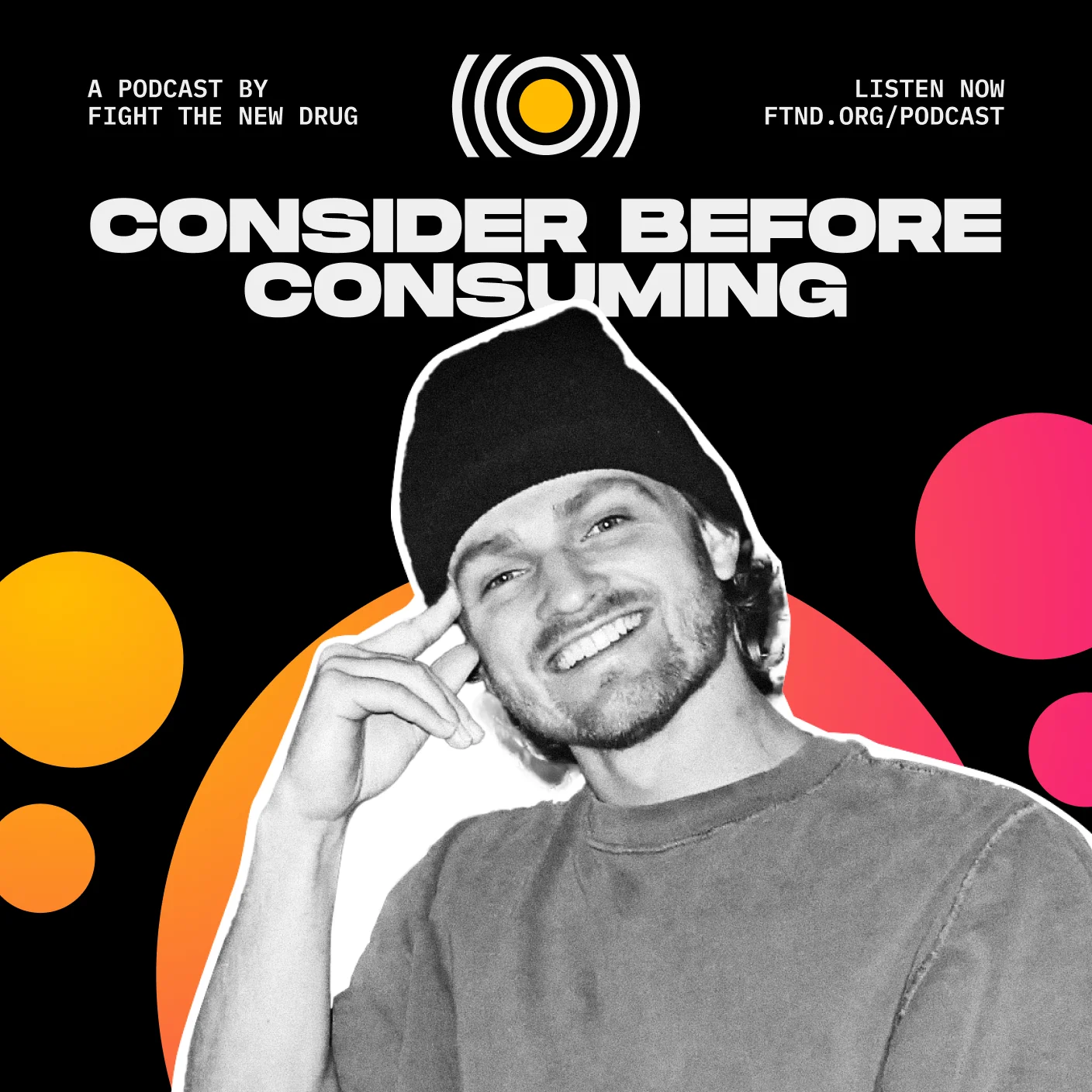
Episode 160
I Tried Everything To Quit Porn
Available wherever you get your podcasts
Hunter Clark was first exposed to pornography as a child. What started as curiosity eventually became a habit he struggled for years to overcome. Like many people, he tried everything he could think of to quit—willpower, accountability partners, blockers, even extreme personal challenges—but nothing seemed to work. In this episode of Consider Before Consuming, Hunter shares how shame kept him stuck in that cycle for years and how things began to change when he stopped focusing only on quitting porn and started looking at the deeper reasons behind the behavior.
In this conversation, we explore questions many people are already asking: Why is porn so hard to quit? Does shame make porn habits worse? Can pornography affect relationships? And why do so many partners blame themselves when they discover a loved one’s porn habit?
Hunter opens up about the moment he realized his struggle was connected to deeper emotional wounds, the impact pornography had on his relationship with his wife, and how honesty and open conversations helped break the isolation that shame can create. We also discuss the idea that porn habits are often a symptom of something deeper—whether that’s unresolved trauma, stress, loneliness, or other emotional struggles—and why simply trying to “have more discipline” often isn’t enough.
This episode is sponsored by Relay, a secure peer-support app that connects you with a small group of people who understand what you’re going through and help you stay accountable on your journey to quit porn. CBC listeners can try Relay free for 7 days when they sign up here.
FROM THIS EPISODE
- Article: Why Fighting Porn Must Include Fighting Shame
- Podcast: Consider Before Consuming Ep. 152: Chris Chandler
- Hunter’s Podcast: Quit Porn with Hunter Clark
- Hunter’s Instagram: _hunter.clark
EPISODE TRANSCRIPT
FTND (00:00)
Well, welcome listeners to Consider Before Consuming. I’m so excited to be here in the studio today with Hunter. Thank you for joining us. Can you tell us a little bit about who you are and what brings you here today? Just to dive right in.
Hunter (00:14)
Yeah, I, you know, we’ll probably get into it more, but, you know, I’ve had quite a long journey with pornography, and within the last two or three years I’ve started posting about it openly and talking about my story, and it’s gotten a lot of traction. Yeah, that’s kind of why I’m here, I guess.
FTND (00:32)
Yeah, and that is why we reached out to you. Let’s dive into your story. Can you take me back to when pornography first entered your life and what you remember about that moment?
Hunter (00:43)
Yeah, well, I think it’s a little good to go back a little bit. You guys were kind of making fun of me because I’m Gen Z a little bit before we started the podcast. And what’s interesting is when I turned nine was when the first iPod Touch came out. Like you had the iPhone and then the iPod Touch came out. And so it’s really the first time that kids had internet access in their pockets.
I was just a kid in a candy store. Like when you have unlimited access and you’re curious and you’re going through puberty and hormones and all of that.
I think I watched like Transformers 1 and really liked got a big crush on Megan Fox. And that was kind of my first journey into it.
It felt very innocent. It felt very curious. And that’s kind of how it all started.
I would, you know, view just really exploring and just seeing what was out there. It was such a new world for me. And, as I kind of got older, that’s when it shifted more into a negative habit that I would use to escape and run from things. I didn’t know it at the time, but…yeah.
And in middle school, I felt super alone, felt like I was the only one struggling with it. And then is when I got into high school, it kind of became like a joke. And I think that was honestly kind of healthy for me to, be able to just joke about it, laugh about it. And so that’s kind of how I got introduced.
Idon’t remember there being a ton of shame until I got a little bit older and like realizing it wasn’t something that I was, you know, quote unquote supposed to do. Right. And so that’s kind of how it really started.
FTND (02:40)
Yeah.
You mentioned your first exposure being pretty young. When exposure happens that young, it can influence a lot of things in your life. Looking back now, how do you think it affected the way that you understood sex or relationships growing up?
Hunter (02:58)
Yeah, I don’t feel like when I was so young, it was pretty light. It wasn’t, you know, the extreme stuff. And I don’t feel like it really affected me until I was older.
And I would say the biggest thing that it affected was how I viewed women and how I viewed sex as a whole. Like, I had an expectation of sex. I had an expectation of how women should look. And, yeah, I would say it didn’t start till later, though. I think it did plant a seed of some wrong expectations, I would say.
FTND (03:40)
Right. And later, being like high school, around the time that it was kind of a joke or normalized a little bit more, or you think even after that?
Hunter (03:47)
I would say even after, so I served a mission for my church, and you know, thought that I was good and I overcame it, and then getting back, and when I was really dating seriously for marriage, I think that’s when it was really affecting me.
FTND (04:01)
For many people, porn becomes a way to cope with something deeper. At that time in your life, what kinds of emotions or experiences were you trying to escape or cope with, do you think?
Hunter (04:14)
Yeah, so I have a belief that a lot of addiction in general is escaping from trauma or wounds or things of the past. And so I had a few things happen to me when I was young that I didn’t think honestly were that big of a deal.
But when I was like nine years old, right when I started viewing pornography, I was sexually harassed by a cousin, and I didn’t really think of it that much, but you know, in my later twenties, I realized that that was a big wound that I was actually escaping with to pornography.
And so, you know, a lot of guys, when they say, I escape boredom, stress, inadequacy. I think those things are true, but for me, what I’ve seen with most of the people I work with, there is usually a deeper wound or issue that they’re escaping from.
FTND (05:19)
Yeah. What was it like for you to realize that that was kind of tethered back to that?
Hunter (05:24)
It was in a therapy session that I really realized that that was going on. And once we kind of had resolved it, I feel like afterwards, my desire to view porn like really went down. And so there wasn’t like anything in the moment specifically, but I did notice big time afterwards, like my desire to view was like a nine out of 10, and it went to like a four out of 10. So it just felt like I was in the right direction, healing, doing.
FTND (05:57)
Yeah.
You had mentioned that this was something that when you were kind of seriously dating for marriage, when you were a little bit older, that’s when you started to decide, okay, maybe this is something that I want to kick, a habit that I want to kick. When you realized this was something you didn’t want in your life anymore, what were some of the things that you tried to be able to stop consuming pornography?
Hunter (06:26)
Yeah, I I tried, first I would say it was always a habit I was trying to kick. There never wasn’t a time that I wasn’t trying. And I tried a whole bunch of things.
Obviously, the first one is just more willpower, more grit. That didn’t work. I tried blockers. I tried accountability partners. I tried contracts with myself. I even gave a buddy two grand, and I was like, hey, if I mess up again, two grand’s yours. I want you to have it.
Long story short, lost the two grand. So I tried everything. But I think all of those things were focused on stopping the behavior and not viewing it as a symptom of something that was actually deeper, kind of like what we were talking about earlier.
FTND (07:17)
I want to ask you a little bit about…you mentioned that you didn’t have a lot of shame around it when you were younger, which I think is something we’ve heard, you know, it’s either kind of one or the other for a lot of people. There’s either immediate shame, which fuels this, or it’s something that’s like it is pretty normalized among your peers. And it’s not something people are experiencing a lot of shame around. At what point do you feel like that shifted for you when you started to feel that shame, and did that shame make it more difficult?
For you in the season where you were really, really trying to, you know, all of these different things to quit, did that shame kind of keep you stuck in that?
Hunter (07:53)
Oh, for sure. Yeah, I remember there was this one lesson that we had where our teacher came in, and we were like 12, and he’s like, I know none of you guys struggle with this, but we need to talk about porn. And I was like, I’ve been dealing with this for four years now. And that felt like a lot of shame.
And then I also felt…my parents caught me when I was young, and that added a whole nother level of shame. I remember just hearing things like, why don’t you just stop? Like, why don’t you just, you know, you can control it, or it’s worse than drugs on your brain, and like things like that.
FTND (08:32)
And you were like, why don’t I just stop?
Hunter (08:34)
Yeah, I was like, I’m trying. I can’t, yeah. I’m trying, but I can’t. So I think shame kind of is what put the nail in the coffin, per se, of really creating it into a nasty habit.
FTND (08:47)
Yeah, and as you were trying all of these different strategies in adulthood, know, filters, accountability partners, giving a friend two grand to try to hold over your own head. You know, what was the experience of trying all of these different things like?
I think it’s something that a lot of people who are in this position, they try, you know, everything they can think of, and kind of run into a brick wall each time and what was your experience kind of going through those?
Hunter (09:17)
Yeah, I felt honestly super hopeless. A little bit more into my story, I got back from my church mission and was dating, and I wasn’t going to tell my wife, my now wife, about it because I thought that, you know, once we get married, it’s just going to go away, right?
FTND (09:36)
Which is a really common thing people experience.
Hunter (09:42)
At this point, my parents were on my side, and they were really helping me. And my dad had a pretty honest conversation with me and was like, hey, whether, because I was dating my wife at the time, and he was like, whether she breaks up with you or not, you need to have a conversation with her. And I was like, okay. And it just felt true. It felt right. And so I went and had a conversation with my wife and told her everything. And I’m really, really glad that I did.
And, know, we got married, things were great for six, eight months, and I was in a high-pressure sales job, and the, the habits started to come back. So to answer your question at this point, you know, my wife was like, Hey, I don’t necessarily want to divorce, but I just don’t know how much longer I can deal with this.
And so we were driving in, in our Sprinter van that we had across to California. And we were going 80 miles per hour. There were ditches on both sides of the road. And I think that morning I looked up porn or something. And I was in the back taking a nap because I was driving most of the way and no seatbelt, tall Sprinter van. And my wife, she hits the rumble strips like hard. And I’m like, okay, if we go off the road, we’re rolling for sure. And I’m in the back with no seatbelt on going 80 miles per hour, right? Like we’re not going to make it. Or I wasn’t going to make it. And at that moment there was this sense of relief that it was all gonna be over.
And so to answer your question, there really was a sense of like hopelessness, really trying everything and just like, like, am I gonna be 50 and still struggling with this, right? And so…
FTND (11:29)
Yeah.
Hunter (11:33)
I would say, yeah, hopelessness was for sure the main emotion that I felt after failing so many times.
FTND (11:42)
And that’s such a vulnerable thing to share, but I think it is something that I’ve certainly heard from many others in conversations like this is just that desire for the struggle to be over is so strong that just like any relief from that is really compelling when there is that hopelessness. So thank you for sharing that with us.
When you first decided to tell your wife and disclose this to your wife, which is not an easy thing for anyone to do. And this was before she was your wife. Do you remember how that conversation went, and or how she responded to you at that time?
Hunter (12:14)
Yeah, so I went to her and I did it right off the bat. I don’t think that’s the smartest move to do with a girl that you like. Kind of more into dating, I opened up and I just was like, hey, I need to tell you something, and opened up about my whole story of like, this is when it started, this is where it’s at now. Like I can’t promise perfection, but I can promise honesty.
And I think because I told her so early on in the relationship, it did build a lot of trust, and obviously, she’s not stoked to hear anything like that. But after some thought, she, she felt really good about moving forward, and she never struggled with pornography, but she had like seen a few things, and it like really scared her. So I think that created a little bit of empathy with what I was struggling with.
FTND (13:21)
And so when you got to this point where you had now been together and married for, I’m not sure how long, when you got to the point where she said, you know, I don’t really want a divorce, but I don’t know how much more I can take. What was that experience like?
Hunter (13:37)
Yeah, I mean, it was super sucky because I had felt like I was trying, but nothing was actually working. And to kind of go back on the dating thing, there is something I do want to say to that is, yes, like you said, it was a very hard conversation, but I feel like that developed our relationship in such a deeper way.
I believe intimacy is like into me, you see. And so when I was able to open up all the good, the bad, the ugly parts of me, and she saw that, and then she accepted me, relation, like fireworks were happening. Like it really, really strengthened our relationship.
So then moving into marriage and, you know, after two years of trying and failing and trying and failing, there was never a threat of like, if you don’t figure this out, we’re gonna get divorced. She was just genuinely like, I don’t know how much longer I can deal with this.
So it was really hurtful, but I think it’s exactly what I needed. Cause my understanding of addiction was flawed. It wasn’t working. And so that was kind of the last-ditch effort of I’m going to throw everything that I think I know about addiction off the table, and I am going to start fresh. And so it really was a pivotal moment in overcoming it.
FTND (15:12)
And what happened next when you had that kind of shift in your thought process?
Hunter (15:17)
So I started researching. I was like, I need to figure this out. No one’s going to come save me. And one of the first things that I read was about shame and how shame can really fuel addiction and fuel this problem specifically, especially in a high conservative, high religious area. I was like, okay, well, how do you get out of shame? And the first things that I read was bring it to the light, like start talking about it openly.
I was already in conversation with my wife about it, but I hadn’t talked to anybody else. So I started talking to my friends. I was on a men’s retreat of 50 men that I really looked up to. And we did like this breath work thing. And I just had this impression to go up and talk about what I was experiencing. Not in the sense where most people talk about it where they’re like, yeah, this thing in the past, like whatever, right?
I was like, no, I’m currently struggling with this, and I’m a dad, or I’m a husband. I have a kid on the way, and I’m currently dealing with this, and that’s when I really felt like I started bringing things to the light. And when I did that kind of like what I was saying earlier, my desire to view really started to go down.
FTND (16:37)
Which is so great for so many people who are struggling with this in their relationship but haven’t disclosed to their partner. A lot of the shame often builds from knowing that they’re hurting their partner and their partner has no idea. In this case, you were able to be completely open and honest and transparent with your partner, knowing still that it was a difficult thing for her to experience. You had kind of that piece lifted.
Do you feel like the shame you were experiencing at that time was coming still from hurting your partner, or because you’d been able to be open and honest with her, it wasn’t so much there as maybe some of the external things that once you started to speak openly about this, that shift?
Hunter (17:17)
Yeah, I would say it was both. It was the fact that I could see that it was hurting my partner, right? Even though I was honest, it was still hurtful. So I would say that was a big contributor was I was hurting her, but I mean, more than anything, it was, I just felt weak. just felt…I felt like my self-trust was eroded. Like nothing had worked.
You know, how many times had I promised myself that I was never going to do it again? Thousands, probably thousands of times. And how many times did I break my own promise to myself? Thousands of times. And so, yeah, very desperate, and then just adding the partner on top of it.
FTND (18:11)
And feeling like when you get to that point where your self-trust is broken, it feels like maybe you’re not in control of anything, or like, how can I possibly kick this if I’m not even able to be accountable to myself? Like, I think that really builds for so many people who are kind of find themselves in that place.
Hunter (18:29)
For sure. Yeah, I even signed up for an ultra marathon, and I was like, yeah, if I can do this, I can quit. I can quit porn, right? And that didn’t even work. Right? Like I ran a 50-mile marathon or ultra marathon, and like the discipline that it took to do that still didn’t translate into. Yeah.
FTND (18:53)
As you started to learn, research this, and learn about addiction, did you start to see why that was true? Why you could have the discipline you needed to run this ultramarathon but not be able to kick this habit?
Hunter (19:07)
Yeah. So for me, what it really was, and we mentioned it earlier about the trauma, it’s a way to escape a wound. The way I like to view pornography is it’s a signal, like a check engine light in your car is going off, and something underneath the hood is off. And so it’s not that, the actual light, the porn is the problem. It’s just showing you that something is off, whether you’re missing connection, whether you need to deal with some traumatic stuff that happened in the past, whether you’re out of alignment, whether you need to apologize to someone.
To me, it just is a check engine light. And so it’s a symptom of something deeper. So it’s not necessarily that you need more discipline. You just need to listen to what it’s trying to communicate to you to then learn from it and then grow from.
FTND (20:07)
Yeah, well said.
What changes did you notice when you started healing your relationship with shame around pornography?
Hunter (20:16)
For sure, the biggest one was confidence. I didn’t realize how wrecked my confidence was with this. When I started to gain a healthier relationship with pornography and shame, I feel like my confidence went through the roof, which I think confidence will contribute to every area of your life.
FTND (20:38)
Yeah, for some people with a porn habit, confidence, they will notice a kind of hit from like comparison to what they’re consuming. Was it that or was it more like your, as you mentioned earlier, keeping promises with yourself, and or kind of all of it.
Hunter (20:54)
Yeah, I would say there was a little bit of body dysmorphia, but I would say more than anything was the making and breaking promises to myself over and over and over again. So that was the biggest confidence wrecker for me.
FTND (21:10)
And it makes sense that then keeping promises that you made to yourself over and over again would kind of reverse that. Yes. Which is awesome.
Hunter (21:16)
Yeah, and we are in an interesting time where, when I was young, we had to search for pornography, right? Like it wasn’t coming to me. Now it’s like, because of social media and I think OnlyFans, they are trying to push it in front of you. And it’s a very interesting mix of like not only is cocaine in your pocket as a drug addict, for that example, it’s like put in your face all the time. So it’s such a tricky thing to navigate. It’s interesting.
FTND (22:01)
It’s difficult to avoid.
Hunter (22:03)
For sure, it’s like every, I mean, it depends on what your definition of pornography is, which I’d actually be curious, Fight the New Drug, what is the definition of pornography? Cause that’s also a tough…
FTND (22:17)
Yeah, that’s a great question. We actually don’t define it. And that’s for many reasons, but mostly because pornography looks so different through so many different mediums, through so many different avenues, the way technology is rapidly evolving. We could not have anticipated five years ago the way that people are being exploited now online, the way that we have deepfakes, AI, nudifying apps. It’s something that is ever evolving.
And we have found that with something like this, for someone to say, what’s the definition? Okay, I will hear this definition and say, well, what I’m consuming is outside of my interpretation of that definition. So, I’m, at least this can’t have any harmful effects, and that’s simply not true.
And so often when we’re sharing, you know, research or statistics, we will be sure to be clear about how that study is communicating what the research is about…it’s about hardcore explicit pornography.
We often reference a judge who many years ago said, “you know it when you see it.” But that really is something that we deliberately don’t define it, and that is because there are so many different things that are explicit in nature that can be triggering to different people on kind of different areas of this journey.
FTND (23:44)
When we discuss pornography, people know what we’re talking about, though I will say there’s a gap in people’s understanding of what certain things are like OnlyFans that you mentioned. So many people, so many parents have no idea what OnlyFans is, right? And that’s a huge way that pornography is being disseminated now and targeting young people. You know, we’re learning every day of a new way that new technology is creating, you know, pornographic content and sexually explicit content, and that people are being exploited. So we actually don’t have a definition for it for that reason.
But yes, back to your answer of how you define pornography.
Hunter (24:25)
Yeah. Well, I don’t know. And when I say pornography, some people think that I’m talking about like, the explicit hardcore websites. And I’m not. I’m talking about, you know, when you see it on Instagram, right? Or on TikTok.
FTND (24:43)
And there’s research to show that those things have just as much impact, right? And especially for someone who has had a compulsive habit or addiction to pornography, those things can certainly be just as triggering to those same pathways in the brain as hardcore content could be for someone else. I think it certainly matters. Everything that you’re saying is relevant and considered, I would say, fine under the umbrella of pornography.
Hunter (25:04)
Yeah. And just, I know I have a narrower view of it than you guys do, but a lot of the guys that come to me that I get DMs, I mean, it’s probably 50-50 now of like, some of these guys don’t even go to websites. They’re just on social media, and they can see just as much. something to that, you asked like, what are the physical changes off of porn?
Hunter (25:42)
And I’ll be super direct, my wife is way hotter when I am not viewing pornography. I find her so much more attractive. And I’m not even talking about the hardcore stuff.
And as I have distanced myself, I’ve…I’ve become more appreciative of what I have in front of me. And yeah, I mean, it really does affect your brain. And I’m not even saying that from like a religious or moral point. I’m just saying for me, it affects. Even when I’m not looking at the websites, it’s still.
FTND (26:20)
And to be clear, your wife hasn’t made any changes. It’s your perspective.
Hunter (26:23)
She’s the same. Yes. My lens of her is different.
FTND (26:30)
Yeah, and I want to talk a little bit about partners.
A lot of the time, partners of consumers or someone with a porn habit will blame themselves immediately when they learn that their partner has a porn habit. They would blame themselves for saying, know, I didn’t, I’m not good enough. didn’t do that exactly. What would you say to someone who’s in that position?
Hunter (26:53)
Yeah, kind of like what we talked about, I would educate what is actually happening with pornography and how long has your partner been struggling with pornography, right?
This has been an issue much before you even came into this picture, which doesn’t diminish your feelings. I actually think that’s really important that you still have your feelings, and they’re very valid. But I would also say, and this is where it’s a little bit tricky, but I would almost compare it to like an eating disorder in a sense of like, it’s not about food, right? An eating disorder is not about food. It is a coping mechanism, a way to escape whatever you call it. It’s not about food. And I would say the same with a partner that’s struggling. It’s not about lust. It can be, but I would say if, if someone is genuine of like, Hey, I’m trying to quit. I don’t want this in my life.
I would say it’s not a lust issue; it’s an escapism issue. And I feel like once my wife and I came to that, it really just put her back in her power of like, like it doesn’t mean anything about me if you choose to go look at this. If anything, if I have a conversation with her about it and she’s like, okay, like, you know, obviously I’m not stoked to hear that you just went and looked at porn, but also like what’s going on?
Like, why did you find yourself with the need to escape to pornography? And so we’ve created, actually, a really healthy relationship around it that I think has been a massive role in helping me recover, is her really understanding it. So I would say one, your feelings are so valid, and don’t suppress those feelings because that will make it worse.
But two, maybe try and educate yourself a little bit on what is actually happening here. And that might take some of the sting off of it.
FTND (29:04)
And I think that’s really, really well said. It’s so important for partners to still take care of themselves through this process. In many cases, find the support that they need, whether that’s being able to talk to a friend or a family member or a licensed clinical professional, a counselor, a therapist, and make sure that they also have support through what they’re experiencing this.
But also, the more that any of us can learn about this, we can really understand what pornography addiction or compulsive habit is about and so much of it, it really isn’t about your partner in your relationships and for some people it could be and that’s important not to negate that either but so, so often it’s something that did as you mentioned start so long before that relationship or any relationship existed and think that’s so helpful to be able to have some clarity about that to understand.
Hunter (29:59)
Totally. Yeah, and for the spouses, just your feelings are so valid, right? And that’s probably the last thing I’d say with it.
FTND (30:12)
That’s something that, you know, there can be misconceptions about that. Are there other misconceptions you think or, or things you think people misunderstand the most about a struggle with pornography that you’d like to talk about?
Hunter (30:25)
Yeah, well, I think we’ve talked about it a lot. I think porn is the top of the iceberg. It’s the symptom. And there’s things going on that are deeper. That if people focused less energy and time on just trying to quit porn, and they focused more energy on the actual iceberg, not just the tip, I think it would…go a lot smoother for a lot of people to quit.
And I would also say this one’s a hard one, but like, what is the definition of success? Right?
I mean, my definition for the longest time was I’m never gonna view again. Right? But I think in today’s age, whether you…seek it out or whether it’s shown in front of your face, there’s porn everywhere. And so my definition has shifted from, hey, I’m never going to view again, to I’m going to develop a healthy relationship with pornography where I don’t feel like it controls me. If I do end up looking at pornography, I have an open conversation with my wife about it. I don’t have any habitual with this thing.
But to me, it’s more about how is your relationship to shame and pornography, rather than I’m going to put this pressure on myself to be perfect. Cause every time I did that and I broke that perfection, I would go straight into a binge.
And so for me, it’s much healthier to view it as how am I feeling with shame? How’s my relationship with my wife? Can we communicate about this? Can we talk about it? Can I control this? And that’s where I found the most success. So talking about success, I would be very curious to hear your guys’ perspective of like, what even is success?
FTND (32:28)
I think that’s a great question because I love what you said. It’s this idea that setbacks don’t mean failures, right? And that progress not perfection is the way to overcome something that has been habitual, that has been integrated. It takes a long time to, like if you think about you first saw this when you were nine, this is something that was with you for many years of your life, right?
As a coping mechanism for some of these things that require deeper work, it can take a long time to do that work and to overcome those things. And so if you have decided that any time you make a mistake, you’ve completely failed and what’s the point of even starting, then there’s really, you’re always gonna find yourself back in that same place and you’re always gonna be adding shame back to the mix of saying, great, I failed, I failed at my expectation. And so I do think we always encourage progress over perfection.
And, you know, we kind of look at this from two perspectives. Obviously, we want to remove shame. We want consumers to be able to, or porn viewers, or however you want to identify someone with an addict, a compulsive habit, to be able to overcome that. So porn is not something controlling their lives. You know, we have seen all of the research that shows how pornography negatively impacts individuals, their relationships, but then there’s also a societal piece of this where we are seeing the people who are being exploited through pornography and the people on the other side of the screen and we’re fighting for them too.
And so, you know, our ultimate goal as an organization is to help create a world free from exploitation, to help create a world where everyone is so educated.
You know, we could, we could as a society band together and say, let’s ban pornography. We can say that all day long. will never go away. This is something that’s been around for all of time. Banning things doesn’t necessarily stop them.
We would love to protect children, especially legislation that can help protect children. need so much right now. Legislative efforts to maintain accountability for acts that are already illegal, and making sure we have safeguards in place for those things.
But outside of that, our goal is to decrease the demand for sexual exploitation and also to decrease the demand for pornography across the board. We want everyone to become so educated that, yes, we’re striving for progress over perfection. Yes, this is something people are able to overcome and heal in their own way. We don’t want anyone back in a shame spiral that’s sending them back into this, as we know from research, that’s what shame does.
We also want a society that demands something better, and that wants something better, and that isn’t willing to accept people being exploited, that isn’t willing to accept content that’s perpetuating stereotypes that are harmful against women, against people of color. Like we want to demand and fight for something better. We’re approaching this from both sides.
I think societally, success for us is to not have sexual exploitation in society. And then on an individual level, we want everyone to get to experience the freedom that we know from thousands of people we’ve spoken to or heard from who’ve been able to overcome a struggle with pornography, the freedom that comes from not having this be something that controls your life.
And, you know, the strength and vulnerability in relationships that can be built when this isn’t something controlling their life as an individual or in a relationship, not just romantic relationships, but platonic as well.
So, I think it’s a great question. But to any listeners who are in a similar position to you, we would say…just one step at a time, right? Just navigate the next challenge and find your way through the next step. And that does mean that there will probably be setbacks. That’s often part of the process of recovery, and that’s okay.
And the goal is to gain information from them, to learn from them, and to be able to move forward with that information, as you’ve done, to say, okay, I’ll have a conversation with my wife about it. We’ll figure out. What were we escaping? What was going on? You have clear expectations around what you’re navigating in that moment.
Hunter (36:57)
Yeah, a motto that I, I don’t know if I heard it or what, but it’s like, shame less, educate more. Yeah. It’s like, I think that would solve so many.
FTND (37:07)
Yeah. And I mean, we often talk about it can sound silly, but you know, for most people who want to smoke a cigarette today, there’s a warning label on the package that says, hey, you can totally choose to do this, but just FYI, I’m paraphrasing, obviously, it doesn’t say this, just FYI, these are some negative health effects that could happen with this habit.
The goal would be to be able to educate people about those same harms of pornography that absolutely exist. But often, porn is reaching people before this education and information can reach people. And so the habit is built well before the warning comes. And then it’s something that we have to reverse engineer that education about.
Hunter (37:51)
Totally. Yeah.
FTND (37:54)
Is there anything we haven’t spoken about yet today? I want to give you a chance to talk a little bit about the work you’re doing.
Hunter (38:00)
You mentioned like, what are the misconceptions with this? And I do want to hit on that one more time. I feel like when somebody has an urge to view pornography, they have essentially three ways they can go about it. And the two most common are that they can either go view porn, or they can distract themselves. And I don’t feel like either is very effective.
I do think there’s actually a third option. Because if you go and you look up porn and you feel shame, you’re going to reinforce more urges. If you go and you distract yourself, you run from the urge, you’re not solving, like we were saying, that signal that’s going off, like, hey, there’s something going on, look underneath the hood. But if you’re just running, like going to the gym, which can be good to create some momentum.
But also, the third option is actually sit in it and like listen to what it’s trying to say and learn, like you said, learn from what is it communicating? Because if you’re escaping a wound or trauma or whatever it is, and you are distracting yourself, you are not solving the problem. You are just running, right? Which is essentially what you’re doing with porn, again.
And so I would just say a misconception is I think the way out of it is to not run from it, is to actually sit in it and learn from it, learn what it’s trying to communicate, learn the lessons that it’s trying to give. It’s kind of more of a spiritual way to look at it, but that’s what’s really helped me is that it’s a signal that something’s off. And you know, if I look at porn when I’m 45, right, which used to be my biggest fear, all it is.
It’s a car signal light. Something’s off. Don’t freak out. Just address what is going on underneath the hood. And that’s been a big help for me.
FTND (40:03)
I love the way you said that because I think so often we think of this as like, I’m gonna kick my porn habit. And if you’re thinking about it when you’re not in those moments where you are experiencing that urge, could think, okay, what’s the deeper feeling here that I need to address? And you can think through what it might be. But as you mentioned, if porn is a symptom of something deeper, the best way to know what it’s the symptom of is when you’re in the moment where you’re choosing it as the coping mechanism. And that’s a really difficult thing to do, to sit in that discomfort. That’s why we have coping mechanisms in the first place. But I think that’s great advice for someone to be able to try to sit in it and try to discover what it is that they are actually experiencing in that moment.
Hunter (40:52)
Or even after you view. A lot of guys, they view it, and if they have a lot of shame around it, they’re like, all right, now I’m going to be good. Now I’m going to be dialed in, or I’m just going to sweep it under the rug.
But it’s like, no, can you just like get curious just for a second and just like, okay, I did this thing that I didn’t want to do. That’s okay. But can I learn and can I be curious of what happened? And that’s where I think I always like to say there’s a lot of room for growth before the urge and before the mess up, let’s call it. But there’s also so much growth to be had after a mess-up. Can you love yourself even though you just did something that you didn’t necessarily want to do?
FTND (41:35)
Yeah, and if you think about it really, if is a coping mechanism to help you escape, it’s avoidant, right? You’re not wanting to think about what you’re feeling as you’re using porn. And then if you’re using porn and then feeling bad about it, and so you’re avoiding that you even engaged with it, if ⁓ all along the way you’re avoiding everything, you’ll never actually get to the root of what is causing that warning light to go off, right? What is causing that symptom of the deeper problem?
Being able to start to practice that, you know, practice that process of the before, during, and after to be able to find your way into what you might be actually trying to cope with is really significant.
Hunter (42:17)
Yeah. And essentially that’s, that’s what I found helpful for me. And that’s what I do for work now. Like that is what I do. I have a program for men that feel like they’re struggling with this, and that’s really what it’s about is, is learning to understand what porn is trying to communicate to you. And when you do that, you mentioned earlier in the podcast, like freedom doesn’t, hasn’t felt so good or what did you say exactly, something about freedom?
FTND (42:50)
Yeah, to be able to experience the freedom that we know from research and thousands of people telling us is possible.
Hunter (42:58)
And freedom to me, I always thought it would look like, right, I’m gonna, May 1st, I’m done, right? And I’m gonna be 700 days clean, right? But for me, what freedom has actually felt like is, my desire to view isn’t even really there. Like, I don’t even want it. And that is where I feel like there’s so much power.
Because I mean, gritting your teeth and white-knuckling this your whole life, that’s a pretty sucky way to live. And there is a place where you can get to the point where you don’t even want it anymore. Not saying that you’re going to be perfect the rest of your life, but just like your desire is going to go to like a two out of 10 instead of a nine out of 10.
FTND (43:44)
Which puts it back in a place where you ultimately have control.
Do you have any success stories from your program and the work that you’ve done that you want to share?
Hunter (43:56)
Yeah, I would say there’s two things that come to mind. One is, we’ve helped a lot of guys have this first conversation with their wife. And in my program, we do provide some wife support as well, so that they can go and express how they’re actually feeling around this.
There, I won’t say names, but there was this one experience where, he was actually one of my friends, he came in, and he’d been married for like two or three years, and he had never had this conversation with his wife. And he came into the program, and we finally like, he got the courage to have this conversation with his wife.
And he did, and their relationship, because I remember intimacy is into me, you see. And so they were able to see each other on such a deeper level, even though it was a struggle, their relationship just like skyrocketed.
And unfortunately, six months later, this guy actually passed away. And as sad as that is, it was really beautiful to see their relationship just go to that next level for the last, you know, six months of his life.
And that’s when it like really like settled in of like, okay, like we’re doing this, like we’re really trying to like, help people, just like you guys as an organization are doing. It is a real problem and I think it can be easier than you think, and it can happen faster than you think to overcome it, but you just need the right tools to actually do the job, which I think you guys are doing a great job at preaching.
FTND (45:47)
Thank you. And I am so grateful you shared that with us. And I think it’s just such a beautiful reminder that, you know, there’s never gonna be a great time to disclose something that is so difficult or that you’ve struggled with, but as soon as you can is always best, right?
But I just think it’s something that anyone we’ve ever had the opportunity to have a conversation with like you, who’s not only experienced this themselves, but also helped others through their own journeys of being able to overcome pornography, that is kind of a resounding thing that we hear is the way that all of their relationships, not just with romantic partners,
But all of their relationships in their lives with their friends, with their family members, with their coworkers, were able to flourish and have deeper connection because they were able to get to the root of some of these things that cause us to have coping mechanisms to keep distance with people in our lives.
It’s such a beautiful gift to be able to experience that in this lifetime, so any encouragement we could give to someone who’s thought about, you know, opening the door to this recovery is, it’s difficult and it’s a difficult process and it’s, you know, no two journeys look the same, but the freedom that waits on the other side is so, so beautiful.
Hunter (47:09)
Yeah, and I would say it’s hard, but it’s not as hard as dealing with this your whole life. Yeah. I will say that.
FTND (47:16)
Yeah. And for anyone who’s maybe listening who has felt hopeless, do you have any kind of final thoughts you want to leave them with?
Hunter (47:31)
I would say that there is, if someone would have told me two years or three years ago that I’d be where I’m at today, I would be like, no, like I don’t believe it. And so there is light at the end of the tunnel, and maybe, just maybe, what you’re trying isn’t working. So maybe it’s time to try something new, like bringing it out of the dark and putting it in the light and having a conversation with someone.
FTND (48:02)
Well said. Well, it is such an honor to get to chat with you in person. I have plenty of things I’d love to ask you, and hopefully you’ll come back and join us sometime in the future. I’d love to hear more about the work you’ve been able to do and the stories you have of those you’re able to help through this.
If someone’s looking to learn more about you or look into your program, where would you like to direct them?
Hunter (48:26)
Yeah, so there’s two spots. The first, I do have a podcast called Quit Porn with Hunter Clark. And then the second is just on my Instagram. It’s _hunter.clark. And I have a website in my bio that you can click on if you are interested in, just hopping on a call with us, and just seeing what it would look like to work together. Or I post, you know, everything that I’m learning. So if you want to just follow along the journey.
FTND (48:57)
Well, thank you so much. And to our listeners, we hope that you do choose to follow Hunter and stay tuned for more conversations like this in the future. Thank you.
Fight the New Drug collaborates with a variety of qualified organizations and individuals with varying personal beliefs, affiliations, and political persuasions. As FTND is a non-religious and non-legislative organization, the personal beliefs, affiliations, and persuasions of any of our team members or of those we collaborate with do not reflect or impact the mission of Fight the New Drug.
MORE RESOURCES FROM FTND





A database of the ever-growing body of research on the harmful effects of porn.