

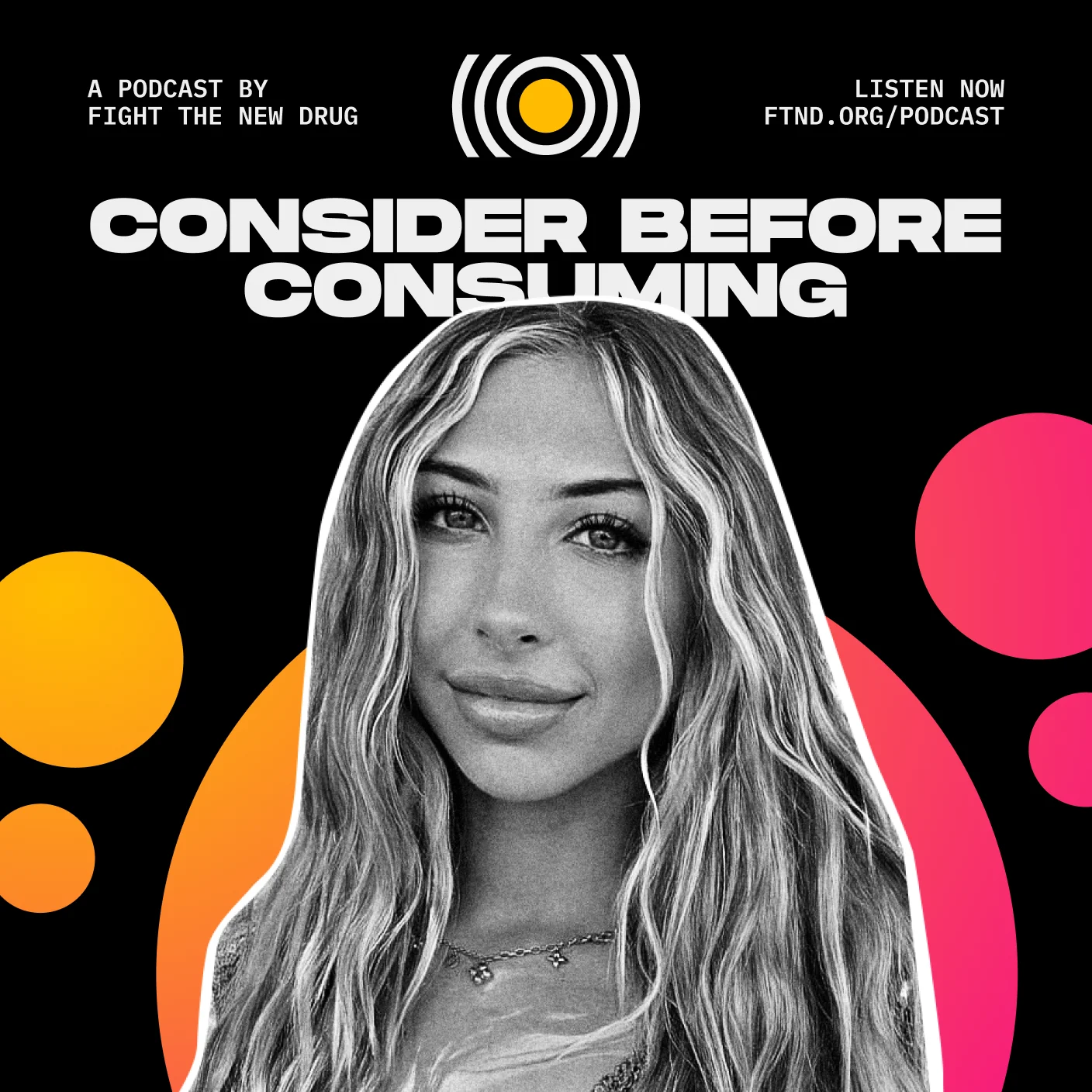
Episode 153
The Truth About OnlyFans From a Former Creator
Available wherever you get your podcasts
Trigger Warning:*This episode contains discussions about sexual exploitation and coercion. Listener discretion is advised.
In this episode of Consider Before Consuming, former OnlyFans creator Taylor shares what the platform was really like—from the money promises that drew her in to the pressure, contracts, safety concerns, and identity toll that made her want out. Taylor talks about how hard it can be to leave once you’re in, what the industry expects from creators, and how stepping away impacted her mental health.
FROM THIS EPISODE
EPISODE TRANSCRIPT
Fight the New Drug (00:00)
Well, Taylor, thank you so much for joining me today.
Taylor (00:03)
Thank you.
Fight the New Drug (00:04)
Can you start by sharing a bit about yourself and what led you to join OnlyFans? What was appealing to you about the platform at the time?
Taylor (00:13)
Yeah, so I joined kind of when like COVID was just ending. And, you know, I was in college, college kind of shut down, everything went online. And during that period of time, I ended up going to Miami and moving there, just because Miami was the only city that was open. And Miami is also a pretty big hub for the OnlyFans industry, especially now. So I think just being subjected in that environment.
Also, I was, what like 19,20 and it was just new and it seemed like okay I can make money this way and I can live this lavish lifestyle that I was around and I don’t have to you know like ask my parents for anything I can travel I can have freedom I can have time and for me my logic at least at this time was if I just have money coming in basically doing nothing, then I can just focus on my dreams. don’t have to work a nine-to-five and have time be taken away. So I was like, this is perfect. It’s going to be like a stepping stone into my future. Everything is going to be so easy, breezy, beautiful. And that’s really what appealed me too. It was more the freedom of time and just money coming in without having to really like think or do anything. Yeah.
Fight the New Drug (01:30)
Absolutely. And what type of content did you plan to post initially and how did that evolve over time?
Taylor (01:38)
Yeah, so I the first thing I did was I scraped my Instagram of all my bikini photos and I just put them on there. And then I also had a vegan page when OnlyFansTV this was like the first time it came out. So OnlyFans kind of existed and then OnlyFansTV came out like a few years later. And so I was like one of the first people to join OFTV, and I was just posting like food content. I was posting, you know, smoothies and this like healing lifestyle. so that’s kind of what I started. And then I think, you know, the whole industry just escalated super fast. And, know, you see it, but at that time I was not comfortable with, you know, doing anything explicit. So I was like, okay, like we’ll go from bikinis to lingerie and then maybe we’ll do implied. And, you know, I wasn’t doing anything explicit. I never had the desire to it wasn’t you know something that I was like always dreaming of doing and I actually quit only fans after that because I just felt uncomfortable you know like the men making all their comments and like everyone just started to want like more you know explicit aggressive content I was like what no I’m not gonna do that so this is it for me so I actually left for a period of time because of that reason and then I had a manager you know reach out to me, I want to say like August of 2022 and like we were kind of just back and forth and he’s like, listen, like if you do a certain type of content, like I promise you, you will make at least 50 grand a month. And even before I was like not making that, like I was still making money, but it wasn’t making, you know, 50 grand a month. So to a 20-year-old, I was like, oh, okay.
And then actually my contract, the deal was that I would have to do partner content in order to hit that mark. So that was kind of my like, all right, if I’m gonna do this and I’m gonna go back into this, it’s gonna have to be full out. And at that time, I was just like, okay, I’ll just do it. And that’s kind of what tracked it into that, and the more explicit side of OnlyFans.
Fight the New Drug (03:54)
Can you share a bit about how your experience in OnlyFans compared to what you expected it to be when you initially joined and even when you took the break and decided to come back? How did your actual experience compare to your expectations?
Taylor (04:10)
You know, I just expected to kind of go in not really care just be posting content I mean I loved content creation in general so I was like, okay I can get like paid for that and I just figured I would be making so much money none of it would even matter and I think that’s really the mindset that a lot of people go in is they’re like the money is almost this like Novocaine for you because you’re like, okay. Well, you know, I’m making so much money. I’m rich now, I have all this freedom and I can do whatever I want, so it’s not as bad. So that was kind of my expectation.
And I think nobody around me at that time really cared either. Obviously, the managers don’t care. They’re like, you’re doing so good. This is so great. And then I think also I had friends that were in the industry, and they didn’t really have their coming to light moment either. So everyone’s kind of collectively like, oh my God, we’re making so much money and it’s so fast and we’re so young and now we have all of this freedom. And I think then from that point, it starts to…decline, but it takes a minute. You get that like dopamine rush at first.
Fight the New Drug (05:13)
Right, and that’s a pretty common story that we have heard from individuals who have joined OnlyFans or young people who are saying, you know, I don’t need to go to college, I can just join OnlyFans and make lots of money. And then often the reality of the money made isn’t even what it’s kind of proposed to be often or sold to be.
Fight the New Drug (05:33)
We often hear from people who say they hear how glamorous OnlyFans is, glamorous the lifestyle can be, but there’s only a very small percentage of creators that are actually making money. The average creator isn’t making a lot of money. Can you speak a little bit to that?
Taylor (05:45)
Yeah, I mean first of all everybody lies. Money is the easiest way to pull people into something. That’s why you see so many people selling courses. That’s why you see, you know, they sell the lifestyle and that’s the selling point. But the money, yeah, I mean, you could make a lot of money years ago because it was fresh and it was new. But now it’s a lot harder. The competition’s harder because there’s just so many people doing it and I mean, yeah, no, I think the average is like a hundred and eighty dollars a month for creators.
So I think now it’s just so oversaturated. No, you’re not going to make, you know, a hundred grand a month just from starting unless you already have a really big platform or you’re famous. And that’s where they see like, you know, celebrities making what? Nine million dollars a month. I don’t know. And it’s like, OK, well, you’re not them. And, you know, not even trying to be rude, but like a small town girl, you’re not going to be making nine million dollars a month on OnlyFans So I think that’s just the misconception.
And that’s really what hooks people is just selling them this, well, you’ll make so much money. And it’s like, no, your manager will make a lot of money. Yes, I was living in a six grand a month apartment, but my manager was living in a $50,000 a month mansion with his Lambo and his Maybach and all his cars. So where is that to? That money’s not yours. And I think that’s also where people, they get confused. It’s like, at least half your money is going to be taken from you off the bat. That’s every contract.
But yeah, your money’s not yours. So most of it’s gonna go away to taxes, to bills, to upkeeping a lifestyle, and to a manager.
Fight the New Drug (07:31)
It sort of takes the glamour out of the idea of what it can be when you really see it for what it is.
Taylor (07:36)
Yeah, like if you’re living in a penthouse paycheck to paycheck, you’re still living paycheck to paycheck, you know, there’s a lot of upkeep to the lifestyle. And that’s why you see everyone you see so many people who go broke trying to prove that they’re rich and that’s the easiest way to go broke So I just always say if someone’s trying to sell you a lifestyle in your face, they’re probably lying They’re probably not making as much money as they say they are and it’s it’s just not as easy as it was to make money like that on this platform There’s too much noise
Fight the New Drug (08:10)
I think that’s really well said. Thank you for sharing that.
Alot of the people we’ve spoken with who have been in similar positions as you have talked about the pressure to escalate the type of content that they post over time. Have you seen or experienced that progression yourself?
Taylor (08:23)
Yeah, absolutely. I mean, I think going from making vegan content to going and making like, like full-on porn is a pretty big jump. So yeah, I definitely think the pressure is there. I think the pressure is there because of the money. And I at least for me, it was because of the money. It’s like, okay, you’re like, okay, well, if I do this, I’ll make more money. And then you make the money and you’re like, okay, so maybe it’s not as bad. And like, I am finding this thing and it’s that like, just temptation of just constant greed and wanting more. And so as they’re wanting more explicit content, you’re just wanting more money. And it’s just, it’s rough.
Fight the New Drug (09:06)
Because over time, you can’t make the same money doing vegan content, for example, or you have to escalate.
Taylor (09:12)
Well, yeah, and the industry has changed so much since I first joined. And I think that’s really why I’m very open about it is because I’m like, you know, yes, I was making 10k a month off vegan content. That’s impossible now, so, you know, it’s not the same industry that it was in 2022 or 2021. It’s completely different now. And now you have to do explicit content because that’s the majority.
Fight the New Drug (09:38)
There’s been a lot of news about creators like Bonnie Blue or Lily Phillips. Do you think that their stories reflect a wider pattern of what happens on platforms like OnlyFans?
Taylor (09:43)
Yeah, absolutely. I mean, it’s kind of like finding your selling point, and you know now you have everybody is making boy-girl content, girl-girl content. You know everyone’s doing porn. So how can you differentiate yourself and get to the top and make the most money? And it’s having to be extreme and that’s really you know you see it in the porn industry in general, of like the extreme content that needs to be made, and the appeal of it. It always starts with something that’s simple, and then it always escalates to something more and something dangerous. And that’s really what escalates all of these other things, like pedophilia trafficking. It goes into a whole different world. And it’s the same thing on OnlyFans. And I think that’s what people are maybe now just learning is because it was thrown in your face as this social platform.
Even though all their revenue is coming from sex work, but it works the same. So yes, the pressure to escalate your content is there. The pressure of people wanting more is there. And you know, now you have these big faces and characters who are doing extreme sport because they need to put themselves at the top as quick as possible.
So yeah, it’s not really shocking. It’s just, it’s dangerous. And that’s the slippery slope that you go down.
Fight the New Drug (11:12)
Yeah, I’m so glad that you mentioned what that type of content is fueling. We often talk about how porn is fueling the demand for sex trafficking and sexual violence and sexualized racism and objectification and the slew of issues, societal issues that so many people are dealing with today. And to your point earlier, even if someone maybe goes into this consensually, just taking note of what this content is feeling and how others are being harmed as well because all of these things are so interconnected.
Taylor (11:41)
Yeah, absolutely. I mean, you know, it’s just another breeding ground for all of these things to exist on. It’s the same system. It’s just wrapped in a different box. And, you know, it’s still fairly new, even though it’s been around. So there’s still a lot of like research, you know, there’s way more research on street prostitution than there is now on OnlyFans. So it’s going to be a process, but yeah, that’s why these conversations are important.
Fight the New Drug (12:15)
Yeah, absolutely. How did being on OnlyFans affect the way that you saw yourself?
Taylor (12:22)
Um, so I suffered from identity dissonance really badly. I think because I was very separated from the industry. I didn’t want to, you know, collab with people. Like after my one collab, I was like, all right, never doing that again. Hated that. So I kind of was living like two lives.
You know, I knew that this was my income. This was fueling my lifestyle. Everybody else was like, oh my God, she’s able to like go to Italy for a month. That’s so cool. And then I was also, you know, still being true to myself and working on my own projects and, you know, trying to launch other businesses to get myself out of the industry and replace that income. So it was definitely odd because there was this character that existed that was so, you know, such a big part of my life and was like funding my whole life. And then there was me.
And so I think a lot of people were like, even confused when they would talk to me and then I’d be like, yeah, well like I do OnlyFans and like that’s how I’m able to live here. And they’re like, what? Like, you know, so it didn’t make sense to others. And then it really didn’t make sense to me. Cause I was like, yeah, this isn’t me, but she exists and I have to play her and it’s like acting. And then you get like lost in the character. You have to pull back and then you go home to different things and you’re playing, you have all these masks on. And I think over time that really weighs on you.
Fight the New Drug (13:44)
Yeah, because you’re putting on this persona and playing this character, but it also is physically you showing up and physically you being disseminated online in this way. And so I can imagine that there’s some cognitive dissonance in reconciling those two personas together.
Yeah. Oh yeah, definitely. And that’s kind of what was like, like I never watched my content. I never would look on my page. When I was deleting my page, I had to like delete a bunch of the photos because they didn’t actually let me delete my page until like over a month later. Um, which is a whole different story. But yeah, so I think that was the first time I actually even saw like what was even being done and posted. Cause I was like, I don’t even want to look at it. I don’t want to look at it. I don’t want to see it. It exists, but it’s not me. And it was just like this thing that was there. Just like a pimple that just wouldn’t go away.
Fight the New Drug (14:42)
Yeah. How did being on OnlyFans impact your relationships or the way that people treated you?
Taylor (14:50)
You know, it didn’t really affect as much as I think people try to make it seem like it did, because I think everyone kind of collectively is… Well, they’re either lying to my face and telling me that they don’t care, and they actually do because they’re just scared to tell me. Or I think people are like, you know, maybe this is a good thing. Like, if you’re making so much money, we live in such, you know, a money-based society now. And it’s like…you know, if you’re making all this money, what does it really matter? So I think that’s kind of money really is I think the main source of people convincing themselves that maybe it’s okay.
But yeah, I think my relationships, you know, I’m lucky to have really strong friendships and strong family connections. So I don’t think that changed how they viewed me. I think it was just a process of them trying to get me to remember who I was and being like, yeah, this isn’t you. And this, you know, I’m not gonna judge you and like, you know, try to shame you to leave, but like, you definitely should.
I think romantic relationships were hard, but at least in my stance, you know, I was already with somebody who was toxic. So I think this was a good leverage point for them to like go out and cheat and blame it on that. And it was really just an excuse. I don’t think that was like genuine them not liking it. I, you know, I said it before that. I don’t think men are ever gonna want their girl to do this, just because of that territorial protectiveness. So I think, no, they did not like it, but I think it was a good point for them to kind of be like, you know, treat me like shit because of it.
Fight the New Drug (16:25)
Do you think that your friends and family really saw that there were kind of two of you? There was the character you mentioned and then the you that they know?
Taylor (16:31)
Yeah, definitely. And they saw me, you know, doing both. So it was kind of like, no wonder she’s so stressed out, and no wonder she’s like going mental all the time is because it’s like I had to do this, and then I was doing this, and it’s like so much to keep up with. So yeah, I think they definitely saw that, and I think that was like, whoa for them. But like, what do you do, you know?
Fight the New Drug (16:59)
Yeah. What kind of safety concerns do creators face both online and offline?
Taylor (17:06)
You know, I think there’s a really big, I guess point that people like to assume that OnlyFans is safer. In my opinion though, it’s actually more unsafe because you don’t know who your enemy is. When you’re exposed like that online, and everything is filtered through social media. So you’re on Reddit platforms, you’re on, you know, Instagram, TikTok, Twitter, you’re on everything. You don’t know who has their eyes on you, and it’s this specific industry that pulls in some of the worst people. So, you know, I have friends who have been stalked, they’ve had people break into their homes, they’ve had people send stuff to their homes, like everything’s so public now, and you don’t even know who it’s coming from, you know, until they’re sitting in your living room. And that’s just terrifying in itself.
Also the messages, you know, I get messages of men still they’re like I know you did OnlyFans and I hate you and I hate everyone and I mean you you don’t people are so insane nowadays You literally have no idea, you know people get death threats over You know wearing a shade of blush that people don’t like so you really don’t know and I think that’s what makes it so unsafe is you’re not only attracting Just the bottom of the barrel type of human, but you don’t even know where it’s coming from.
Fight the New Drug (18:23)
How do you think platforms like OnlyFans contribute to misconceptions about what’s safe and empowering, especially for women?
Taylor (18:32)
I mean, empowerment is their whole selling point, you know? It’s, well, take the power back because men are gonna sexualize you anyway, so you might as well get paid for it. And I think that people don’t really realize that they’re playing the same game they tried to leave. And just because, you know, if you’re playing chess, just because you’re on one side of the board or the other, you’re still playing chess.
And, you know, I think empowerment is…the new fancy word that people like to use, they’ll just throw, well, it’s empowering to do this. It’s empowering to treat people like this. It’s empowering to whatever. It’s just a lie. It’s a marketing tactic. It’s avoiding accountability of what’s truly happening. It’s presenting a present in front of you that has nothing in it. And there’s nothing safe and empowering about it. It’s just you’re not protecting yourself from anything. A lot of it, you just turn bitter and rageful because you’re like, my god, you’re exposed to these men who, you know, obviously they’re just sexualizing you and objectifying you. That’s the whole game. And then you kind of go out in the world and you’re like, so all men are like this. And you don’t see how it like seeps into other aspects of your life. And you know, it’s just a shitty feeling overall.
And I don’t think there’s anything empowering in having to take off your clothes. I think this whole, you know, I think women in general, when you’re going from like girlhood to womanhood, it’s uncovering this whole message of like male attention means that they like me. And I think a lot of it is playing on, you know, the victims of believing that validation. And if I look hot and I get likes that I’m worth something, and it’s kind of exploiting that inner wound as well.
Fight the New Drug (20:21)
Right. And you mentioned earlier as well that if you’re kind of staying stuck in something like OnlyFans because you don’t know how you’re going to replace the income, if you’re kind of staying in something because of the financial strain you may be experiencing or other external circumstances that are keeping you stuck in this, it really enthusiastic consent or is it a means to an end? Right? Engaging empowerment in that way, as well, I think is so important. Thank you for sharing all of that.
Taylor (20:54)
Mm-hmm. Yes, of course.
Fight the New Drug (20:56)
We hear about parasocial relationships often when we talk about platforms like OnlyFans. How do parasocial relationships affect people who are posting on platforms like this?
Taylor (21:02)
I mean, I think that’s the most dangerous part of the industry is the parasocial relationships. You have these people who believe that they are truly dating you, and they are truly married to you, and that you truly like them and love them.
And if you keep convincing them of something, they’re gonna really start to believe it. And that’s where you see it escalate into the violence and the stalking and the breaking in and, you know, the sending things and the threats. Because to them, you’re conditioning them to think that this is real. And, you know, you have people who are playing a character and they think they’re talking to the girls and they’re not talking to the girls. They’re talking to somebody from overseas or some guy from the Philippines, and they have no idea. And so they’re, you know, they’re being fed their delusions and they’re being affirmed in their delusions. And I think even overall on social media, you can see what people do when they’re affirmed in their own delusions and how it escalates into a bigger issue that goes off the platform, and it, you know, it becomes a societal issue. So yeah, I think that’s the most dangerous part about it is the chatting and the forming of a connection that causes people to really start doing, you know, heinous things.
Fight the New Drug (22:21)
What kind of mental and emotional toll can that kind of attention take?
Taylor (22:26)
I think you’re just scared, you know? I know a lot of girls, most girls actually, don’t, you kind of retreat into your home because you’re like, I don’t know who knows me, I don’t know who doesn’t know me, I don’t know who’s seen me, I don’t know, you So I think you get nervous and then you start to just hide and you know, you’re already dealing with your own thoughts and emotions about the whole thing and having to deal with, you know, the thought of somebody out there stalking you, watching you, you know, these obsessive people who believe they’re dating you. I think that’s really scary.
And, you know, I also just want to mention that like this is where traffickers go to find victims. So it’s like you’re already you’re literally in the pot that they pick from. So you have no idea. And like it’s already such a big issue. And now it’s just, you know, with girls who are already doing it, those are much easier victims to go pull from. They’re already conditioned to believe certain things. So I think that’s even the most dangerous part or one of the most dangerous parts.
Fight the New Drug (23:32)
What made you start questioning whether you wanted to stay in the industry?
Taylor (23:37)
Well, I always wanted to leave the industry, and that’s where I thought this was a stepping stone for me, but there was no endgame here. And I think that’s also why I personally kept everything very separated because I was like, well, this isn’t me, and I’m not saying this. And I also, you know, never fully dipped my toes in. Like even towards the end for me, like everyone had social media platforms. I didn’t really post on social media with it. My accounts were grown on the backend, which you can’t do that anymore, but at that time, you were able to. And so that was how I kept everything, you know, as separate as possible.
Fight the New Drug (24:14)
How difficult is it for someone to leave OnlyFans once they’ve built the following or signed contracts?
Taylor (24:21)
I mean, you’re definitely not going to leave without a fight. That’s for sure. You know, I’m still fighting certain things, and I’ve been gone, but I mean, the management, they’re going to convince you of every reason why you shouldn’t leave and why, you know, you’re never going to be able to, and no one’s going to hire you. You’re never going to make money like this. You’re already damaged goods.
And then if you’re in a worst case, you’re going to get sued for whatever reason and you’re gonna be in a legal battle, and people are gonna be like, well, you signed a two-year contract with me, so you have to work for two years. You cannot financially bind people in contracts to perform sex work for you. So hopefully that reaches the court system soon enough because that’s a big one that I think people are trying to push right now is like, well, you signed it and you said you would do this, so you have to do it. It’s like, I don’t have to do anything, especially because…you know, we’re in the sex industry. These contracts, this is not like I’m doing marketing work for you. You know, it works a little different. So, yeah, I think leaving is definitely not the easiest. You already have a mental toll and a mental battle, and then these people, they’re gonna do everything in their power to make sure that you stay.
Fight the New Drug (25:32)
Yeah, are there additional obstacles that people face when they try to walk away from OnlyFans that others that you know have experienced, or you yourself?
Taylor (25:42)
Yeah, I think a lot of it has to do with you buy yourself into a lifestyle that you have to upkeep. And that was a big thing for me, and why I didn’t fully leave until I came back home, because I mean, I had bills that cost 10 grand a month, you know, so that’s another reason. And that’s kind of what I’ve been hearing some creators come on is they’re like, well, I just bought a $5 million house. So how am I going to afford my lifestyle still?
If I’m not doing this, and you know that’s another one of the like wars you go through, is like okay I now have all of these expenses and I have to upkeep with them and I don’t have something yet that’s going to replace that, so do I just burn my entire life to the ground? I mean, that’s what I did, but I understand why some people wouldn’t want to do that. So yeah, I think that’s another big reason why a lot of people just don’t leave, because they don’t know what to do and I think the whole world tells you that no one’s going to want you now, no one’s going to want to marry you, hire you, that you have no skills and that your life is basically ruined and you made the worst decision. And I think that’s what keeps people in the industry as well is because they don’t really have hope for anything else.
Fight the New Drug (26:53)
Can you share a bit about how stepping away from OnlyFans affected your life and your mental health?
Taylor (26:59)
Yeah, I feel like it’s just been a weight off my shoulders. I feel like now I can fully just step into myself and just focus on myself. And I think a lot of at least my personal journey was that I just didn’t believe in myself enough. And so I wanted that crutch of money. And you know, because I didn’t trust that what I felt called to do would actually work out. So it was kind of like a buffer. And I think now, you know, seeing that path completely just crash and burn. I’m like, okay, now I’m still stuck in my purpose and everything, so I must just go full force. So I think it’s also been a very, like, you know, self-transformation journey. And I just think now I’m personally way more confident than I was years ago, making that decision. So that’s also really helped. And yeah, I think just overall my mental, I don’t have to worry about this.
I mean, I do have some lingering issues that I’m just like, this is so stupid, but you know, and I think now I feel very like empowered to talk about things. I think there’s a lot of people in this industry who want me silent. Well, I know they want me silent cause we were fighting, but so I think that being able to just come out and talk about it and you know, even helping one girl who was thinking of like, maybe this is the path for me or, you know, I’ve had people reach out to me about how to get out of their contracts and stuff.
I also work with one of the most amazing lawyers ever who’s very called to this mission as well. I think also doing that, I understand the purpose of that journey. And being able to come back with all of this information and really just share it with people, I think that’s been the best, and that’s, I don’t know. It makes me almost not grateful, but kind of grateful that it happened. So yeah, I think my mental health has been better, but no, I would never do that again.
Fight the New Drug (28:49)
Yeah, and thank you for sharing that in that way. It’s so important to hear from people like you who have experienced this because I think something you said at the beginning of that was just noting that you didn’t believe in yourself enough. And this is really an industry that preys upon insecurity, right? It preys upon promising a better life if someone will do exactly what is spelled out for them. And I think it takes so much courage to be willing to look at that and confront that and say, this maybe actually isn’t what I want to be doing. And then to be so bold as to share your story now to help others know what this really is like to go through this experience, because this is something that’s being so normalized and pitched to young people as a super easy, empowering, glamorous means to an end. And it’s really not.
Taylor (29:22)
I mean, yeah, that was a lot of my journey. I think, you know, it’s really hard when people are like, money won’t make you happy, and I think everyone says it, but until you really live the experience of having everything and feeling empty, it’s kind of hard to trust when people tell you that. And I think that’s really what I’ve learned through this as well, is that all of the glitz and the glamour is not gonna make you happy if you are doing something that you hate and you are empty and lacking purpose. And so that’s also where the belief in myself has really come from, is like, okay, if I’ve been called to do something, I need to trust that calling, I need to trust myself. Instead of running away and believing that a lifestyle is gonna make it better and that money is gonna make it better and that if I’m able to go to these places and do these things, that I’m gonna feel better. Cause you’re gonna do that and you’re gonna be miserable everywhere, cause you’re not dealing with like the root of the problem.
Fight the New Drug (30:37)
It’s so important to have stories like yours shared. So again, I want to thank you for being willing to share yours with us. What inspired you to start speaking out and sharing your experience publicly?
Taylor (30:41)
So I first talked about it in December 2024. I posted a TikTok video, and I don’t know what it was. I mean, I honestly think it might have been when Lily Phillips first came out with that video, and just something about seeing it just sparked something in me, and I was like, my god, I gotta talk about this. And I was so nervous. Like, I was so scared to talk about it. I was like, my god, because I was still in the industry.
And I was like, oh, this is gonna be brutal. And I was also still heavily involved in some legal matters. So I was like, Oh my God, this is just terrible. But I just felt the call on my heart, you know? And I was like, okay, if I’m feeling called to speak now, then I have to speak now. And I wrestled with that for a little bit. And I remember even talking to my therapist about it. So I was like, how can I speak out about this when I’m still doing it?
How can I bite the hand that feeds me and then go online? It was that guilty conscious type of thing. So I think I just felt so called to do it that I was like, I feel called to do it for a reason. So I did it once, and that’s what’s kind of brought a lot of opportunities. And then I started just getting more comfortable with speaking about it. And I was just trying to be honest of like, okay, yes, I’m speaking about this, but also understand I’m still in the industry for these specific reasons, and I do have an exit plan, but I just want to talk about this now. I mean, there’s a lot to uncover. I could talk about it forever. So, yeah, I just felt really called to do it, and I just trusted that call.
Fight the New Drug (32:25)
Yeah, since you’ve started speaking out about this, are there specific stories or scenarios that you’ve shared that you found people are so surprised to learn?
Taylor (32:36)
I think pretty much everything, like everyone, kind of just assumed that it was this great thing and that I was living this great life, and that’s what it looks like on social media, you kno,w like I was traveling Europe all summer,I was living in a beautiful apartment. was moving to different cities. I moved to three different cities in three months. So everyone was like, my God, she’s really out here doing the absolute most. And so I think people were shocked to hear about what was going on behind the scenes. And I think pretty much everything possible, like the illusion was really there for people, that everything was fine. Now, when I tell them, yeah, I hated that, and I dealt with this. They’re like, what? Like how? How you were doing all this stuff? And I’m like, yeah, but I was also dealing with this.
Fight the New Drug (33:25)
Yeah. What does healing look like for you since leaving OnlyFans?
Taylor (33:29)
I think healing, you know, it’s convincing yourself, or, you know, not even convincing yourself, but undoing all of the lies that you have already told yourself, so that, like I won’t make money doing something that I love or, you know, nobody’s going to love me after what I’ve done or all men cheat. All men are like this. And having all of these ideas that come into your head after, you know, being in this industry, I think it’s been realizing and also being around different crowds and, you know, not being around the people who are, you know, necessarily in the industry or still kind of, you know, glamored by it. So I think it’s that and just realizing like, this isn’t normal. And if it was normal, I would have felt good doing it and trusting your body that was picking up on signals and, you know, coming back into your body and also removing all these ideologies that you’ve picked up. I think another big one is also this like, feeling of money coming in fast and understanding that, you know, things that are going to be worth your while are going to take a long time.
And it doesn’t mean they’re gonna take 10 years, but it might take, you know, a few months. And OnlyFans is so instant. So it’s also breaking these bad habits of believing that everything should just come to me immediately. And I should be able to do this immediately. And almost this like entitlement that you kind of pick up when you’re in the industry, because you’re living in a fantasy land. So I think healing has really been like uncovering all of the lies. And then I’ve definitely gotten stronger, like in my faith, which I don’t push.
You know, Christianity or anything on anybody. I’ve always been very spiritual. So I’ve kind of just incorporated that into my spiritual life and into my spiritual practice and trying to gain understanding of, you know, my journey, my purpose here. You know, why did I make these decisions? How can we not, you know, stay clear of making decisions that are unaligned for me in the future, and making it just this self learning lesson?
I think it has also been very healing and just learning how to understand yourself more. And then, yeah, I think body stuff is also important because when I went into the industry, I was definitely not confident in my body. But I think being in front of a camera so much, you kind of either have to fake it or you just have to learn to love your body. And so that was probably one of the only, I guess, positives was learning to love my body through that.
So it’s also just healing the relationship to your body, not uncovering that being an object thing, because I was like, in the same mindset a lot of girls are in of, I’m just an object, men just look at me to have sex with me, whatever. So it’s uncovering that as well and understanding that you’re way more than a body and learning to love your body and cherish your body in whatever way that looks, and keeping it away from men who are not going to treat you good in any capacity.
So yeah, that’s definitely been a healing journey as well.
Fight the New Drug (36:33)
Really beautifully said. Thank you for sharing that.
For anyone who is considering joining OnlyFans, what would you say to them? What would you want them to know?
Taylor (36:44)
Just believe in yourself enough to do what you’re actually called to do, and that this is not a crutch, this is not a buffer, this is not going to give you the lifestyle that you want. There is an end to this and it’s pretty fast. And you’re going to end up having to start over anyways. learn to believe in yourself more and get comfortable with yourself and play the long game. You know, things that start fast for and just as fast.
And that was really, you know, what this is. There’s no shortcuts to success. And you hear that in everybody’s story, and the people who do try to shortcut it, they end up losing everything and having to start over anyways. So just avoid that step. Avoid trying to, you know, go around the maze and just go right through it. And it’s not going to be easy, and it’s going to suck. And you’re going to see people that it seems like everyone’s moving faster than you. And it is what it is. That’s part of it. But you have to do it right. And if you do it right the first time, it’ll be done right the first time. And if you do it wrong and you try to, you know, scam people, shortcut, you’re gonna get pushed back to the back of the line. So I think that’s pretty much, you know, the biggest thing, especially with the girls that are really young. And also, just the whole lifestyle is all fake. You know, everything’s fake. People aren’t as rich as they say they are. Everything’s pretty boring. It’s really not as glamorous as you think. I think the most glamorous thing to be is at peace with yourself. And that can look…however you want it to look. You don’t have to have a Birkin bag to be glamorous. You don’t have to, you know, be on a yacht to be glamorous. So just stop watching people on social media if you’re going to be convinced to go down paths that you know are not right for you.
Fight the New Drug (38:22)
Is there anything we haven’t spoken about yet today that you would like people to know about OnlyFans or about your story?
Taylor (38:31)
There’s a lot, but I’m trying to see how I can word this.
OnlyFans avoids a lot of their responsibility, at least that I think it’s their responsibility to deal with what actually happens on this platform. I mean, I know some people don’t agree with holding platform owners accountable for what happens, but I think in this case, you can only hide from things for so long, and that anyone who’s dealing with a matter that is, you know, complicated, you’re not alone in it, you’re not the first one to go through it. There’s nothing normal about 40-year-old men suing 20-year-olds for millions of dollars. So please reach out to people. You have every right to take control of yourself and your body and your money and your life.
Nobody can take that away from you even though they’re gonna try to and I really hope that over time you know certain at least restrictions or you know take downs are in place because I don’t think it’s fair for these and it’s not just OnlyFans pretty much every sex platform that avoids accountability of what happens there and this is you know it’s a breeding ground for traffickers and for exploitation and you don’t know who’s trafficked. You don’t know who’s there willingly, most of them are not there willingly, and I really hope that over time some you know action is actually taken with stuff like this because you can’t keep hiding behind a mask and calling this, you know, artistic expression. You know when you’re just basically allowing Crime to take place on your platform. So that’s kind of another goal, I guess. I hope that happens.
Fight the New Drug (40:25)
Yeah, that’s very well said. I think obviously anyone who’s exploiting someone should be held accountable. Culturally, for anyone listening to this, even if you’re saying, I’m not on OnlyFans, I don’t consume content on OnlyFans, I don’t participate, this is something that’s so normalized that we have to be willing to have conversations about what impacts this has in our society, who is being exploited through these platforms, why are people being exploited through these platforms, who’s supporting the platforms. You know, from the information we have about OnlyFans consumers, chances are pretty good that someone you know and love is consuming content on OnlyFans. And so culturally being willing to hear stories like this, share stories like this, and have conversations about a world where we don’t stand for exploitation and we don’t tolerate exploitation, and what we can all do to build some momentum to move forward so we can have some progress on these issues. It’s so important.
Taylor (41:21)
Yeah, and I think that a lot of people just assume, specifically the men that comment on my posts, like, all the girls are just whores anyway, they just care about money and they’re there by choice. And, you know, do your research. Like, I think this is not something that’s spoken about in schools. It’s not spoken about on the news. Unless you’re actively looking this up, you’re really not gonna know about it. Why it’s hidden, I don’t know. But…just do your research because I think like I’ve really just been trying to educate people who are like, well, everyone’s there by choice. I’m like most aren’t. And when does it stop becoming a choice? You know, when you try to leave or move on to somebody else or something else and then, you know, you’re stuck in something. Is that still a choice? Because to me, it’s not.
And I also just think shaming people, whether it’s for consuming the content or for, you know, participating in making the content, think shame causes people to stay in the actions that is gonna just prolong this and when you tell girls, you’re damaged goods or you tell guys, well you’re disgusting, it’s kind of like, okay, well, why are they gonna stop then? If you’re already, you know, excluding them out of society, they’re not gonna have any desire to come back in, and they’re just gonna keep doing what they do. So I also think shame is something that really just, like, it’s just not helpful. It’s not doing anything.
To anyone, you’re only trying to put yourself on a pedestal above people. You don’t know what brought them there. You don’t know the story. And you don’t know anything that happens because you’re not involved. So unless you’re involved, you really don’t know. And yeah, that’s pretty much it. Thank you. Yeah.
Fight the New Drug (43:07)
It’s very well said, and there’s a lot of research to back up the idea that shame keeps people stuck in cycles rather than allowing them to break free from cycles. So truly, if we want to reduce the demand for exploitation, if we want to reduce exploitation, if we want to let people know about the harms that are on the platform so they can make an informed decision regarding their consumption of content, we have to be willing to have these conversations in a shame free way to help create safety to motivate those changes.
Taylor (43:33)
Mm-hmm.
Fight the New Drug (43:41)
Well, Taylor, thank you so much for joining me. Is there anything else you wanted to share before we wrap up?
Taylor (43:43)
You know, my DMs are always open for girls who need help and just don’t know how to navigate this. You know, I always post about that. And then I am writing a book about a lot of this that will come out in 2026. So that’s super exciting. But yeah, I just always, you know, open the door for people who are struggling with this, who don’t feel like they have anywhere to go or a turn. And, you know, they’re not in a Miami where they’re dealing with a bunch of OnlyFans girls who might be experiencing something similar, and they’re somewhere else. So yeah, if you are, you know, struggling to leave in a bad contract or just, you know, having a mental health day, like I just am always here for the girlies.
Fight the New Drug (44:29)
Thank you so much, Taylor. We’re so grateful that you’re willing to share your story with us, with our listeners, and also for the work that you are doing to help share the realities of OnlyFans out in the world. And we look forward to seeing your book when it comes out. Best of luck with that.
Taylor (44:36)
Thank you so much.
Fight the New Drug collaborates with a variety of qualified organizations and individuals with varying personal beliefs, affiliations, and political persuasions. As FTND is a non-religious and non-legislative organization, the personal beliefs, affiliations, and persuasions of any of our team members or of those we collaborate with do not reflect or impact the mission of Fight the New Drug.
MORE RESOURCES FROM FTND





A database of the ever-growing body of research on the harmful effects of porn.